

Google has released the open mobile platform Android 15. The source code related to the new release is available in the project’s Git repository (branch android-16.0.0_r1). Firmware builds have been prepared for the Pixel 6/6a/6 Pro, Pixel 7/7a/7 Pro, Pixel 8/8a/8 Pro, Pixel 9/9 Pro/9 Pro XL/9 Pro Fold, Pixel Fold, and Pixel Tablet. In the coming months, firmware with the new version is expected for smartphones from Samsung, Honor, iQOO, Lenovo, Motorola, Nothing, OnePlus, Oppo, realme, Sharp, Sony, Tecno, vivo, and Xiaomi. Additionally, universal GSI (Generic System Images) builds that are suitable for various devices based on ARM64 and x86_64 architectures will be created.
The release of Android 16 is being developed under a new schedule, according to which there will not be one significant Android release each year, but two releases — the first in the second quarter (instead of the third as before), and the second in the fourth quarter. The summer release will include significant innovations, changes in SDK behavior, and new APIs. The winter release will contain improvements, new APIs, and changes that do not affect application performance.
Key innovations in Android 16:
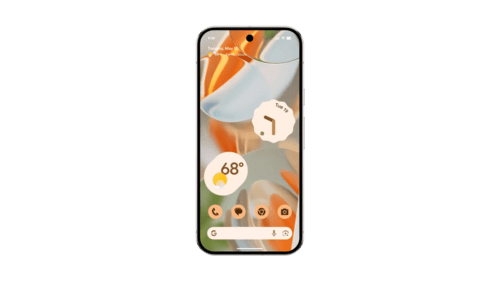
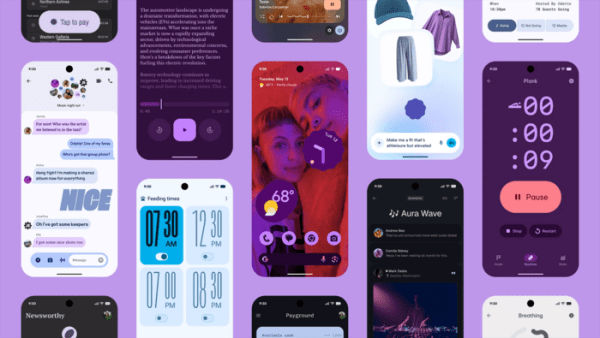
- The interface design has been updated, incorporating a new Material 3 Expressive design concept.

- Dynamic color themes and styles have been updated.

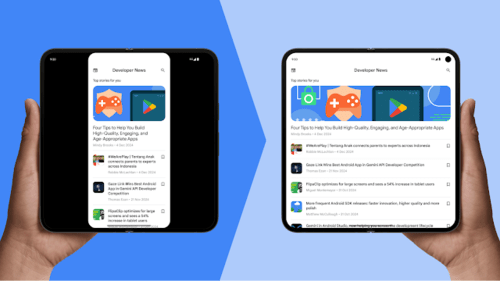
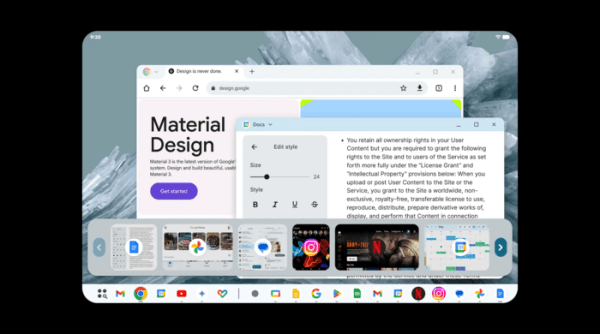
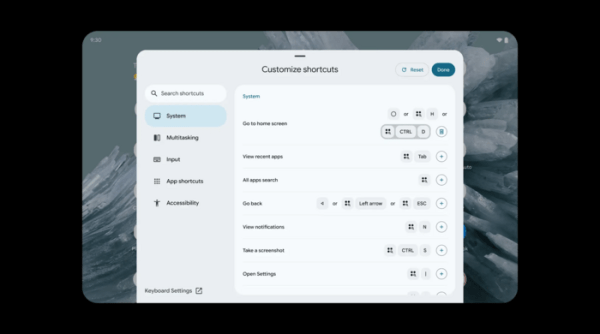
- On devices with large screens, such as tablets, desktop systems, and smartphones with foldable screens, an adaptive interface has been implemented. On devices with a screen width of over 600 density-independent pixels (dp), the platform will display applications in resizable and movable windows on the screen. Manifest file settings for applications (not games) that restrict window size and fix screen orientation will be ignored on large screens. Developers are given the option to disable this new behavior until 2026.
It is now possible to simultaneously arrange windows of different applications on the screen, similar to a traditional desktop environment. Later this year, plans are in place to add a taskbar, support for custom key combinations, and options for connecting tablets and phones to external displays.

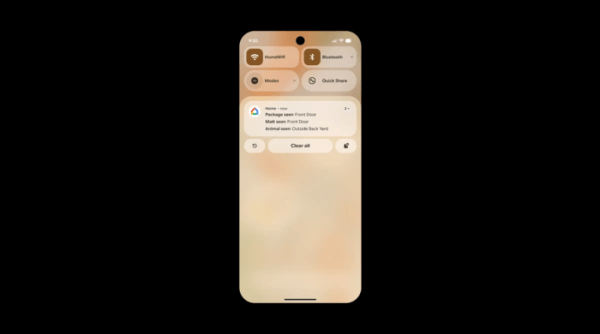
- A new type of notification has been proposed — live updates that allow tracking changes related to a specific activity (for example, displaying delivery stages or route movements). A ProgressStyle has been introduced for new updates, enabling the creation of a block for displaying the progress of an operation.
- Automatic grouping of notifications from a single application has been ensured.
- An embedded interface has been proposed to provide applications with access to photos and videos selected by users, stored both on the current device and in cloud storage. The key difference of the new interface is that the application gains access not to the entire multimedia library, but only to individual files chosen by the user.
- By default, a 'predictive' animation is invoked for operations returning to the home screen when performing the 'back' gesture, as well as when switching between tasks and activities. The essence of the predictive return lies in the ability to preview the area to which the transition will occur (for example, if returning to the home screen, the application window shrinks, displaying the home screen). Support for predictive return in the new version is realized not only for gestures but also for navigation using the 'Back,' 'Home,' and 'Overview' buttons.
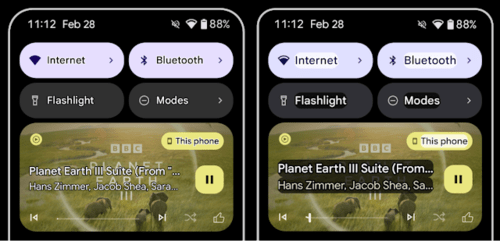
- A text contrast enhancement mode has been added, which removes transparency behind the text (light text is displayed on a black background, and dark text on a white background). This mode may benefit individuals with vision impairment.

- The settings have been augmented with an 'Advanced Protection' section, offering a set of optional protection mechanisms that enhance security in the presence of device compromise risks or targeted attacks on users. This mode includes features such as automatic smartphone rebooting after 3 days of inactivity, protection against USB attack methods, automatic device locking upon detecting signs of theft, backup of logs for auditing in case of a breach, engagement of the hardware protection mechanism MemTag, blocking the installation of unknown applications, preventing connections to 2G mobile networks, disabling automatic reconnections to unsecured Wi-Fi networks, spam and fraudulent message filtering, and blocking advertising calls.
- Support for the APV (Advanced Professional Video) codec has been added, intended for recording and processing video at a professional level of quality, close to the original content quality with lossless compression. To simplify usage during video editing, the APV format provides high bandwidth and low intra-frame coding complexity, while ensuring there is no loss in quality during re-encoding. Resolutions of 2K, 4K, and 8K are supported, along with HDR10/10+, frame tiling for parallel encoding/decoding, various color sampling formats, multi-view video, and metadata add-ons (depth, transparency, preview data). The implementation is based on the OpenAPV library and utilizes the APV 422-10 profile (YUV 422 and 10-bit per channel), supporting bitrates up to 2Gbps.
- The Linux kernel has been updated to version 6.12.
- The Vulkan graphics API has been designated as the official API for the Android platform. To pass certification with Google and leverage Android 16, a device must support the basic capabilities of Vulkan 1.3. Work is underway to transition Android to a new unified rendering stack based on Vulkan. For certain games and applications that have been verified and whitelisted, an OpenGL ES implementation based on the ANGLE layer operating on top of Vulkan is employed.
- An experimental Linux Terminal app has been added, allowing the launch of a virtual machine with Debian GNU/Linux in the Android environment, where regular Linux applications can be executed. Development is ongoing for the possibility of running graphical Linux applications.
- Significant improvements have been made to the reception and making of calls using hearing aids. The ability to control hearing aids (such as volume adjustments) directly from an Android phone has been added.
- To optimize performance, the internal structures of the Android Runtime (ART) have been modified, which will require updates to applications using such structures.
- For applications that work with the camera, the capability to detect the use of night shooting mode has been provided.
- A low-level API for vertical text rendering has been added. The Paint class now supports the VERTICAL_TEXT_FLAG, which allows for handling vertical text parameters at the same level as horizontal text.
- The RangingManager API has been added, enabling the determination of distances and angles between the user's current and external devices, using various distance estimation techniques based on the analysis of channel parameters and the received BLE (Bluetooth Low Energy) signal, as well as response time assessments via Wi-Fi.
- Support for technologies developed under the Privacy Sandbox initiative has been added to facilitate advertising in mobile applications while ensuring user privacy.
- A Local Network Protection (LNP) mode has been added, allowing applications to restrict access to internal intranet subnets (192.168.x.x, 10.x.x.x, etc.) to block attacks on resources within the local network. In this new mode, in addition to having 'INTERNET' permissions, the application will require separate access confirmation from the user.
- Support for creating screenshots with an extended brightness range (HDR) has been added.
Source: opennet.ru
