

The release of the Rhino Linux 2023.3 distribution has been introduced, implementing a variant of Ubuntu with a continuous delivery model for updates, allowing access to the latest software versions. New versions are mainly transferred from the devel branches of the Ubuntu repositories, where packages with new application versions are built, synchronized with Debian Sid and Unstable. Desktop components, the Linux kernel, boot screens, themes, the Firefox browser, and developer utilities are distributed through a separate Pacstall repository. Installable images, which can boot in Live mode, are prepared for x86_64 (2 GB) and ARM64 (1.9 GB) architectures, as well as for ARM devices like PineTab, PineTab2, PinePhone, and Raspberry Pi.
Package management is handled by its own package manager rhino-pkg (rpk), which wraps around the APT, Pacstall, flatpak, and snap package managers. Rhino-pkg provides a single universal tool for performing standard operations with various package formats, such as installing, removing, updating, and searching for packages. The distribution is built using the LiveBuild toolkit from the Debian project with modifications sourced from VanillaOS. The Calamares installer is used for the installation of the distribution.
For the graphical interface, a custom user environment, Unicorn, has been employed, which is a redesigned version of Xfce, styled closer to GNOME but remaining lightweight. In Unicorn, the developers aimed to combine a more modern appearance with a traditional approach to desktop construction. Plank Dock is used as the application sidebar, and the standard Xfce panel serves as the top panel. Navigation through installed applications is facilitated by the App Grid mode, implemented on the basis of Lightpad.
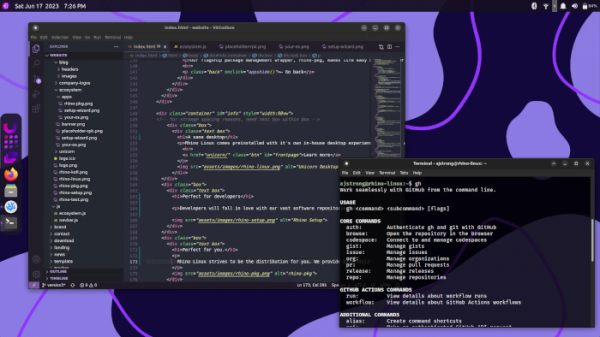
Navigation between open windows and virtual desktops is organized using the Xfdashboard package, which implements a GNOME Shell and macOS Expose-style application switching interface for Xfce. For quick application launches, uLauncher is offered, providing a search bar for running commands, browsing directory contents, and finding programs and files. The project also develops a first setup wizard, an application for file sharing between different devices (a fork of Snapdrop), and an application for viewing system information and updating the distribution.
In the new version, the Unicorn desktop has transitioned to using a unified global menu. The launch time of the uLauncher application has been accelerated. The panel features an effect that enlarges the icons when the cursor hovers over them. The first setup wizard has addressed the issue of prompting for a password to restart. The appearance of the Calamares installer has been improved. The basic package now includes the timeshift backup system, which uses rsync with hard link creation or Btrfs snapshots to provide functionality similar to System Restore in Windows and Time Machine in macOS. Linux kernel versions have been updated: 6.5.5 in general builds, 6.6.0-rc3 in builds for Pine64, and 6.5.0 in builds for Raspberry Pi.
Source: opennet.ru
