

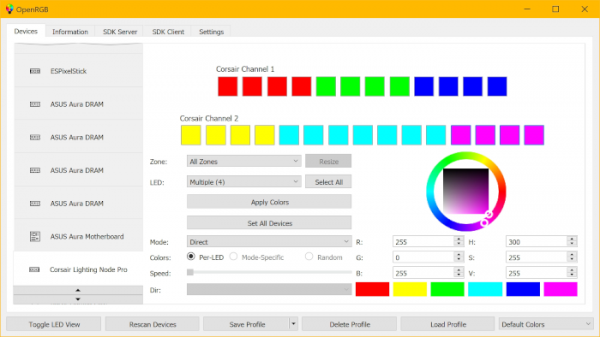
After 7 months of development, OpenRGB 0.9 has been released, an open tool for managing RGB lighting of peripheral devices. The package supports ASUS, Gigabyte, ASRock, and MSI motherboards with RGB subsystems for case lighting, memory modules with lighting from ASUS, Patriot, Corsair, and HyperX, GPUs from ASUS Aura/ROG, MSI GeForce, Sapphire Nitro, and Gigabyte Aorus, various LED strip controllers (ThermalTake, Corsair, NZXT Hue+), illuminated coolers, mice, keyboards, headphones, and Razer accessories with lighting. Protocol information for device interaction is mainly gathered through reverse engineering of proprietary drivers and applications. The code is written in C/C++ and is distributed under the GPLv2 license. Ready builds are generated for Linux (deb, rpm, appimage), macOS, and Windows. As before, all experimental builds generated after the release will receive version number 0.91.
New features:
- Segments that allow breaking up LED zones into smaller subgroups, for example, to visually separate daisy-chained devices on ARGB ports (coolers, strips)—earlier they were displayed as a solid band. Zones are configured manually by users.
- Keyboard Layout Manager (KLM), simplifying the development of integrations for layouts when keyboards are delivered to different regions with different layouts (e.g., QWERTZ, AZERTY). The functionality of KLM will be expanded in the next release as support for it is added to controllers.
- A page with device IDs that simplifies the development of new devices.
- Plugin integration with the SDK, allowing plugins to define their own SDK commands.
- PNG icons have been replaced with more universal icons. * Added translations in Malay, Japanese, Croatian, and Polish. Existing translations have been updated.
- The requirement to not use Cyrillic in file paths (plugins, profile names, settings folder path, username, etc.) has been canceled for all OS.
Support for new devices:
- Numerous new GPUs from ASUS, Colorful, EVGA, Gainward, Gigabyte, iGame, MSI, NVIDIA, Palit, and PNY have been added to existing controllers.
- AOC controller: AOC GK500 (keyboard), AOC GMM700 (mouse pad), and AOC GM500 (mouse).
- The ASRock controller has received updates for ASRock Polychrome USB boards.
- The ASUS controller has implemented support for the ASUS ROG Ally and added new devices.
- Support for Cherry keyboards has been implemented. * The Corsair controller now supports Corsair Dominator Platinum DDR5 and Corsair Vengeance DDR5.
- Support for CRYORIG H7 Quad Lumi has been added.
- Support for new Das Keyboard devices has been added.
- In the ENE controller, the parsing of the ENE SMBus configuration table has been improved (the Unknown LED error in the LED signatures on most ENE RAM models has been corrected). Due to unstable saving on some RAM module models, the save mode feature is hidden in the configuration file.
- Support for new GaiZhongGai devices has been added.
- New layouts for Gigabyte motherboards have been added.
- The HyperX controller has added support for new devices. For devices whose HID descriptor does not meet the standard requirements, a device class has been added to force them to work through libusb-hidapi under Linux.
- Support for the JSAUX Steam Deck dock has been added.
- Support for the LEGO Dimensions toypad has been added.
- Support for new devices in the controller for Lenovo laptops has been added.
- Support for some Lenovo motherboards has been added.
- Support for new Lian-Li devices has been added.
- Errors in the Logitech controller have been fixed.
- The list of unlocked MSI Mystic Light board models has been expanded.
- Support for Nollie32 controllers has been added.
- Support for NZXT Hue 1 (Smart Device V1) has been added.
- Support for new NZXT Hue 2 devices, including additional accessories, has been added.
- Support for OKS keyboards has been implemented.
- The Razer controller has added support for new devices and fixed an initialization error that caused unreliable support for some devices. Many Razer keyboards have been transitioned to use KeyboardLayoutManager.
- Support for RedSquare keyboards has been added.
- Support for Roccat headphones has been added.
- New features for Sapphire devices have been added.
- Support for TP-Link Kasa Smart has been added.
- Support for new Wooting devices has been added.
- Errors in console mode (CLI) have been fixed.
Known issues:
- The wave effect still does not work on the Redragon M711.
- Some Corsair mice have unmarked LEDs.
- The layout list is incomplete on some Razer keyboards.
- The number of Asus Addressable channels may be inaccurate.
- NVIDIA and AMD graphics card support may not work on Linux, in both cases this is related to issues with device drivers (amdgpu and proprietary nvidia driver). The beta version of the nvidia driver may resolve the issue.
- MinGW compiler is not supported.
Notes:
- Due to the renaming of certain device controllers, existing profiles may require recreation. Previously configured ARGB zone sizes may also not be preserved.
- When upgrading from versions prior to 0.6, it is strongly recommended to disable the settings for OpenRazer and OpenRazer-win32. This will allow the application to use the new Razer controller with improved device support. OpenRazer is planned to be removed in the next release.
- When upgrading from versions prior to 0.6, you need to clear the plugins directory, as there was no plugin API versioning system prior to the 0.6 release.
Source: opennet.ru
