

The release of project Monado 25.0.0 has been published, which develops an open implementation of the OpenXR standard. The OpenXR standard is prepared by the Khronos consortium and defines a universal API for creating virtual and augmented reality applications, as well as a set of layers for interacting with hardware. Monado provides a runtime fully compliant with OpenXR requirements, which can be used to organize work with virtual and augmented reality on smartphones, tablets, PCs, and any other devices. The project code is written in C and distributed under the Boost Software License 1.0, compatible with GPL.
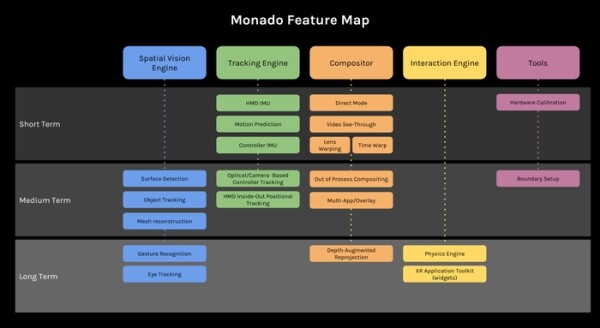
Platform Composition:
- Spatial vision engine that performs tasks such as object tracking, surface detection, mesh reconstruction, gesture recognition, and eye-tracking.
- Character tracking engine offering components for predicting movements, optical motion tracking via a camera, data-based positional tracking from VR headsets, gyrostabilizers, and controllers.
- Composite server, supporting compositing, direct output mode, video passthrough, lens correction, and workspace formation for simultaneous work with multiple applications.
- Interaction engine providing a set of widgets and toolkit for virtual reality applications, including tools for simulating physical processes.
- Toolkit for calibrating hardware and defining movement boundaries.
Main Features:
- Drivers for virtual reality headsets HDK (OSVR Hacker Developer Kit), PlayStation VR HMD, SteamVR, Panotools (PSVR), various Vive models, and devices for which OpenHMD drivers are available.
- Driver for the North Star augmented reality glasses.
- Driver for positional tracking systems such as Intel RealSense T265.
- Set of udev rules for configuring access to virtual reality devices without root privileges.
- Motion tracking components with a framework for filtering and streaming video.
- Character tracking system with six degrees of freedom (6DoF, forward/backward, up/down, left/right, yaw, pitch, roll) for PSVR and PS Move controllers.
- Modules for integration with graphic APIs Vulkan and OpenGL.
- Headless mode.
- Spatial interaction and viewpoint control.
- Basic support for frame synchronization and information (action) input.
- A ready composite server that supports direct output to a device. Shaders for Vive and Panotools are provided. There is support for projection layers.
Among the changes in the new release:
- The internal software interfaces XRT (XRT Runtime) have been expanded, abstracting the low-level hardware interaction features. The method xrt_instance_android and the header file xrt/xrt_android.h with calls for the Android platform have been added. Functions have been added to xrt_compositor to manage screen refresh rates. Support for the XR_FB_face_tracking2 extension has been added, along with the ability to activate advanced functionality on the fly, such as control through eye tracking.
- Functions for determining battery charge status and obtaining properties of motion-tracking related devices have been added to libmonado.
- The State Trackers have implemented the OpenXR extension XR_EXT_active_action_set_priority, ensured support for the OpenXR specification 1.1.47, and added the ability to enable and disable advanced capabilities, such as eye tracking.
- In the drivers for the Android platform, CPU load has been reduced.
- Support for the unofficial Haptics API for Oculus Rift CV1 devices has been added to the driver using OpenHMD.
- Support for visibility masks has been added to the simulation driver to control which objects will be visible in each eye.
- Support for HP Reverb G2 Omnicept and Acer AH100 3D headsets has been added.
- In the compositor server Dynamic screen refresh rate adjustment has been implemented on the Android platform. An environment variable WAYLAND_CONNECTOR has been added to select the output device in Wayland-based environments.
Source: opennet.ru
