

Google has released the second quarterly update of the open mobile platform Android 16 (QPR2). The source code associated with this new release is hosted in the project's Git repository (branch android-16.0.0_r4). Firmware builds have been prepared for Pixel 6/6a/6 Pro, Pixel 7/7a/7 Pro, Pixel 8/8a/8 Pro, Pixel 9/9a/9 Pro/9 Pro XL/9 Pro Fold, Pixel Fold, and Pixel Tablet devices. In the coming months, firmware with the new version is expected for smartphones from Samsung, Honor, iQOO, Lenovo, Motorola, Nothing, OnePlus, Oppo, realme, Sharp, Sony, Tecno, vivo, and Xiaomi. Additionally, universal GSI (Generic System Images) builds will be created, suitable for various devices based on ARM64 and x86_64 architectures.
The release of Android 16 QPR2 has been developed under a new timeline, according to which every year there will be not just one significant Android release, but two updates—one in the second quarter (QPR1) and another in the fourth quarter (QPR2). The summer release includes significant innovations, behavioral changes in the SDK, and new APIs. The winter release contains improvements, new APIs, and changes that do not affect application compatibility.
Key innovations of Android 16 QPR2:
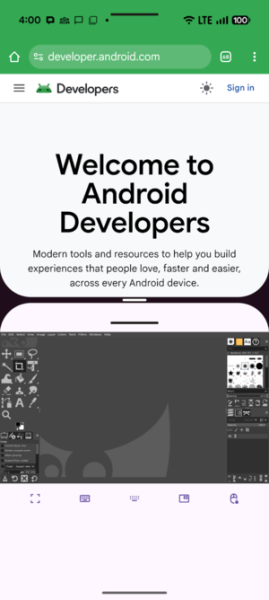
- The ability to run graphical applications built for Linux has been added. This is done through the Linux Terminal app, which allows launching a virtual machine with Debian GNU/Linux within the Android environment, enabling the execution of standard Linux applications. A ‘Display’ button has been added to the Linux Terminal app to facilitate graphical output through components in the main Android environment. Once the ‘Display’ button is activated in the terminal, you can start the Weston compositor, which provides a minimalist window session, and then use it to run any graphical applications, such as demonstrating the launch of the GIMP image editor.

The functionality of the Linux virtual machine is being developed under the Ferrochrome project. Debian GNU/Linux runs in the guest environment. The AVF (Android Virtualization Framework) is used for virtualization, implemented on the basis of the hypervisor Weston. KVM and the crosvm toolchain. The graphical environment uses the Wayland protocol and is based on a compositor. server For hardware acceleration of graphics, VirGL—a virtual GPU from Virgil3D—is utilized. Applications compiled for X11 are launched using the DDX component XWayland.
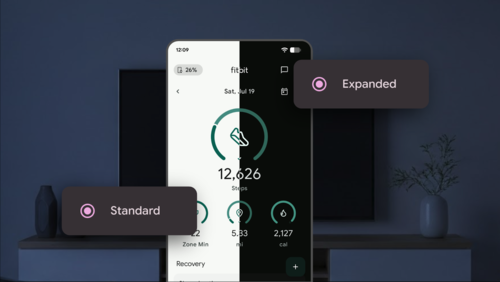
- An expanded dark theme has been implemented, which automatically inverts colors in applications that do not provide a dark theme. The need for inversion is determined individually for each application based on the isLightTheme attribute. The inversion is applied to user interface elements based on Android Views, Composables, and WebViews, but is not used for applications with custom rendering engines, such as those based on the Flutter framework.

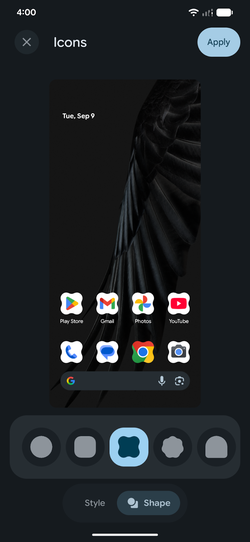
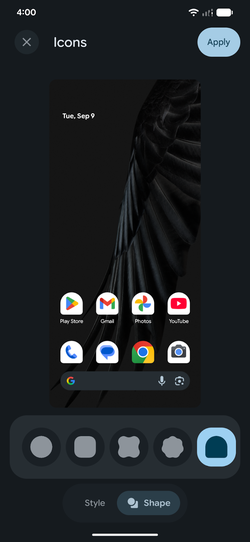
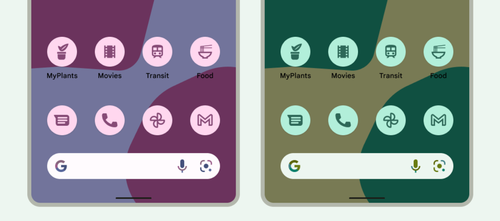
- The ability to select specific shapes for icons has been provided, which will be applied to all displayed icons and directory shortcuts.

- For applications that do not offer separate icon options for themes, an automatic icon generation feature has been implemented, styled according to the themes. When generating, a color filter is applied to the existing app launch icon.

- The ability to continue interactive engagement with the app after opening the system Share dialog has been provided, allowing the application's interface content to update while selecting a data sharing handler.
- A generational concurrent mark-compact garbage collector has been added to the Android Runtime (ART), which employs separate handling of "old" and "young" objects, increasing the efficiency of clearing recently created objects with short lifetimes. The use of the generational garbage collector reduces the risk of pauses during resource allocation and lowers CPU load, improving energy consumption efficiency.
- Tools for analyzing user interaction with widgets have been expanded — the application can now receive metrics on interaction events such as clicks, scrolls, and impressions.
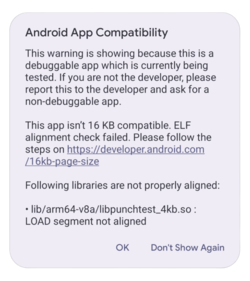
- A warning about the lack of memory alignment at page boundaries, sized at 16 KB, in the debugged application has been implemented. In the future, a transition to using 16 KB pages instead of 4 KB is expected for certain architectures, which will enhance the performance of memory-intensive programs.

- A software decoder has been added for the IAMF (Immersive Audio Model and Formats) sound format, used for distributing surround sound (considering the propagation of sound signals in three-dimensional space to recreate sound as closely to natural as possible).
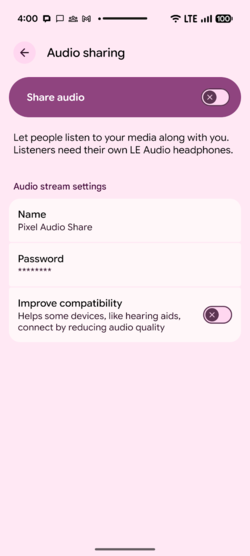
- The Output Switcher device selection interface now integrates the ability to share sound over Bluetooth LE, which does not require separate Bluetooth settings adjustments.

- Health Connect has added support for automatic step tracking using available sensors. Access to step count information is provided to applications with READ_STEPS permissions. The new method simplifies code in applications and reduces energy consumption during step tracking. Health Connect ensures centralized data storage from fitness trackers and other health-related devices, allowing various applications to share health data.
- A new Data Transfer API has been introduced to enhance the reliability of data migration between Android and iOS devices.
- An API has been added for developer verification during the installation of APK packages. Commands to simulate verification have been added to the ADB utility (the ability to install applications without verification using ADB will remain unchanged).
- Protection for SMS with one-time passwords (OTP) has been ensured. To guard against interception of one-time passwords by malicious applications, SMS delivery with a hash for the SMS Retriever service will be delayed by three hours for most applications. During this time, broadcasting the RECEIVE_SMS event will be blocked, and SMS database queries will be filtered.
- A new secure lock state 'Secure Lock Device' has been added, which, when activated (for example, via the 'Find My Device' service), will immediately lock the device and require a PIN code or password to unlock. Notifications and reminders in this mode will be hidden from the lock screen, and biometric unlocking will be temporarily disabled.
Source: opennet.ru
