

The release of Zulip 6 has taken place, which is a server platform for deploying corporate messengers suitable for facilitating communication among employees and development teams. The project was initially developed by Zulip and was open-sourced following its acquisition by Dropbox under the Apache 2.0 license. The server-side code is written in Python using the Django framework. The client software is available for Linux, Windows, macOS, Android, and iOS, and an integrated web interface is also provided.
The system supports both direct messaging between two individuals and group discussions. Zulip can be compared to the Slack service and can be viewed as an internal corporate equivalent of Twitter, used for communication and discussions on work matters within large employee groups. It provides tools for tracking participation and status across multiple discussions simultaneously, using a threaded message display model, which optimally balances room-specific interactions in Slack with a single public space like Twitter. The simultaneous threaded display of all discussions allows for encompassing all groups in one place while maintaining logical divisions between them.
Among Zulip's features, it also supports sending messages to users in offline mode (messages will be delivered once they come online), preserving the complete history of discussions on server and provides search tools for the archive, the ability to send files via drag-and-drop, automatic syntax highlighting for code blocks sent in messages, a built-in markup language for quick list and text formatting, tools for group notifications, the ability to create private groups, integration with Trac, Nagios, GitHub, Jenkins, Git, Subversion, JIRA, Puppet, RSS, Twitter, and other services, as well as features for attaching visual tags to messages.
Key innovations:
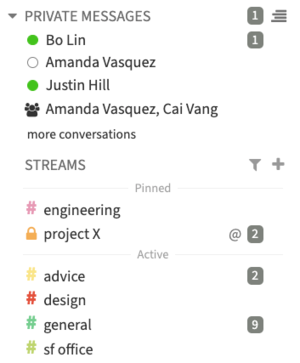
- The design of the sidebar has been modified to simplify navigation through discussions. The panel now displays information about new messages in private discussions, which can be accessed with a single click. Topics with unread mentions are marked with an '@' symbol. Channels are divided into pinned, active, and inactive.

- Support has been added for viewing all recent discussions in one place, encompassing both channels and private discussions.

- Users can now mark messages as unread, for instance, to revisit them later when they don't have time to respond immediately.
- The ability to view the list of users (read receipts) who have read a message has been added, including private messages and messages in channels (streams). There is an option in the settings to disable this functionality for specific users and organizations.
- A button has been added to navigate to the discussion where a message is sent (Zulip allows sending messages to another discussion while in one discussion, for example, when you need to forward some information to another participant; the new button makes it easy to switch to that discussion).
- A button has been added for quick scrolling to the bottom of the current discussion and automatically marking all messages as read.
- Users can now display up to two additional fields of information in their profile, alongside the standard fields for name, email, and last login time; for example, they can show their country of residence, birthday, etc. The interface for customizing personal fields has been redesigned. The design of user cards and profiles has been updated.
- A button has been added to switch to invisible 'mode', where other users see you as offline.
- The public access feature has been stabilized, allowing channels to be opened for viewing by anyone, including those without a Zulip account. There is now the ability for guests to quickly log in without registration and choose a language, dark or light theme.
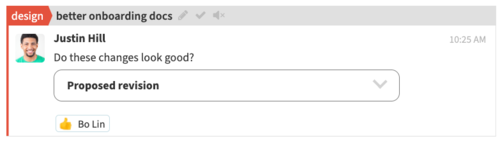
- Usernames of those who reacted to messages are now displayed (for example, you can see that your boss approved a proposal by sending 👍).

- The emoji collection has been updated to Unicode 14.
- The right sidebar now displays messages with status by default.
- Emails notifying about new messages now clearly explain the reason for the notification and allow multiple replies.
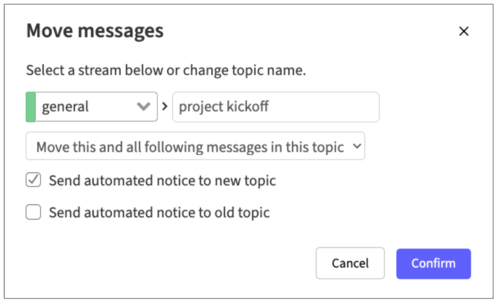
- The interface for moving messages between different topics and channels has been completely redesigned.

- Modules for integration with Azure DevOps, RhodeCode, and Wekan have been added. Integration modules with Grafana, Harbor, NewRelic, and Slack have been updated.
- Support for Ubuntu 22.04 has been added. Support for Debian 10 and PostgreSQL 10 has been discontinued.

Source: opennet.ru
