

The release of the open platform webOS Open Source Edition 2.15 has been published, which can be used on various portable devices, boards, and automotive infotainment systems. The Raspberry Pi 4 boards are considered the reference hardware platform. The platform is being developed in a public repository under the Apache 2.0 license, with development overseen by the community, adhering to a collaborative development model.
The webOS platform was originally developed by Palm in 2008 and was used on the Palm Pre and Pixie smartphones. In 2010, after acquiring Palm, the platform came under Hewlett-Packard's control, which then attempted to use the platform in its printers, tablets, laptops, and PCs. In 2012, HP announced the transition of webOS into an independent open project and began releasing the source code for its components in 2013. In that same year, the platform was acquired from Hewlett-Packard by LG and is now used in over 70 million LG TVs and consumer devices. In 2018, the webOS Open Source Edition project was established, through which LG aimed to return to an open development model, attract other participants, and expand the range of devices supported by webOS.
The webOS system environment is formed using the OpenEmbedded tools and base packages, as well as the build system and metadata set from the Yocto project. Key components of webOS include the System and Application Manager (SAM), which is responsible for running applications and services, and the Luna Surface Manager (LSM), which creates the user interface. The components are written using the Qt framework and the Chromium browser engine.
Rendering is done through a composite manager using the Wayland protocol. For developing user applications, it is recommended to use web technologies (CSS, HTML5, and JavaScript) and the Enact framework based on React, although it is also possible to create programs in C and C++ with a Qt-based interface. The user interface and built-in graphical applications are mainly implemented as native programs written using QML technology. By default, the Home Launcher interface is offered, optimized for touch screen navigation and featuring a concept of interchangeable cards instead of windows.
Data is stored in a structured format using JSON with the DB8 storage system, which uses LevelDB as the backend. Initialization is done through bootd based on systemd. For multimedia content processing, the uMediaServer and Media Display Controller (MDC) subsystems are available, and PulseAudio is used for sound. server For automatic firmware updates, OSTree and atomic partition replacement are used (two system partitions are created, one of which is active while the other is used for updating).
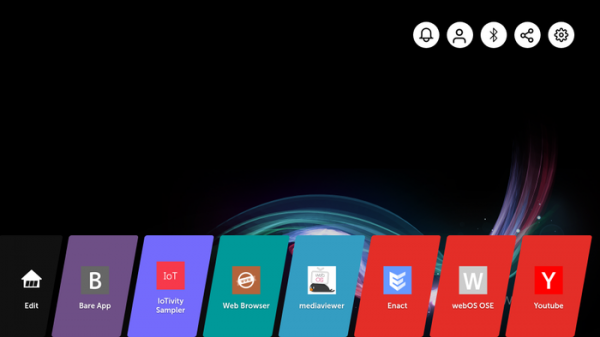
Key changes in the new release:
- Support for keyboard and mouse has been added. The Luna Surface Manager (LSM) has been adapted to manage and organize input using a keyboard and mouse, rather than just a touchscreen. For instance, a keyboard and mouse can be connected to a mobile device or a webOS-based TV for use as a workstation. Keyboard shortcuts have also been added for quick access to settings (F1) and the application launcher interface (Start or Windows button).
- Rendering performance has been improved and the quality of animations in applications using the Qt library has been enhanced.
- Components and resources for customizing QML applications have been added to the Home Launcher.
- Support for volume tracking has been added to the audiod sound management service.
- A set of example applications and solutions based on webOS has been proposed.
- The browser engine has been updated to Chromium 91 (previously used Chromium 87). The web engine has implemented support for GPU vsync for Wayland.
- The emulator now includes swap compression (zram) and out-of-memory handling (oomd).
Source: opennet.ru
