

After a year and a half of development, the user environment Enlightenment 0.26 has been released, based on the EFL (Enlightenment Foundation Library) and Elementary widgets. The release is available in source code, while packages for distributions have not yet been created.
The desktop in Enlightenment is formed by components such as a file manager, a set of widgets, an application launcher, and a set of graphical configurators. Enlightenment is very flexible in customization: the graphical configurators do not restrict the user in settings and allow for the adjustment of all operational aspects, providing both high-level tools (changing themes, configuring virtual workspaces, managing fonts, screen resolution, keyboard layout, localization, etc.) and low-level tuning options (for instance, cache parameters, graphics acceleration, power consumption, and the behavior logic of the window manager).
To extend functionality, modules (gadgets) are suggested, while themes can be used to change appearance. Specifically, modules are available for displaying a calendar-planner, weather forecast, monitoring data, volume control, battery charge assessment widget, etc. The components of Enlightenment are not tightly coupled and can be used in other projects or to create specialized environments, such as shells for mobile devices.
Mandatory dependencies include EFL, libexif, and libpam (only on Linux). Among the recommended dependencies necessary for full functionality are: connman for network configuration; bluez5 for Bluetooth support; bc for the built-in calculator; pulseaudio for managing audio devices; acpid for handling various hardware events; packagekit for tracking system updates; udisks2 for mounting external drives; ddcutil for controlling screen brightness; gdb for tracing crashes.
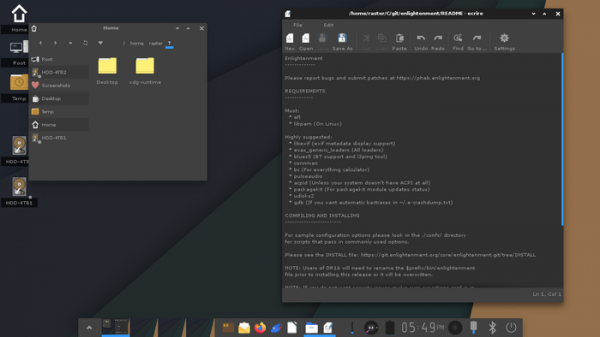
The most noticeable innovations in Enlightenment 0.26 include:
- A setting has been added to use the DDC (Display Data Channel) protocol for managing screen brightness.
- The size of window thumbnails in previews has been increased.
- Corrections have been made regarding the implementation of Wayland protocol support. In the Wayland mode, a screen label indicating the experimental nature of Wayland support has been provided.
- A new API for synchronizing changes on disk, provided by the Eet library, has been introduced to ensure the saving of configuration changes.
- In the EFM file manager, the ability to add file actions through desktop files has been implemented.
- Support for disabling screen saver activation via the org.freedesktop.ScreenSaver API has been added.
- Support for the DBus API provided by the systemd service logind has been added for locking and unlocking sessions.
- A watchdog process has been added to detect hangs in the main event processing loop.
- An API for playing sound samples has been added and activated in the notification system.
- An option to use the X11 Randr extension through the xrandr utility call has been added instead of accessing it through the API.
- Additional sound mixing options have been added.
- An option for scrolling with acceleration has been added.
- An option for controlling the hidden window state installation through the NetWM API (property _NET_WM_STATE_HIDDEN) has been added.
At the same time, the Enlightenment project published a set of EFL 1.27 (Enlightenment Foundation Library) libraries, allowing for the creation of visually appealing graphical interfaces that are compact, resource-efficient, and high-performing. Despite its initial development as a basis for the Enlightenment environment, EFL components are often used for building interfaces for consumer electronics and mobile devices. For example, EFL is part of the Tizen mobile platform, used in Electrolux appliances, Samsung products, ProFUSION, Free.fr, and Calaos.
In the new version of EFL:
- API for working with relative paths and sha1 hashes have been added to the Eina library. The Eina library provides functions for handling various data types (array, hash, list, tree) and useful tools (log handling, performance assessment, format conversion, etc.).
- In Ecore, the ability to forcibly terminate the execution of an exe file along with the parent process on the Windows platform has been added. Ecore is a library for organizing event processing cycles, equipped with a set of modules to simplify event-related tasks such as working with X, Evas, threads, network connections, and more.
- In elm_cnp, the implementation of the copy and paste mechanism through the clipboard has been enhanced with support for URL lists.
- Support for loading and saving images in JXL (JPEG XL) and QOI (Quite OK Image) formats has been added to the Evas library used for rendering text, images, and objects on screen.
- In Eet, the data serialization and deserialization library, a call for synchronizing changes to disk has been added.
- Support for LibreSSL 3.5.x has been added and GnuTLS support has been removed.
- The Elementary widget set mandates the use of standard icons from the theme.
- Widgets now allow pasting from the clipboard into password input fields.
Source: opennet.ru
