

The release of the postmarketOS 21.06 project has been announced, which develops a Linux distribution for smartphones based on Alpine Linux, Musl, and BusyBox. The goal of the project is to provide the possibility of using a Linux distribution on smartphones that is independent of the support lifecycle of official firmware and not tied to typical solutions of major industry players that dictate the direction of development. Builds have been prepared for the PINE64 PinePhone, Purism Librem 5, and 15 community-supported devices, including the Samsung Galaxy A3/A3/S4, Xiaomi Mi Note 2/Redmi 2, OnePlus 6, and even the Nokia N900. Limited experimental support is provided for 330 devices.
The postmarketOS environment is highly unified and separates all components specific to particular devices into individual packages, while all other packages are identical for all devices and are based on Alpine Linux packages. The builds use a vanilla Linux kernel whenever possible, and if that is not feasible, kernels from firmware prepared by device manufacturers are used. The main user interfaces offered are KDE Plasma Mobile, Phosh, and Sxmo, but there is also the possibility to install other environments, including GNOME, MATE, and Xfce.
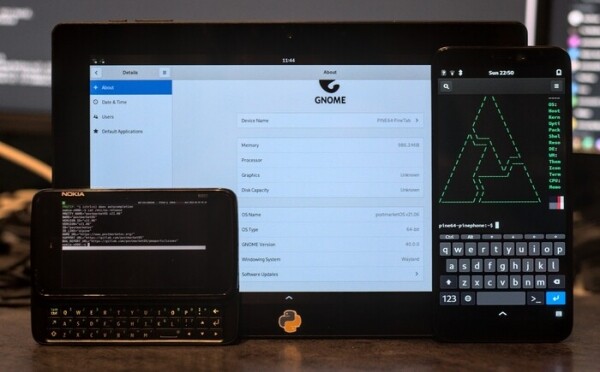
In the new release:
- The package base has been synchronized with Alpine Linux 3.14.
- The number of officially supported community devices has increased from 11 to 15. Support has been added for OnePlus 6, OnePlus 6T, Xiaomi Mi Note 2, and Xiaomi Redmi 2 smartphones. For each of the supported devices, except for the Nokia N900, packages for installing Phosh, Plasma Mobile, and Sxmo interfaces are provided.
- All user interface versions have been updated.
- When unlocking the encrypted rootfs partition with the osk-sdl utility, IO operation queues are now disabled, which has allowed the write performance on a 4K block size filesystem to increase by approximately 35%, and read performance by 33%.
- The installer no longer prompts for a separate username and password for SSH users.
- The kernel for the PinePhone has been optimized to extend battery life. The Linux kernel for the Pine64 devices is built based on the work of the linux-sunxi project.
- Transitioning to sleep mode during music playback is now prohibited, even if the application does not directly block screen saver activation via the inhibit API.
- Changes have been made aimed at enhancing the stability of Wi-Fi on the Librem 5 smartphone. Support for the use of smart cards has been added for the Librem 5.
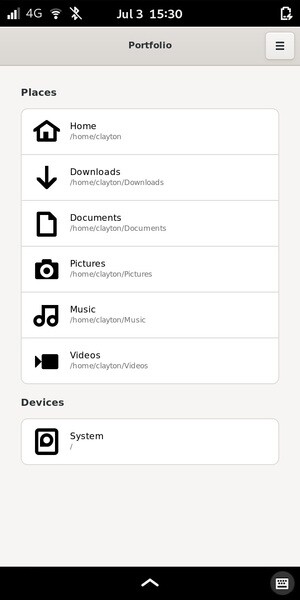
- The Phosh UI user environment is now set by default to the Portfolio file manager, which is better adapted for mobile device screens. The previously supplied Nemo can be installed from the Alpine Linux repository.

- For all devices except OnePlus 6/6T and Xiaomi Mi Note 2, a predefined set of nftables firewall rules is enabled by default. The default rules allow incoming SSH connections via Wi-Fi and network USB adapters, as well as DHCP requests through USB adapters. Incoming connections are prohibited on the WWAN network interface (access via 2G/3G/4G/5G). Outgoing connections are allowed for all types of network interfaces.
Source: opennet.ru
