

The release of Proxmox Virtual Environment 9.1 has been published, a specialized Linux distribution based on Debian GNU/Linux, aimed at deploying and managing virtual servers using LXC and KVM, capable of serving as a replacement for products like VMware vSphere, Microsoft Hyper-V, and Citrix Hypervisor. The size of the installation ISO image is 1.7 GB.
Proxmox VE provides tools for deploying a fully functional industrial-grade virtual server system, managed through a web interface designed for handling hundreds or even thousands of virtual machines. The distribution includes built-in tools for organizing backups of virtual environments and offers out-of-the-box clustering support, including the ability to migrate virtual environments from one node to another without downtime. Features of the web interface include: support for secure VNC console; role-based access management to all available objects (VM, storage, nodes, etc.); and support for various authentication mechanisms (MS ADS, LDAP, Linux PAM, Proxmox VE authentication).
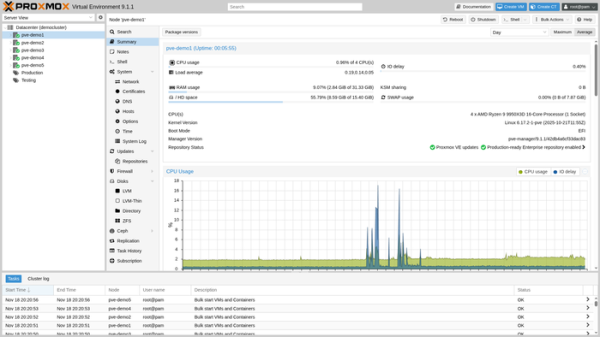
In the new release:
- Synchronization with the Debian 13.2 package base has been completed. The Linux kernel has been updated to version 6.17. New releases of QEMU 10.1.2, LXC 6.0.5, and ZFS 2.3.4 have been implemented. Support for creating storage based on Ceph 19.2.3 (Squid) is now available.
- The ability to create LXC containers from OCI (Open Container Initiative) images, uploaded manually or from repositories, has been added. Support for creating from OCI templates for containers, containers with a full system environment, and containers for running individual applications is provided.
- For containers requiring the attachment of a virtual TPM (Trusted Platform Module) module, the ability to save the state of vTPM in qcow2 format has been implemented. This feature allows for the creation of snapshots of virtual machines with vTPM, for example, used for running guest systems with new versions of Windows, utilizing NFS and CIFS based file storage.
- Tools for flexible management of nested virtualization in guest systems have been provided. A new vCPU flag, "nested-virt," has been added, allowing nested virtualization to be enabled on a vCPU type that fully or partially matches the specifications (manufacturer and generation) of the host CPU. Examples of nested virtualization use include running nested hypervisors and utilizing Windows protection mechanisms based on virtualization in guest systems.
- The GUI has implemented the capability to generate more detailed reports for the Software-Defined Networking (SDN) stack. For instance, you can see which network bridges and virtual networks the guest systems are connected to, as well as the IP and MAC addresses used in the EVPN zones.
- Initial support for the Intel TDX (Trusted Domain Extensions) mechanism for encrypting the memory of guest systems has been added.
- The ability to selectively disable the KSM (Kernel Samepage Merging) mechanism for certain virtual machines, which provides deduplication of identical memory areas, has been added.
Source: opennet.ru
