

A new version of the free monitoring system with fully open source code, Zabbix 5.4, has been released. This release includes support for generating reports in PDF format, a new syntax for aggregations to detect more complex issues, improvements in data visualization, API access token support, metric-level tags, performance enhancements, and much more.
Zabbix consists of three basic components: a server for coordinating checks, generating checks requests, and accumulating statistics; agents for performing checks on external hosts; a frontend for managing the system. The code is distributed under the GPLv2 license. To offload the central server and form a distributed monitoring network, a series of proxies can be deployed,servers, aggregating data from a group of host checks. Data can be stored in MySQL, PostgreSQL, TimescaleDB, DB2, and Oracle databases. Without agents, the Zabbix server can collect data using protocols such as SNMP, IPMI, JMX, SSH/Telnet, ODBC, conduct availability tests of web applications and virtualization systems.
The main innovations of version 5.4 include:
- Support for PDF reports and their scheduled creation and sending to users; a new role for controlling access to this functionality.
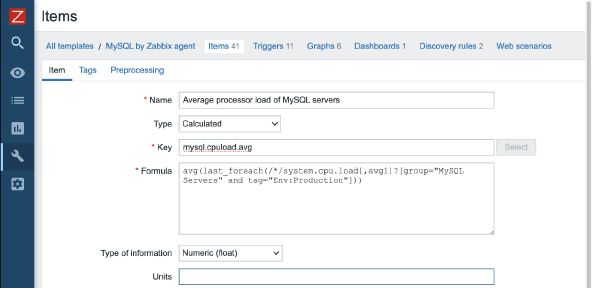
- A fundamentally new syntax for trigger expressions, calculated metrics, and aggregate metrics. We have removed all known limitations of the old syntax while making it simpler.
- Aggregate metrics can now select data based on tags and host and metric key wildcards.

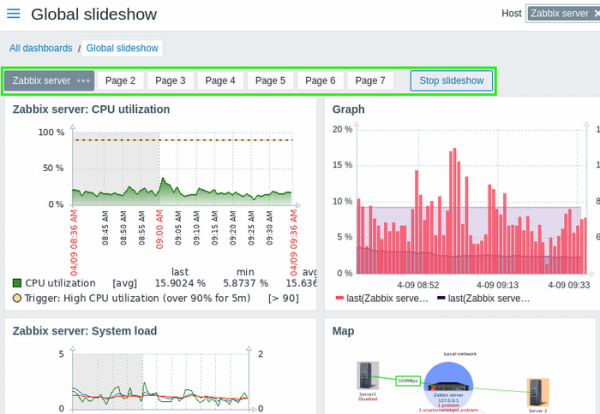
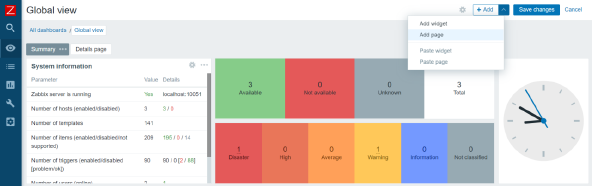
- The functionality of screens and dashboards has been merged, with support for multi-page dashboards added.


- Support for named tokens for API access, with the ability to specify the token's expiration.
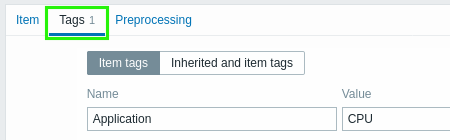
- Support for metric-level tags. Applications are no longer supported.

- Performance and availability enhancements.
- Pollers no longer require a database connection.
- A cache has been introduced for faster processing of trends.
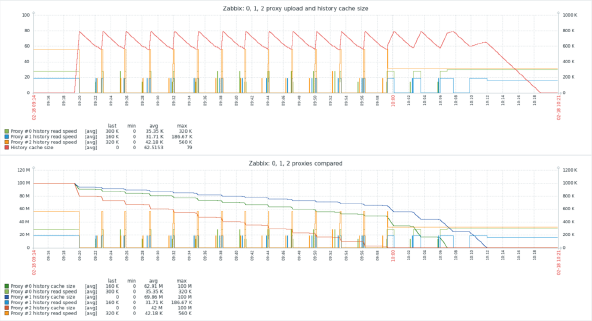
- Support for a more reliable and smoother startup. server in scenarios dealing with and processing a massive amount of new data.
- Improved parallel processing of data on the server and proxies.

- Security improvements.
- Support for all SNMPv3 encryption protocols.
- Details of the error are hidden in case of a failed connection to the interface
- Autofill is disabled for password fields and other sensitive information
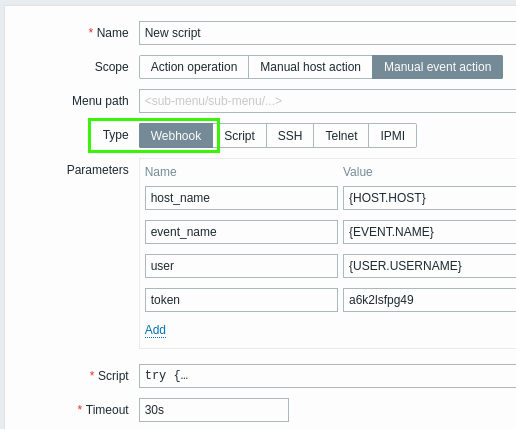
- Support for NTLM authentication for WEB hooks
- Improvements aimed at simplifying monitoring setup and operation
- Third-level menu for better navigation
- Simplified forms for bulk changes and imports
- Availability of metrics now depends on the availability of host interfaces
- Ability to use negative filters for tags in the interface
- Support for value maps at the template and host level for template independence
- Global scripts can be used for alerts, integrations, and custom commands

- Support for processing XML data in preprocessing and WEB hooks
- CurlHttpRequest renamed to HttpRequest in WEB hooks for ease of use
- Other improvements
- Support for monitoring VMware clusters
- Support for Oracle in cluster mode
- Support for the macro {ITEM.VALUETYPE} for alerts
- More granular event export settings
- Availability of official packages for the latest versions of the following platforms:
- Linux distributions RHEL, CentOS, Debian, SuSE, Ubuntu, Raspbian on various architectures
- Virtualization systems based on VMWare, VirtualBox, Hyper-V, XEN
- Docker
- Agents for all platforms including macOS and MSI for Windows agent
- Integration with platforms:
- Availability on cloud platforms AWS, Azure, Google Cloud, Digital Ocean, IBM/RedHat Cloud, Linode, Yandex Cloud.
- Integration with support service platforms Jira, Jira ServiceDesk, Redmine, ServiceNow, Zendesk, OTRS, Zammad, Solarwinds Service Desk, TOPdesk, SysAid, iTOP
- Integration with user alert systems Slack, Pushover, Discord, Telegram, VictorOps, Microsoft Teams, SINGNL4, Mattermost, OpsGenie, PagerDuty, iLert, Rocket.Chat, Signal, Express.ms
- New template solutions for monitoring APC UPS, Hikvision, etcd, Hadoop, Zookeeper, Kafka, AMQ, HashiCorp Vault, MS Sharepoint, MS Exchange, smartctl, Gitlab, Jenkins, Apache Ignite
To migrate from earlier versions, only the installation of new binary files (server and proxy) and the new interface is required. Zabbix will automatically conduct the database upgrade procedure. No new agents installation is needed.
Source: opennet.ru
