

The release of Stratis 3.0 has been published, developed by Red Hat and the Fedora community to unify and simplify the tools for configuring and managing a pool of one or more local storage devices. Stratis provides features such as dynamic space allocation, snapshots, integrity assurance, and layer creation for caching. Stratis support is integrated into Fedora and RHEL distributions starting from Fedora 28 and RHEL 8.2. The project code is released under the MPL 2.0 license.
The system largely mirrors the capabilities of advanced partition management tools like ZFS and Btrfs, but is implemented as a layer (the stratisd daemon) operating above the Linux kernel's device-mapper subsystem (utilizing modules dm-thin, dm-cache, dm-thinpool, dm-raid, and dm-integrity) and the XFS filesystem. Unlike ZFS and Btrfs, Stratis components operate solely in user space and do not require specific kernel module loading. The project is initially presented as not requiring expert qualifications for storage system administration.
Management is provided through a D-Bus API and a cli utility. Stratis has been tested with block devices based on LUKS (encrypted partitions), mdraid, dm-multipath, iSCSI, LVM logical volumes, as well as various HDDs, SSDs, and NVMe drives. When there is one disk in the pool, Stratis allows the use of logical partitions with snapshot support for reverting changes. When multiple drives are added to the pool, it becomes possible to logically combine drives into a contiguous area. Features such as RAID, data compression, deduplication, and fault tolerance are not yet supported but are planned for the future.
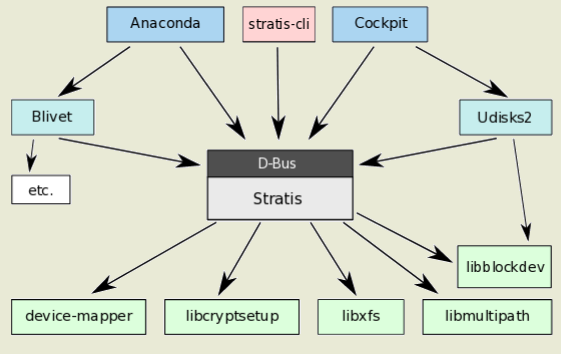
The significant version number change is due to modifications in the interface for management via D-Bus and the discontinuation of FetchProperties interfaces in favor of using D-Bus-based properties and methods. The new release also adds udev rule checking using libblkid before making changes, revises event handling from DeviceMapper, alters the internal representation of error handlers, redesigns the rollback code, and allows specifying logical size when creating a filesystem. In the Clevis framework used for automatic encryption and decryption of data in disk partitions, SHA-256 hashes are utilized instead of SHA-1. It provides the option to change the passphrase and regenerate Clevis bindings.
Source: opennet.ru
