

The Blender Foundation has released the free 3D modeling package Blender 3.0, suitable for various tasks related to 3D modeling, 3D graphics, game development, simulation, rendering, compositing, motion tracking, sculpting, animation creation, and video editing. The code is distributed under the GPL license. Ready builds are available for Linux, Windows, and macOS.
Main changes in Blender 3.0:
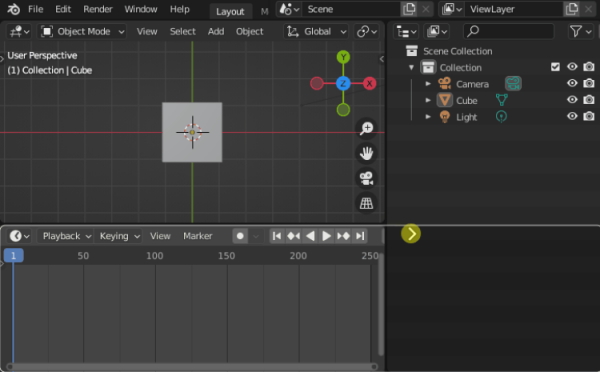
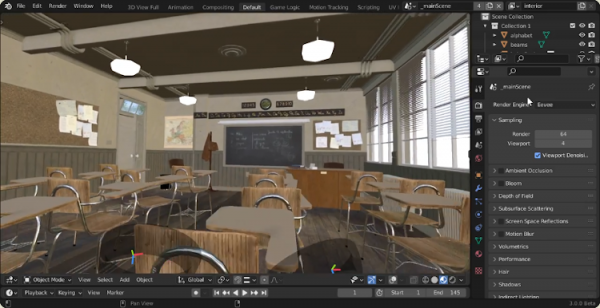
- The user interface has been updated and a new theme has been introduced. Interface elements have become more contrasting, and menus and panels now feature rounded corners. Preferences allow customization of panel spacing and the level of corner rounding for windows. The appearance of different widgets has been unified. The implementation of previews and thumbnail scaling has been improved. The linear non-photorealistic rendering (Freestyle) interface has been completely redesigned. Area management capabilities have been expanded: corner action zones now allow the shifting of any adjacent areas, a new area closure operator has been added, and area resizing operations have been improved.

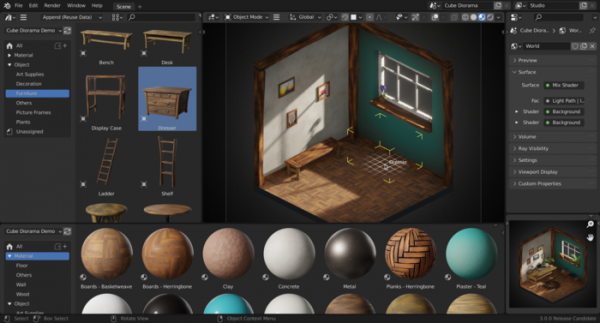
- A new editor has been added — the Asset Browser, which simplifies working with various additional objects, materials, and environmental blocks. It allows for the definition of element libraries, grouping elements into folders, and attaching metadata such as descriptions and tags for easier searching. Arbitrary thumbnails can be linked to elements.

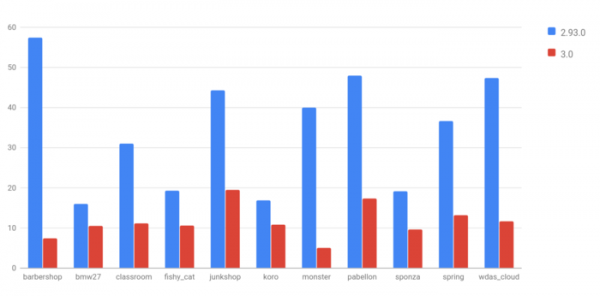
- The Cycles rendering system has been upgraded, significantly improving GPU rendering performance. It is claimed that, thanks to the new code running on the GPU side and the scheduler changes, the rendering speed for typical scenes has increased by 2 to 8 times compared to the previous release. Additionally, hardware acceleration support using NVIDIA CUDA and OptiX technologies has been added. For AMD GPUs, a new backend based on the AMD HIP (Heterogeneous Interface for Portability) platform has been introduced, offering C++ Runtime and a dialect of C++ for creating portable applications with a single codebase for AMD and NVIDIA GPUs (AMD HIP is currently available only for Windows and discrete RDNA/RDNA2 cards, with support for Linux and older AMD graphics card models expected in Blender 3.1). OpenCL support has been discontinued.

- The quality and responsiveness of interactive viewport rendering have been significantly improved, even when overlay mode is enabled. This change is particularly beneficial for lighting adjustments. Separate presets for the viewport and sampling have been added. Adaptive sampling has been enhanced. The ability to set a time limit for scene rendering or render until a specified number of samples is reached has been introduced.

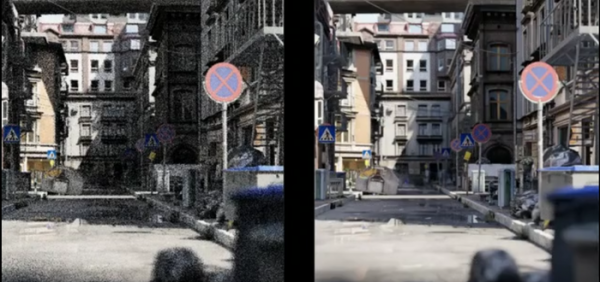
- The Intel OpenImageDenoise library has been updated to version 1.4, enhancing detail levels after noise reduction in the viewport and during final rendering. A new pre-filter setting has been added to the pass filter to control noise reduction using auxiliary albedo and normals.

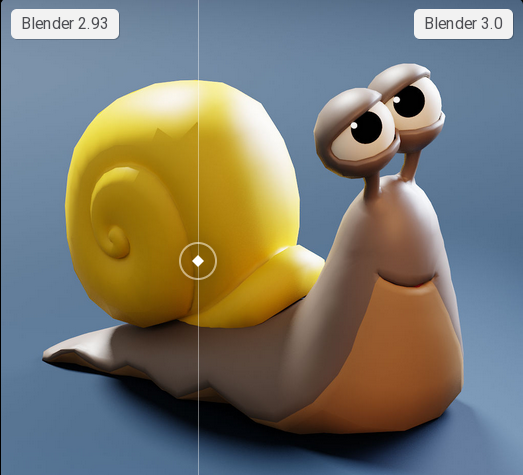
- A Shadow Terminator mode has been added to eliminate artifacts at the boundary of light and shadow that are characteristic of models with a large polygonal mesh step. Additionally, a new shadow catcher implementation supporting reflected light and ambient lighting has been introduced, along with settings to manage the coverage of real and synthetic objects. The quality of color shadows and accurate reflections has been improved when mixing 3D with real footage.

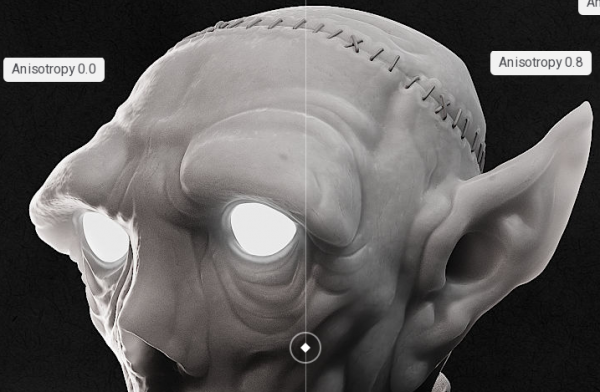
- The subsurface scattering mode has been enhanced with support for changing anisotropy and refractive index.

- In the Eevee rendering engine, which supports physically accurate real-time rendering and uses only GPU (OpenGL) for visualization, performance has increased by 2-3 times when editing very large meshes. The "Wavelength" and "Attribute" nodes have been implemented, the latter for defining custom mesh attributes. Full support for attributes generated by geometry nodes has been provided.

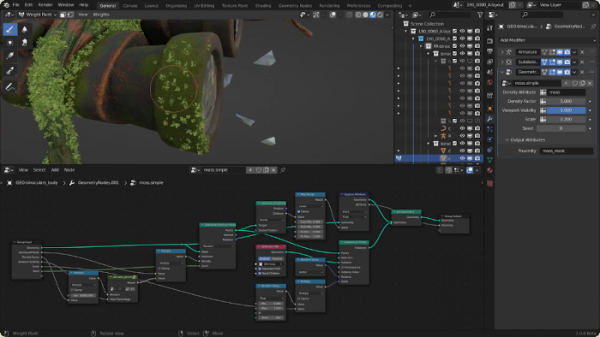
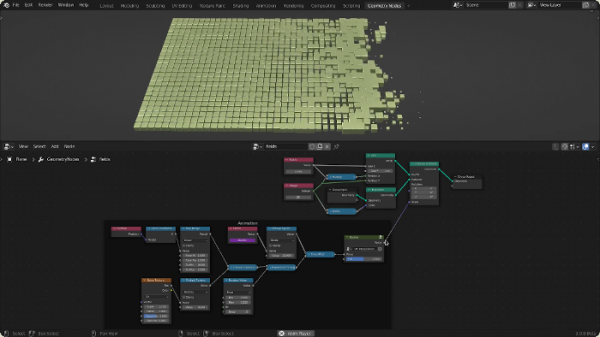
- The geometry nodes interface has been expanded, with a redesigned method for defining node groups and a new attribute system introduced. Approximately 100 new nodes have been added for interacting with curves, text data, and object instances. The visibility of node connections has been improved through color coding of nodes and connecting lines. A concept of fields has been added for organizing data transfer and functions, based on creating operations from basic nodes and connecting them. Fields allow for the use of uncooked named attributes for intermediate data storage without utilizing specialized "Attribute" nodes.
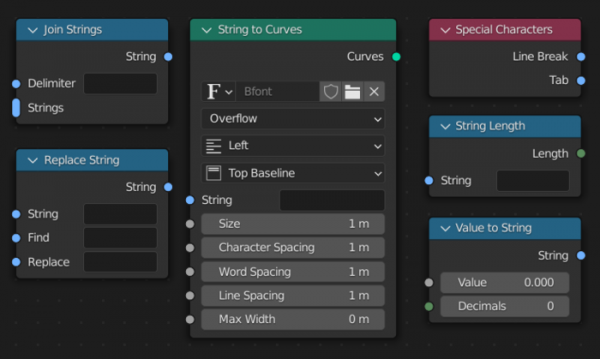
- The geometry nodes interface now includes support for text (Text) and curve (Curve) objects with full attribute system support, as well as the ability to work with materials. Curve nodes (Curve Nodes) allow manipulation of curve data within the node tree — with provided curve primitives, resampling, filling, trimming, setting spline types, converting to mesh, and other operations can now be executed through the node interface. Text nodes (Text Nodes) enable manipulation of strings through the node interface.

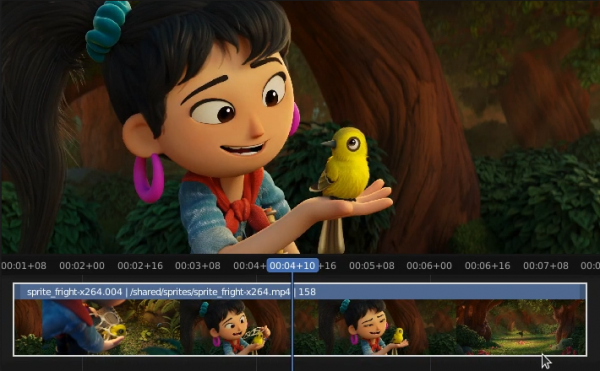
- In the non-linear video editor (Video Sequencer), support for working with image and video tracks has been added, including previewing thumbnails and transforming tracks directly in the preview area, similar to how it is implemented in the 3D viewport. Additionally, the video editor now provides the ability to bind arbitrary colors to tracks and has added a mode for overwriting by placing one track over another.

- The scene inspection capabilities have been expanded with the use of virtual reality headsets, including the ability to visualize controllers and navigate through the scene via teleportation or flying over it. Support for Varjo VR-3 and XR-3 3D headsets has been added.

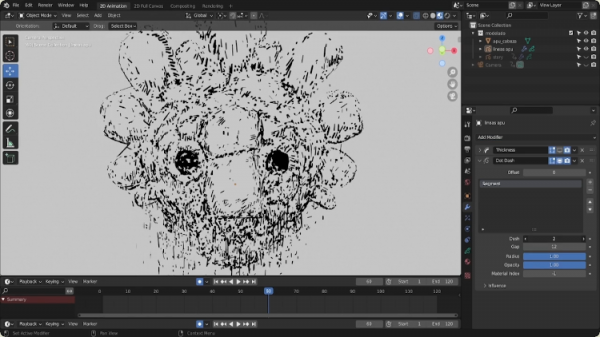
- New modifiers have been added to the Grease Pencil 2D drawing and animation system, allowing users to create sketches in 2D and then use them in a 3D environment as three-dimensional objects (a 3D model is formed based on several flat sketches from different angles). For example, the Dot Dash modifier has been introduced for automatic generation of dashed lines, with options to assign different materials and offsets for each segment. Art line performance has significantly improved. Work has been done to enhance the drawing convenience.
- Loading and saving times for .blend files have been significantly reduced by using the Zstandard compression algorithm instead of gzip.
- Support for importing USD (Universal Scene Description) files, proposed by Pixar, has been added. This includes support for importing meshes, cameras, curves, materials, volume parameters, and lighting. Support for the Alembic format, used for representing 3D scenes, has been expanded.


Source: opennet.ru
