

The Blender Foundation has released version 3.1 of the free 3D modeling package Blender, suitable for various tasks related to 3D modeling, 3D graphics, game development, simulation, rendering, compositing, motion tracking, sculpting, animation creation, and video editing. The code is distributed under the GPL license. Pre-built versions are available for Linux, Windows, and macOS.
Among the enhancements added in Blender 3.1:
- For the Cycles rendering system, a backend for accelerating rendering using the Metal graphics API has been implemented. This backend was developed by Apple to enhance Blender's performance on Apple computers with AMD GPUs or M1 ARM processors.
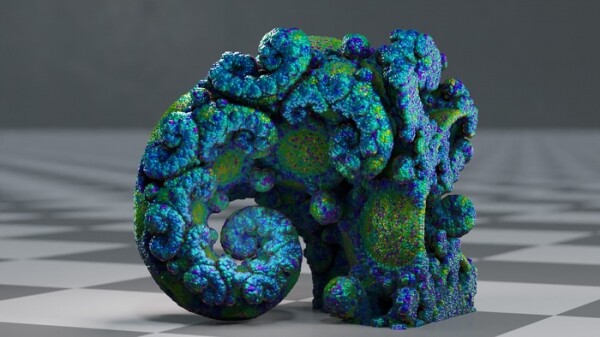
- Direct rendering of the 'Point Cloud' object through the Cycles engine has been implemented to create entities like sand and splashes. Point clouds can be generated with geometry nodes or imported from other software. The memory efficiency of the Cycles rendering system has been significantly improved. A new 'Point Info' node has been added, allowing access to the data of individual points.

- GPU acceleration has been enabled for the Subdivision surface modifier.
- Editing polygonal meshes has been significantly accelerated.
- Indexing in the Asset Browser has been implemented, simplifying the work with various additional objects, materials, and environment blocks.
- The image editor now supports working with very large images (e.g., at 52K resolution).
- Export speeds for .obj and .fbx file formats have increased by several orders of magnitude, thanks to a rewrite of the export code from Python to C++. For instance, if exporting a large project to an Fbx file previously took 20 minutes, export time has now been reduced to 20 seconds.
- Memory consumption in geometry nodes has been reduced (by up to 20%), and multi-threading and node graph calculation support have been improved.
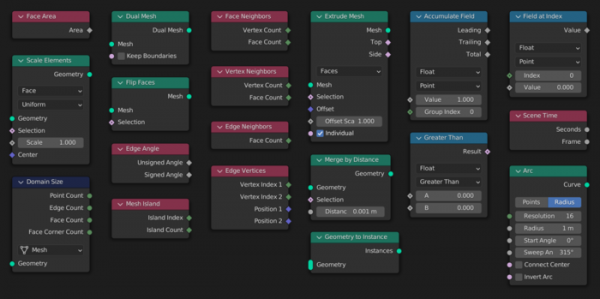
- 19 new nodes have been added for procedural modeling. This includes nodes for extrusion (Extrude), scaling elements (Scale Elements), reading fields from indexes (Field at Index), and accumulating fields (Accumulate Field). New mesh modeling tools have been introduced.

- New tools for animation have been added to the graph editor.
- The user interface has been improved. The option for automatic display of the filtered node list when dragging sockets with the mouse has been provided, allowing visibility of only those socket types to which connections are possible. Instances now support defining custom dynamic attributes. Functionality has been implemented to mark node groups as asset elements, along with drag & drop movement from the asset browser into geometry, shading, and post-processing nodes.
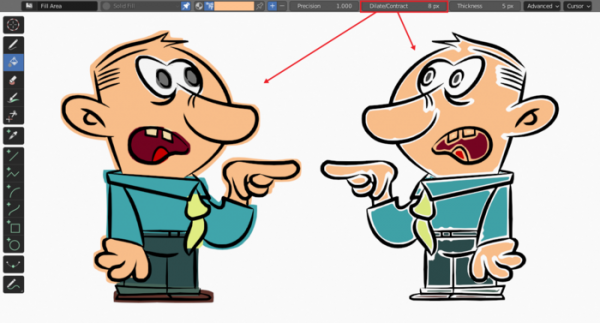
- New modifiers have been added to the 2D drawing and animation system, Grease Pencil, allowing for sketches to be created in 2D and then used in a 3D environment as three-dimensional objects (a 3D model is formed based on several flat sketches from different angles). In the fill tool, negative values are allowed for incomplete filling along the outline to create edge effects.

- The nonlinear video editor capabilities have been expanded. Support for drag & drop movement of data blocks and elements during preview has been added.
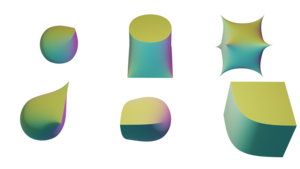
- In the modeling interface, the ability to give individual vertices arbitrary sharpness has been introduced.

- Support for Pixar OpenSubdiv technology has been added for modeling, rendering, and exporting in Alembic and USD formats.
- The Copy Global Transform add-on has been included to bind the transformation of one object to another for coherent animation.
Source: opennet.ru
