

The Blender Foundation has released version 3.5 of the free 3D modeling package Blender, suitable for a variety of tasks related to 3D modeling, 3D graphics, game development, simulation, rendering, compositing, motion tracking, sculpting, animation, and video editing. The code is distributed under the GPL license. Ready builds are available for Linux, Windows, and macOS. A corrective release, Blender 3.3.5, has also been made available in the long-term support (LTS) branch, with updates planned until September 2024.
Among the improvements added in Blender 3.5:
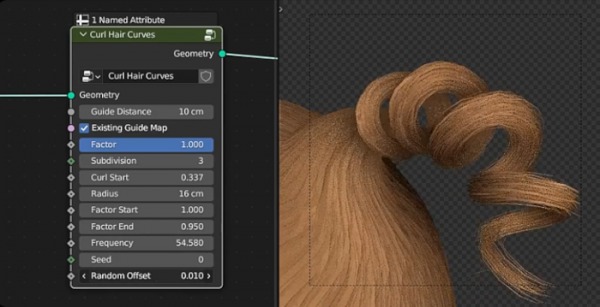
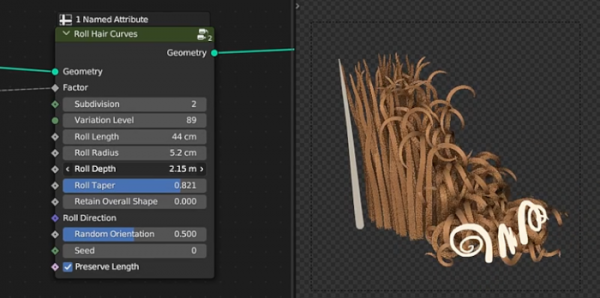
- The capabilities of the hair and hairstyle generation system, based on geometric nodes, have been significantly expanded, allowing the generation of various types of hair, fur, and grass.

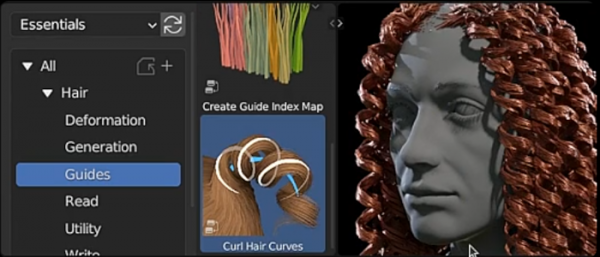
- The first set of built-in assets (attachable elements/node groups) has been accepted. The asset library includes 26 hair operations categorized into: deformation, generation, guides, utilities, and reading/writing.

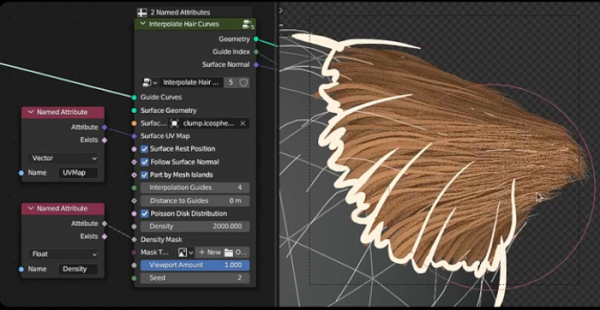
- Generation assets allow for hair curves to be formed in specific locations on the mesh surface, as well as for duplicating hair strands to fill a certain area and using interpolation to change hair bunches.

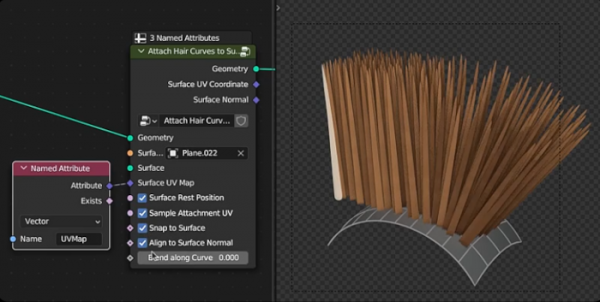
- The 'utilities' group offers tools for attaching curves that define hair strands to the surface. Functionality for binding, aligning, and blending along the curve has been provided.

- The 'guides' group includes tools for linking hair curves together using guides and forming curls or braids by deforming existing hair curves.

- The 'deformation' group contains tools for bending, curling, tangling, shaping, and smoothing hair.

- Assets in the reading and writing groups allow for controlling the shape of hair and highlighting tips, roots, and segments of hair.

- New nodes have been added for extracting information from images, providing access to image files, smoothing attribute values, and interpolating curves. The modifiers interface has been improved and the menu in the node editor has been reorganized. Edge splitting operations in geometric nodes have been accelerated by two times, and clothing simulation performance has been increased by 25%.
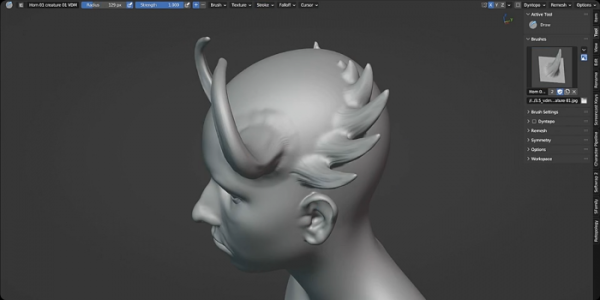
- The sculpting mode now supports VDM (Vector Displacement Maps) brushes, allowing complex shapes with protrusions to be created with a single stroke. VDM brushes can be loaded in the OpenEXR format.

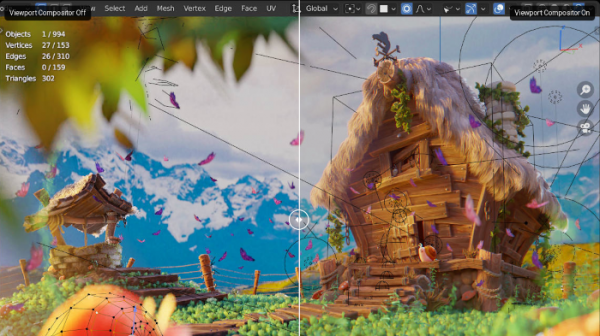
- A new compositing backend has been added, developed as part of the Realtime Compositor project, aimed at enabling interactive work in real-time and utilizing GPU acceleration. The new backend is currently only used in the viewport and supports basic processing, transformation, input and output operations, as well as standard nodes for filtering and blurring. Its application in the viewport allows for continued modeling during compositing, such as working with meshes and other objects that appear over the compositing result.

- On the macOS platform, the Metal graphics API is used for rendering the 3D viewport, which significantly increases animation playback and rendering performance compared to using OpenGL with the EEVEE engine.
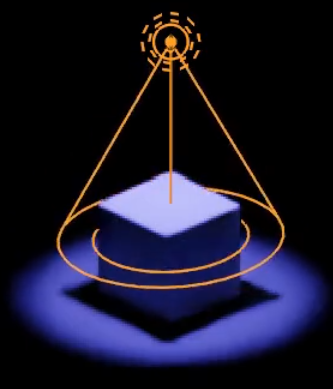
- The Cycles rendering system has implemented a light tree mechanism to enhance the efficiency of processing scenes with a large number of light sources, allowing for noticeable noise reduction without increasing rendering time. Support for OSL (Open Shading Language) has been added when using the OptiX backend. Point light sources now support uneven scaling of objects.

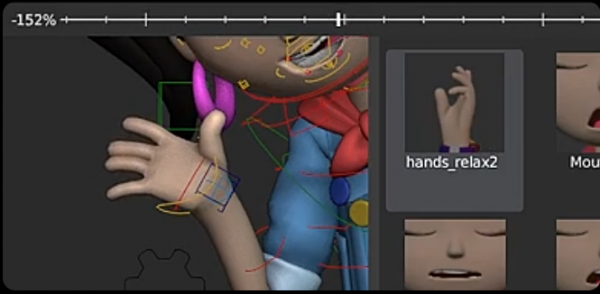
- New options and key combinations have been added to the animation tools to expedite working with the pose library and to go beyond nominal values.

- The capabilities of the Grease Pencil 2D drawing and animation system have been expanded, allowing for sketches to be created in 2D and then used in a 3D environment as three-dimensional objects (a 3D model is formed based on several flat sketches from different angles). A Natural Drawing Speed mode has been added to the Build modifier, which reproduces strokes at the speed of the stylus movement, making them more natural.
- The UV Editor has added support for transferring UV unwrapping via clipboard between meshes.
- Support for importing and exporting in USDZ format (a zip archive containing images, sounds, and USD files) has been added.
- Compatibility with the CY2023 specification, which defines the utilities and libraries of the VFX reference platform, has been ensured.
- The requirements for the Linux environment have been increased: it now requires Glibc version 2.28 or higher (the new requirements are met by Ubuntu 18.10+, Fedora 29+, Debian 10+, RHEL 8+).

Source: opennet.ru
