

The Blender Foundation has released version 4.3 of the free 3D modeling package Blender, suitable for various tasks related to 3D modeling, 3D graphics, game development, simulation, rendering, compositing, motion tracking, sculpting, animation creation, and video editing. The code is distributed under the GPL license. Precompiled builds are available for Linux, Windows, and macOS. Simultaneously, corrective releases Blender 4.2.4 and 3.6.18 have been prepared in long-term support (LTS) branches, with updates planned until July 2026 and June 2025.
Among the added improvements:
- An experimental backend for rendering the interface using the Vulkan graphics API has been proposed. The backend is available for Linux and Windows platforms and can be enabled in the settings sections 'Interface/Developer Extras/Backend', where Vulkan should be selected instead of OpenGL.
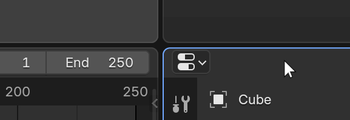
- Changes have been made to the user interface. Support for pinning and unpinning areas has been introduced, allowing the content of interface parts to be moved into separate windows.
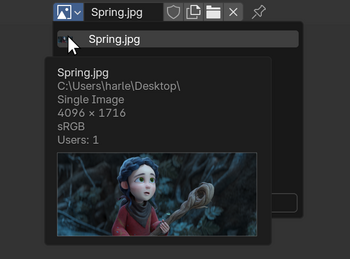
Information displayed in tooltips has been expanded (for example, the resolution and color space of images, duration for videos, and glyph previews for fonts are shown). Themes now include the ability to highlight the area under the mouse cursor.


- The EEVEE rendering engine, which supports physically correct real-time rendering and utilizes the GPU for visualization, has added functionality for light and shadow binding, which was previously only available in the Cycles engine. Light binding allows lighting to be applied only to selected objects in the scene, while shadow binding lets users control which objects can cast shadows.
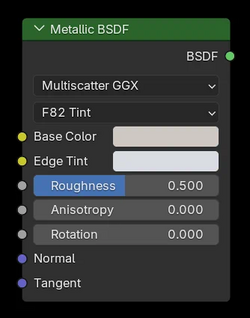
- A new 'Metallic BSDF' node has been added to the shader editor for adjusting metal material parameters.


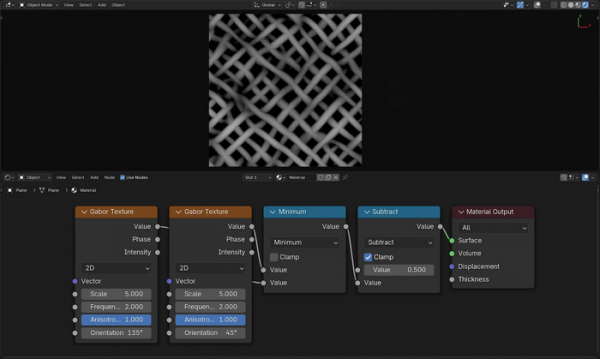
- A new 'Gabor Texture' node has been introduced for creating textures based on the Gabor function, which can emulate various rough surfaces, rocks, and fabrics.

- Support for interactive multi-pass compositing has been added, allowing the creation of complex non-photorealistic (NPR) styles and effects directly in the 3D viewport.
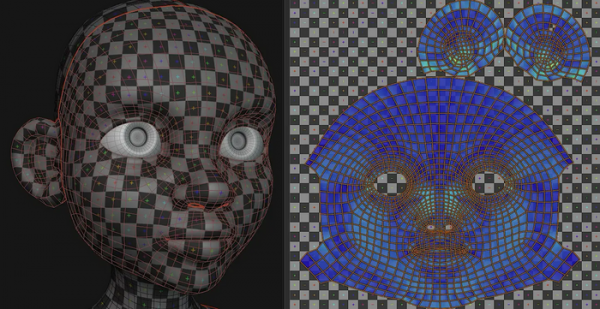
- The UV editor introduces a new UV unwrapping method called 'Minimum Stretch', which reduces distortion when unwrapping organic shapes like characters and animals by iteratively refining the result. This method is based on the SLIM (Scalable Local Injective Mappings) algorithm.

- The capabilities of geometric nodes have been expanded.
- A 'For Each Element' zone has been added, allowing parallel processing of geometry elements; for example, a node can be executed for each face of a polygonal mesh.
- The ability to bind gizmos for manipulation in three-dimensional space with groups of nodes has been implemented, allowing editing of node input parameters without switching from the 3D viewport to the node editor.
- A 'Set Geometry Name' node has been added to simplify the assignment of names to geometric elements, with the option for automatic initialization based on a name collection.
- Support for seamless working with data generated by the Grease Pencil tool has been added, with the ability to split it into layers with curves and attributes. Capabilities for converting Grease Pencil data into curves and vice versa, as well as merging Grease Pencil layers, have been separately proposed.
- A 'Hash Value' node has been added for generating hashes from arbitrary data.
- A 'Math' node has been added for performing mathematical operations on the input integer values.
- A 'Warning' node has been added to facilitate the output of custom warnings during work with groups of nodes.

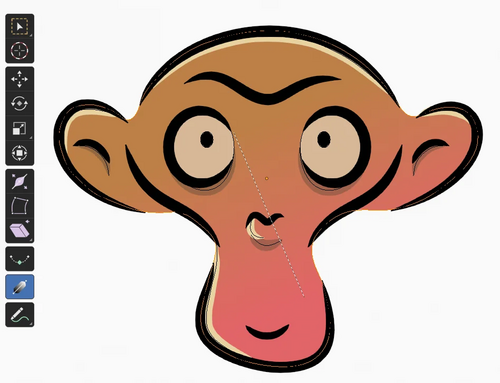
- The engine has been completely rewritten, enabling the two-dimensional drawing and animation system of Grease Pencil, which allows for sketching in 2D and then using those sketches in a 3D environment as three-dimensional objects (a 3D model is formed based on several flat sketches from different angles). The new implementation boasts higher performance and eliminates some limitations. There is now the ability to combine layers into groups and manipulate groups as a single object (for example, you can change the visibility of all layers within a group at once). Support for color tag binding to layers has been added. The 'eraser' tool has been redesigned for smoother cleaning strokes with normalization of the eraser edge intersection with the content being removed. A fill tool using gradients has been added.

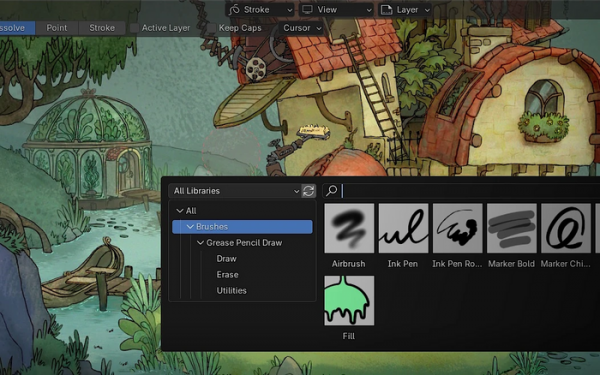
- The brush workflow has been modernized. Blender now includes over a hundred brushes, and each brush is represented as a separate asset, allowing the use of the Asset Browser interface to save brushes, share them across different projects, and create custom libraries.

- The interface of the nonlinear video editor (Video Sequencer) has been improved. A clip binding feature has been added to simplify selecting and transforming clips. In preview mode, binding with alignment to the center, edges of the preview area, or corners of visible clips has been introduced. By default, thumbnails are displayed on clips and in the preview area. Support for precise audio adjustment at the subframe level has been added. Significant performance optimizations have been made; for example, the 'Color Balance' and 'Tone Mapping' features have been accelerated several times, and the time for rendering the timeline and thumbnails has been reduced.
- A significant internal refactoring and optimization of the sculpting mode has been conducted. Switching to sculpting mode has been accelerated by 5 times, while working with brushes has been sped up by 8 times.
- In the Cycles rendering engine for the Linux platform, hardware-accelerated ray tracing has been implemented using the HIP-RT library, which supports AMD and NVIDIA GPUs. The panoramic camera now offers the option of using cylindrical projection.
- Improved support for importing and exporting in glTF format, including support for importing meshes compressed with the Draco library. Added support for exporting point clouds in USD (Universal Scene Description) format.

Source: opennet.ru
