

Google has released web browser Chrome 138. At the same time, a stable release of the free project Chromium, which serves as the foundation for Chrome, is also available. The Chrome browser differs from Chromium by using Google logos, having a crash notification system, modules for playing DRM-protected video content, an automatic update system, always-on sandbox isolation, providing keys to Google APIs, and passing RLZ parameters during searches. For those who need more time to update, an Extended Stable branch is separately maintained for 8 weeks. The next release, Chrome 139, is scheduled for August 5.
Key changes in Chrome 138:
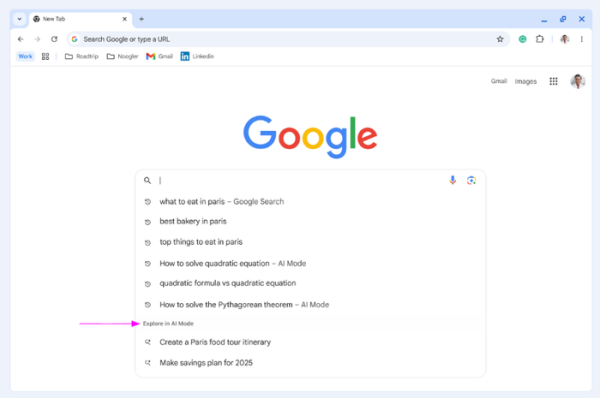
- An AI recommendation mode has been implemented in the address bar and on the new tab page, providing suggestions related to the entered search query.

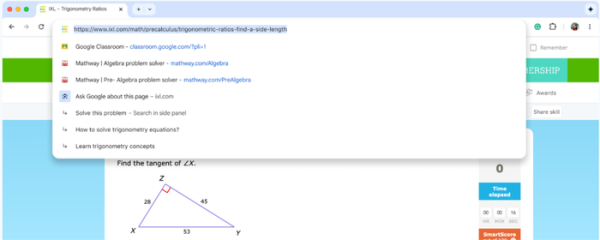
- In the address bar, the contextual recommendation system now allows users to obtain information about a page through Google Lens by asking questions in natural language or pointing at an object on the screen.

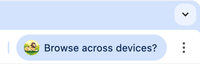
- Some users who have linked their browser to their Google account are offered a new form of synchronization for tabs and browsing history between devices, presented as a prompt message next to the user profile.

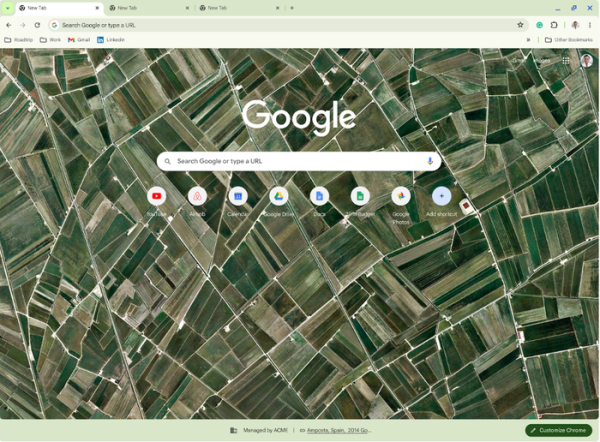
- When using extensions that modify the content of the new tab page, information about the extension that changed the content is now displayed at the bottom of the page.

- Support for tab groups has been added, allowing multiple users to collaboratively work on a set of tabs. A user can create a set of tabs and share it with others, who will see the same tabs on their devices. If any group member changes a tab, the modification will be immediately reflected on other users' devices. Group creation is currently only available to users of beta builds (Beta/Dev/Canary).
- A selective access feature has been provided for certain extensions to the userScript API without needing to activate Developer Mode.
- Support for the TLS 1.3 Early Data mechanism has been implemented, allowing clients to send GET requests before the TLS connection handshake is completed.
- The ability to save bookmarks and reading lists in your Google account has been added.
- A warning for fraudulent pages identified by a large language model through content analysis has been implemented. AI usage is applied in enhanced browsing protection mode (Safe Browsing > Enhanced protection). The AI model runs on the client side, but if suspicious content is detected, additional checks are performed on servers Google.
- Synchronization of extended protection settings (Safe Browsing > Enhanced protection) between browsers on different user devices has been ensured (when enhanced protection is enabled on one device, it will also be activated on other devices linked to the same account).
- An API Translator has been implemented, providing capabilities for translating text from one language to another. An example of use includes integrating translation features into web chat. The AI model Gemini Nano is utilized for translation, executed on the user's local system.
- An API Language Detector has been implemented, allowing the identification of the language of a text fragment.
- An API Summarizer has been implemented for summarizing texts (providing a brief outline of the content) or generating titles and descriptions, using a large language model.
- An API Viewport Segments has been added to organize output on devices with foldable screens.
- In the Android version, the ability to use the Web Serial API for connecting to a serial port over Bluetooth has been added.
- In accordance with changes in the HTML specification aimed at protecting against XSS attacks, character escaping for '' during HTML element attribute serialization has been included. The methods Element.innerHTML, Element.outerHTML, Element.getHTML, ShadowRoot.innerHTML, and ShadowRoot.getHTML will now replace the characters '<' and '>' with '<' and '>' during HTML serialization to string.
- New CSS functions abs() and sign() have been added for determining the absolute value and sign of a number; progress() for calculating an intermediate value between two other values; sibling-index() and sibling-count() for styling elements based on the position or number of neighboring elements.
- The CSS has introduced the keyword "stretch," allowing elements to expand until they fully fill the available space of the block.
- The web development tools have enhanced performance analysis capabilities. Debugging complex CSS values has been simplified. When inspecting network activity, filtering based on specific HTTP headers is now possible. For regular users, an AI assistant has been included, capable of explaining the nature of errors and warnings shown in the web console, along with providing recommendations for their resolution.
- In the Chromium project build system, the transition has been made from the Ninja toolchain to the Siso build system, which can serve as a transparent replacement for Ninja, supporting remote build execution. Siso includes several optimizations to reduce build time and memory consumption, such as minimizing disk and network operations, and memory sharing. The system also supports collecting detailed performance metrics for profiling the build process.
In addition to new features and bug fixes, the new version has addressed 11 vulnerabilities. Many of these vulnerabilities were identified through automated testing using tools like AddressSanitizer, MemorySanitizer, Control Flow Integrity, LibFuzzer, and AFL. No critical issues have been discovered that would allow bypassing all browser security layers and executing code on the system outside of the sandbox environment. As part of the bug bounty program for this release, Google has awarded three prizes totaling $6,000 (one prize of $1,000 and one prize of $4,000).
Source: opennet.ru
