

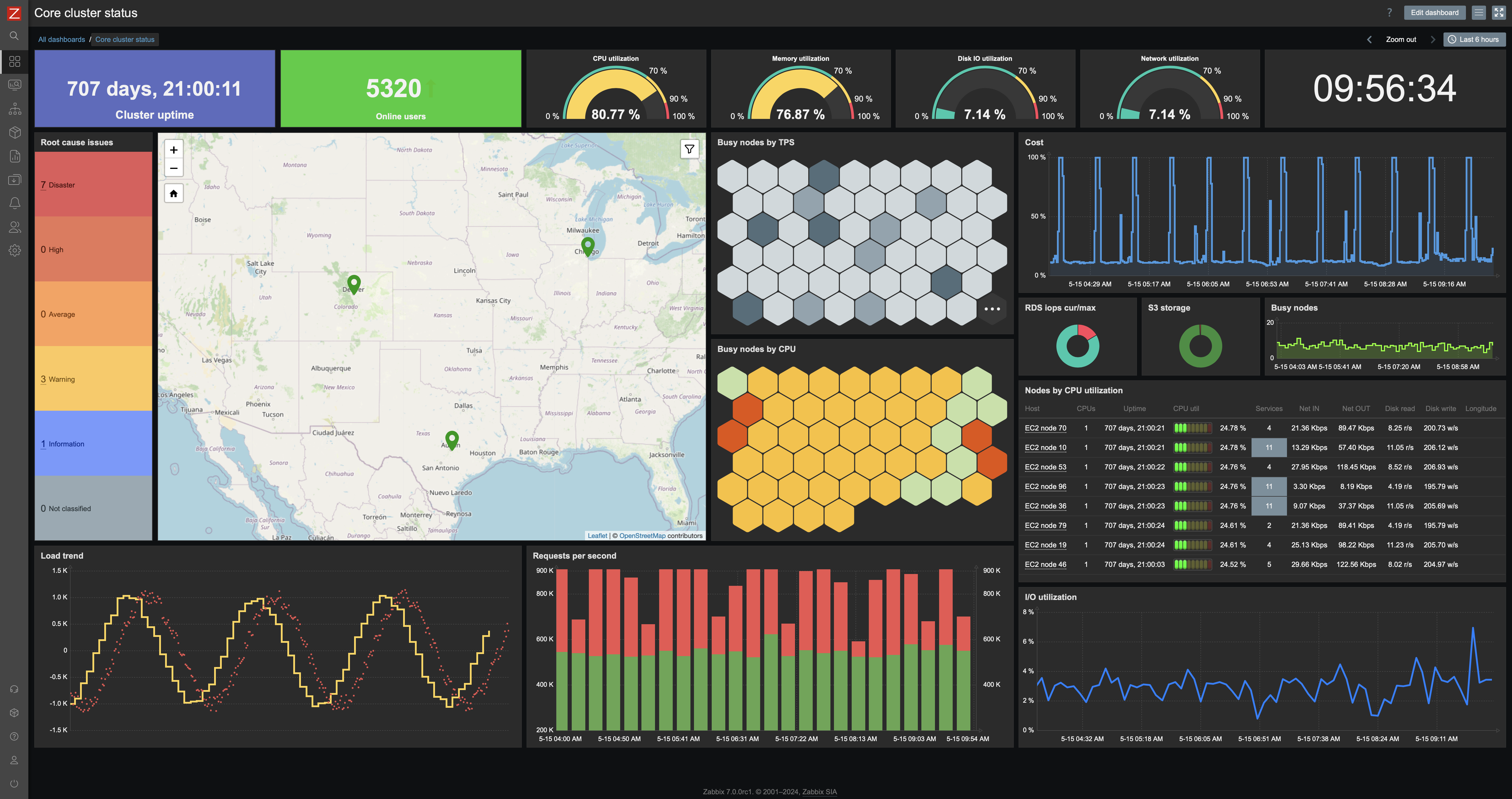
Took place release of the free and open-source monitoring system Zabbix 7.0 LTS. Version 7.0 is classified as a Long-Term Support (LTS) release. Users running non-LTS versions are advised to upgrade to the LTS versions of the product.
Zabbix is a versatile system for monitoring the performance and availability of servers, services, engineering and network equipment, applications, databases, virtualization systems, containers, IT services, web services, cloud infrastructure, and IoT devices.
The system implements a full cycle from data collection, processing and transformation, to analysis of this data for predicting and detecting issues, and finally, storing this data, visualizing it, and sending alerts using escalation rules. The system also provides flexible capabilities for expanding data collection methods, alerts, visualization tools, and automatic incident resolution. A unified web interface and powerful API facilitate automation and centralized management of monitoring configurations and role-based access rights for different user groups. The project code is distributed is licensed under AGPLv3.
Key improvements version 7.0 LTS:
- support for new widgets such as 'Host navigator', 'Honeycomb', 'Pie chart', 'Gauge', 'Top triggers', 'Item history';
- maximal speed in executing actions and scripts without delays;
- support for native multi-factor user authentication;
- centralized management of timeouts at the check, host, proxy, and global levels;
- support for storing metrics in memory for maximum efficiency and performance of proxies;
- support for synthetic monitoring of web applications using complex scripts;
- significant expansion of DNS monitoring;
- sending automatically generated PDF reports (previously classified as experimental);
- support for streaming to send metrics and events to external systems (previously classified as experimental);
- the ability to suspend data collection from lost items during auto-discovery;
- support for tags for webhooks for internal events;
- rapid instant response to switching monitoring items to maintenance;
- significant improvement in performance for access checks to monitoring elements;
- detection of duplicate engineIDs for SNMP monitoring;
- support for aggregated values for many widgets, allowing the creation of capacity reports;
- the ability to use user input when executing scripts;
- enhancement of the communication protocol between all components of Zabbix;
- the long-awaited support for custom macros in item names has returned;
- support for connection attempt quantities and data type filters for connectors;
- validation of configuration file correctness;
- support for macro functions for all built-in macros;
- most forms have been converted to modal;
- support for multi-page dashboards for PDF reports;
- numerous usability improvements;
- support for the history.push method;
- numerous improvements to existing widgets;
- all widgets can be used for host templates;
- expanded agent data collection capabilities, support for new checks;
- ability to execute scripts on active agents;
- support for binary data types;
- support for dynamic dashboards with navigation through monitoring elements;
- support for new trigger functions;
- ability to manage tags of discovered hosts.
Improved performance and reliability due to:
- support for proxy clusters for load balancing and reliability;
- transition to an asynchronous data collection model for agent, HTTP, and SNMP checks and auto-discovery;
- high-performance asynchronous auto-discovery.
Other significant improvements:
- significant acceleration of data processing from Prometheus;
- support for jsonpath and xmlpath trigger functions;
- ability to use discovered host groups across various auto-discovery rules;
- ability to disable audit logging for system events.
New and improved existing templates and integrations: Cisco Meraki, FortiGate, HPE, Oracle, Azure and Azure Cost Management, GCP, AWS and AWS Cost Explorer, AWS ECS, Check Point, MSSQL, Oracle Cloud, Kubernetes, YugabyteDB, MongoDB, VMWare, Prometheus, PostgreSQL, Nextcloud, Acronis Cyber Protect Cloud, HashiCorp Nomad, MantisBT, Cisco SD-WAN, Windows.
Zabbix offers integration with:
- support service platforms Jira, Jira Service Desk, Redmine, ServiceNow, Zendesk, OTRS, Zammad, Solarwinds Service Desk, TOPdesk, SysAid, iTOP, ManageEngine Service Desk;
- user notification systems Slack, Pushover, Discord, Telegram, VictorOps, Microsoft Teams, SINGNL4, Mattermost, OpsGenie, PagerDuty, iLert, Signal, Express.ms, Rocket.Chat;
- a complete list of more than 500 templates and integrations.
Official packages are for the latest versions of the following platforms:
- Linux distributions Alma Linux, CentOS, Debian, OpenSUSE, Oracle Linux, Raspberry Pi OS, RedHat Enterprise Linux, Rocky Linux, SUSE Linux Enterprise Server, Ubuntu for various architectures;
- virtualization systems based on VMWare, VirtualBox, Hyper-V, XEN;
- Docker;
- OpenStack Nova;
- agents for all platforms including MacOS and MSI packages for Windows agents.
A quick installation of Zabbix is available for cloud platforms: AWS, Azure, Google Cloud, Digital Ocean, IBM/RedHat Cloud, Oracle Cloud, Yandex Cloud.
To upgrade from earlier versions, only the installation of new binary files (server and proxy) and a new interface is required. Zabbix will automatically carry out the upgrade procedure. No new agents need to be installed.
Source: linux.org.ru
