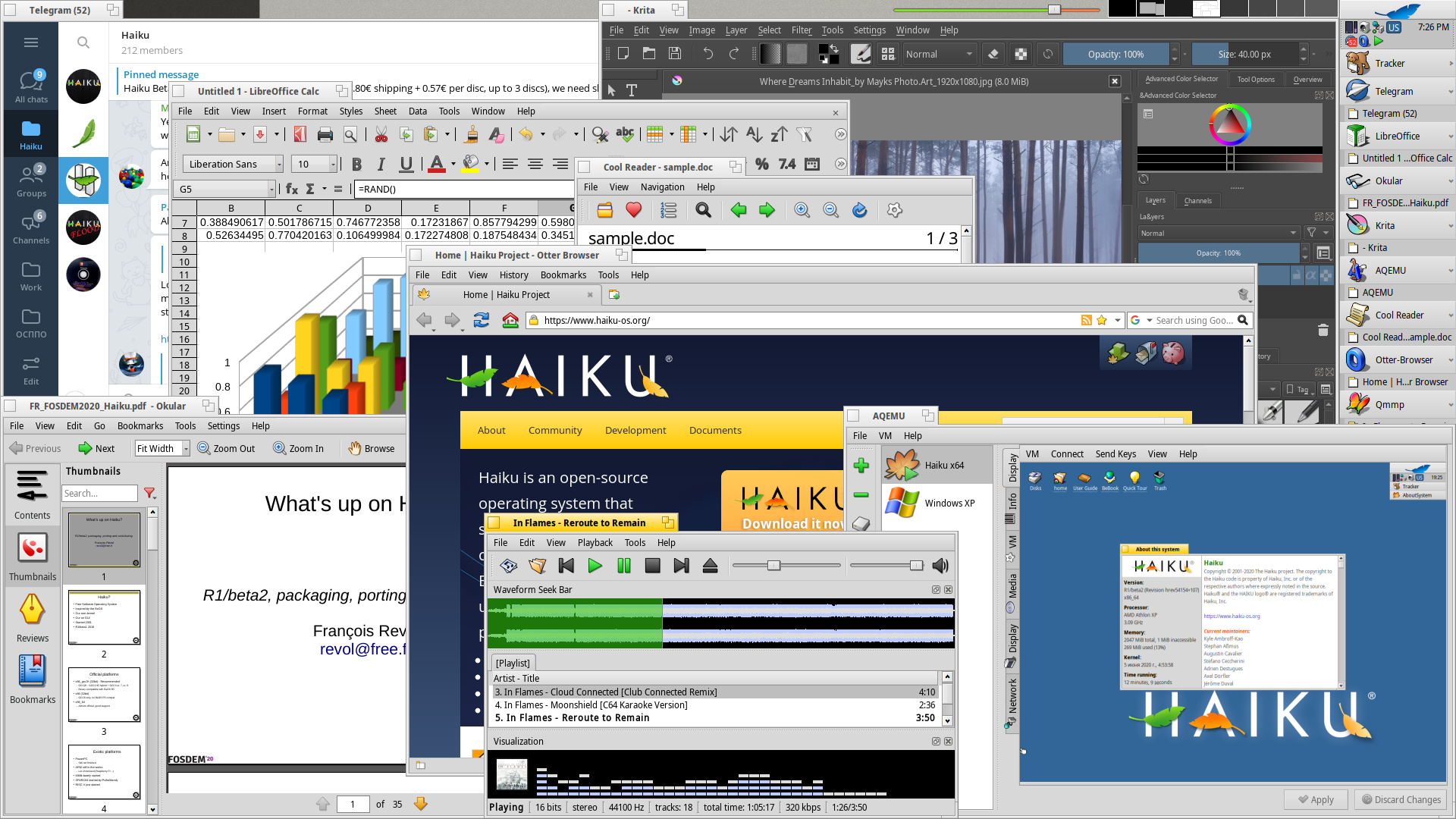
Published second beta release of the operating system Haiku R1.
Originally, the project was created in response to the closure of the BeOS OS and was developed under the name OpenBeOS, but was renamed in 2004 due to trademark claims related to the name BeOS. To assess the performance of the new release several bootable Live images (x86, x86-64) have been prepared. The source code for most of the Haiku OS is distributed under a free license the MIT license, with the exception of some libraries, media codecs, and components borrowed from other projects. Haiku OS is aimed at personal computers, using its own kernel based on a modular architecture, optimized for high responsiveness to user actions and efficient execution of multi-threaded applications. An object-oriented API is provided for developers. The system is directly based on BeOS 5 technologies and targets binary compatibility with applications for that OS.
Minimum hardware requirements: CPU Pentium II and 256 MB of RAM (Intel Core i3 and 2 GB of RAM recommended).
The OpenBFS file system is used, supporting extended file attributes, journaling, 64-bit pointers, support for storing meta-tags (attributes for each file can be saved in key=value form, making the FS similar to a database) and special indexes for speeding up queries on them. B+-trees are used to organize the directory structure. The Tracker file manager and the Deskbar panel from BeOS have been integrated into Haiku, with their source codes released after BeOS's departure from the scene. Over nearly two years since the last update, 101 developers have contributed to Haiku, preparing more than 2800 changes and closing 900 bug reports and feature requests.
Key innovations:
-
Support for NVMe drives has been implemented, allowing them to be used as bootable media.
Support for USB3 (XHCI) has been expanded and stabilized. Booting from USB3 devices has been established and proper operation with input devices has been ensured.
A bootloader for UEFI systems has been added.
Work has been done to stabilize and improve kernel performance. Many bugs that caused freezes or crashes have been fixed.
The network driver code has been imported from FreeBSD 12.
Original article here.
Release notes in English here.
P.S.: Do you have questions? We invite you to join our Russian-speaking telegram channel.
Source: linux.org.ru