

Once, the company Parallels decided to accommodate those employees who had long been with the company and did not want to change it, but wanted to change their residence to be closer to the West, have an EU passport, and be more mobile and independent in their movements.
This gave rise to the idea of expanding its geographical presence and opening a Parallels R&D center in Estonia.
Why Estonia?
Initially, different options were considered, not far from Moscow: Germany, the Czech Republic, Poland, and Estonia. The advantage of Estonia was that nearly half of the country speaks Russian and you can reach Moscow on any night train. Additionally, Estonia has a very advanced model of e-government, significantly simplifying all organizational aspects, and there is genuine work being done to attract investors, startups, and other promising projects.
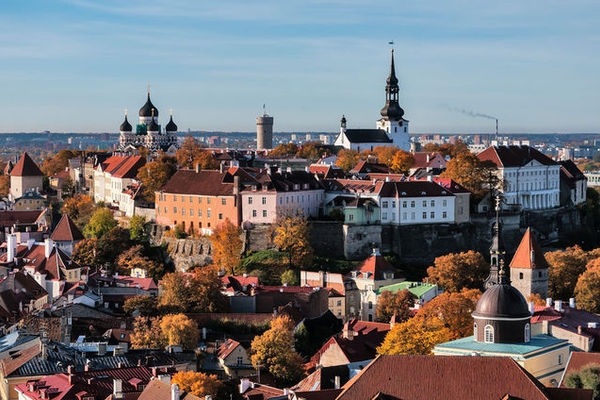
So, the choice was made. Now, let’s hear about the relocation to Tallinn from our employees who share what expectations were met, which were not, and what unexpected challenges they had to face.
Alexander Vinogradov, Cloud Team Frontend Developer:
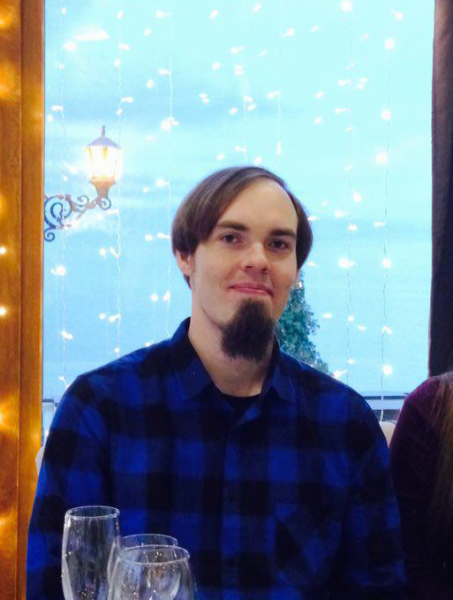
I moved alone, without a car, without pets — the simplest case for relocation. Everything went very smoothly. Perhaps the hardest part was the dismissal process from the Moscow office – a lot of paperwork had to be signed 🙂 When arranging documents and searching for housing in Tallinn, our company's local relocation agency was very helpful, so all I needed to do was have my documents in hand and be at the right place at the right time to meet with the relocation manager. The only surprise I encountered was at the bank, where they requested a bit more documentation than had previously been required. But the team quickly adapted, and after a short wait, I had all the necessary documents and a residence permit in hand.
I can't recall encountering any difficulties during the entire relocation process. Maybe there were some, but I guess I haven’t realized that they were difficulties yet.)
What pleasantly surprised me? First and foremost, the quietness around me. It was so quiet that at first I couldn't sleep because of the ringing in my ears. I live in the very center, but the tram ride to the airport takes only 10-15 minutes, and it's a 10-minute walk to the port and bus station – all trips across Europe have become much easier and faster. Sometimes, you don't even realize how far you were on your trip, because right after the plane or ferry, you find yourself back in your apartment almost immediately.
The main difference between Moscow and Tallinn is the pace of life and the atmosphere. Moscow is a huge metropolis, while Tallinn is a quiet European city. In Moscow, you often arrive at work tired from the long commute and crowded public transport. In Tallinn, my journey from home to work takes about 10-15 minutes in a half-empty bus — 'from door to door.'
I wouldn't say I suffered much from stress in Moscow, but if it's possible to live without it, why not? Moreover, there are the advantages I mentioned earlier. I suspected it would be somewhat like this, but I never imagined it would be this good. Another work-related aspect is that I became closer to the people I worked closely with back in the Moscow office, though there was a much greater distance before; now the process of collaboration has significantly improved, which I am very pleased about.
A few small tips: when searching for housing, pay attention to its condition — in older buildings, you can unexpectedly encounter very high utility costs. It takes about a month to get a local bank card, and this is not an advertisement — the Tinkoff card simplified my life. I was able to pay with it and withdraw cash without any fee during this month.
Everything described above is just my personal opinion. Come and form your own.
Sergey Malykhyn, Program Manager
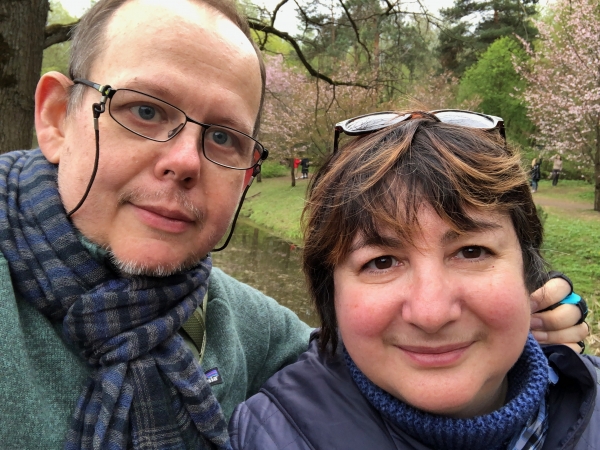
The move itself happened relatively easily.
Moreover, it was largely thanks to the support provided by the company.
A very wise move by Parallels was to hire relocation specialists in Estonia — Move My Talent — who greatly assisted us in the early days: they provided necessary information, conducted workshops for us and our family members, delivered lectures on Estonia, Estonians, local mentality, culture, local laws and official procedures, and the peculiarities of different districts in Tallinn; they accompanied us to official places and helped with paperwork, took us to view rental apartments.
In Moscow, the HR staff at Parallels handled almost all the paperwork (work visa for Estonia, medical insurance, etc.).
We didn't even have to go to the embassy — they simply took our passports and returned them a couple of days later with six-month work visas.
All that was left for us was to make a final decision, pack our things, and go.
Perhaps making the decision was the hardest part.
In fact, at first, I didn't even want to go, because by nature I'm quite a conservative person, not fond of sudden changes.
I hesitated for a long time, but ultimately decided to approach it as an experiment and an opportunity to shake up my life a bit.
In this regard, I saw the main advantage as the opportunity to break free from the frantic pace of life in Moscow and switch to a more measured pace.
Of the things that were difficult and surprising — unpleasantly surprising was the dreadful quality of local healthcare. The equipment, bought with European grants, is often quite good. But there is a shortage of specialized doctors. Sometimes, an appointment with a specialist covered by the local health fund (the Estonian version of compulsory health insurance) can take 3-4 months. And sometimes, appointments with private specialists have to be waited for for months. Good specialists tend to seek work in Western European countries (mainly in neighboring Finland and Sweden). Only older (in age) or mediocre (in qualifications) doctors remain. Meanwhile, paid medical services are quite expensive. Healthcare in Moscow seems to me significantly higher in quality and more accessible.
Another issue for me has been the uniqueness and slowness of local services: from online shops to car repair shops, kitchen manufacturing companies, furniture sales, and so on.
Overall, they are at the level that existed in Moscow in the early 2000s. When comparing the service level in Moscow or St. Petersburg now (even considering all known shortcomings of the latter) – the comparison will clearly not favor Estonia.
Here's an example: I needed to repair the headlights on my car.
I reached out to the local Opel dealership, explained that I wanted to schedule a diagnostics and headlight repair, and also perform a routine maintenance check.
I dropped off the car. Not getting a call by the end of the working day, I called them back just before closing — they said: 'zapirrra, gоttoffo'.
I arrive. I review the invoice — there’s only the amount for the engine oil change. I ask: 'What about the headlights?' The response: 'Headlights? Ah… oh, right! Headlights... not working!' Ugh. And this is almost everywhere. However, the situation is gradually improving. It’s now better than it was four years ago.
One pleasant impression is that I really like that Estonia is a small country and Tallinn is a relatively small city with a calm/slow pace of life, without traffic jams. Locals might argue with me (they consider Tallinn a city with a hectic pace), but compared to Moscow — the difference is very noticeable.
Much less time is spent traveling around the city. Here in Tallinn, in an hour, you can accomplish three times more than in an entire day in Moscow. In Moscow, I sometimes spent up to 5 hours just to drive to the office in the morning and return in the evening. On the best days — 3 hours of pure driving time or 2 hours using public transport. In Tallinn, we reach from home to the office in 10-15 minutes. From one remote end of the city to the other, you can drive in a maximum of 30-35 minutes by car or about 40 minutes by public transport. As a result, each of us has gained a lot of free time that was previously spent on commuting in Moscow.
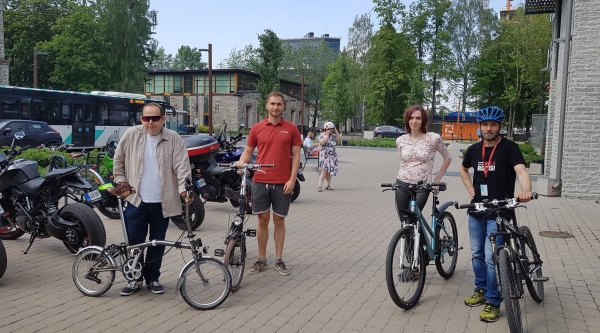
I was surprised to find that one can live fairly well in Estonia without knowing Estonian. In Tallinn, about 40% of the residents are Russian-speaking. Recently, their numbers have significantly increased due to immigration from Russia, Ukraine, Belarus, and Kazakhstan. The older generation of Estonians (40+) still remembers the Russian language for the most part (from the Soviet era).
Most young people do not understand Russian, but they communicate quite adequately in English. Therefore, you can always find a way to communicate. However, sometimes you have to do it through sign language when the person you are talking to doesn't speak either Russian or English — this mostly happens when you encounter people without higher education. We live in the Lasnamäe area (locals often call it Lasnogorsk) — this is a Tallinn district where a compact and large number of Russian-speaking residents live. It's somewhat like a 'Little Odessa' on Brighton Beach. Many residents 'don't go to Estonia' 🙂 and deliberately do not speak Estonian. Unfortunately, this is one of the problems: if you wish to study Estonian, say, to obtain a permanent residence permit in five years or to change your citizenship — unfortunately, you won't find an Estonian-speaking environment that would motivate you to learn and use the Estonian language here. Meanwhile, the Estonian part of society is quite closed off and does not strive to include Russian speakers in their circle.
I was pleasantly surprised by the free public transport, which is also not very crowded (since there aren't many people in Estonia overall) — the total population of the country is about 1.2 million. Locals, however, actively criticize their public transport, but it runs very reliably; most buses are new and quite comfortable, and they are indeed free for local residents.
I was also pleasantly surprised by the quality of dairy products and local black bread. The local milk, sour cream, and cottage cheese are really delicious, and the quality is significantly better than back home. The black bread is also very tasty — in the four and a half years we've been here, we've probably not tried all the available varieties yet 🙂.
The local forests and wetlands are delightful, and in general, the ecology is good. Most wetlands have special educational trails: wooden walkways that allow for walking (sometimes wide enough for a stroller). The wetlands are very beautiful. Generally, 4G internet is available almost everywhere (even in the wetland center). Many educational trails have poles with QR codes that can be scanned to download interesting information about the local flora and fauna. Almost all parks and forests feature special 'health trails'—equipped and illuminated routes for walking, running, and cycling in the evenings. In most cases, well-equipped access roads to the forests with free parking lots and barbecue spots can always be found. In summer, there are a lot of berries in the forests, and in autumn, plenty of mushrooms. Estonia is rich in forests, and with relatively few people around, nature's gifts are abundant for everyone 🙂
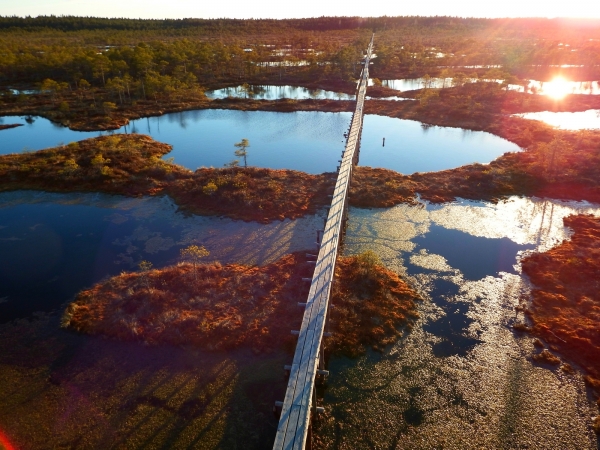
Estonia offers many opportunities for sports activities: whether you want to walk or run in the forests and along the coast, ride a bike or rollerblade, engage in windsurfing or yachting, or practice Nordic walking with poles, you have plenty of options without anyone breathing down your neck (because there are not many people), and there are plenty of equipped places. If space in Estonia is lacking, you can always travel to neighboring Latvia or Finland 🙂
It was also surprising that Estonians, known in Russia for their reputation as slow individuals, are not at all as they are typically depicted in jokes. They are not slow at all! They only speak slowly in Russian (if you are lucky enough to find someone who speaks Russian), and that is because Estonian is vastly different from Russian, making it difficult for them to speak it.
Life hacks for those wanting to move to Estonia
First of all, realize what exactly you are looking for / what you aim to achieve by moving to a new place, and try to understand whether your move will help you reach your goal or complicate things instead. It’s better to spend time reflecting on this in advance than to fall into depression after moving when you find out that expectations do not meet reality.
For some, the slower pace of life, compactness, and smaller population outside of Moscow may seem like a disadvantage rather than an advantage, leading to perceptions of boredom and a lack of excitement (an experience noted by some colleagues).
Make sure to plan in advance with your partner what you will do in Estonia. This is essential to prevent potential feelings of loneliness and depression. It’s worth mentioning that the social scene has significantly improved recently. The Women Programmers Club has emerged — a Russian-speaking expat community made up of the wives/girlfriends of those working in IT/Software in Estonia. They have their own Telegram channel for casual communication, advice, or assistance. Additionally, they regularly meet in Tallinn cafes, host parties, and visit each other's homes. The club is exclusively female: men are strictly prohibited (they are kicked out within 5 minutes). Many incoming women, upon hearing about it, begin networking and gathering valuable information on relocating and adapting even before they leave home. It would be helpful for your wife/girlfriend to chat in the Women Programmers Club ahead of time; trust me — it’s an invaluable source of advice and information.
If you have children moving with you, or if you plan to have a baby shortly after relocating, talk to people living here with small children. There are many nuances involved. Unfortunately, I can't share useful life hacks on this topic as my daughter was already grown and stayed in Moscow by the time we relocated.
If you're driving and planning to bring your car with you, you don't have to worry too much about registering it here: you can legally drive with Russian plates (many do just that). However, registering the car isn’t overly complicated. After one year of permanent residency, you'll need to change your driver's license; this is also straightforward, but keep in mind that you must surrender your Russian license to the Estonian police (though you can request a duplicate in Russia afterward).
Overall, having your own car in Estonia is not really necessary, as it is very convenient to get around the city using free public transport or taxis (which can sometimes be cheaper than petrol plus paid parking in certain areas, especially in the center). If you need a car, it’s quite easy to rent one for a period; however, unfortunately, services like car-sharing have not gained traction in Estonia (there are too few people). So think carefully about whether it's worth coming here with a car or perhaps better to sell it back home before leaving. At the same time, some people do travel to Russia only by car. If you plan to do so, it's definitely better to have your own car, especially with Russian plates, as entering Russia with Estonian plates can be quite a hassle.
Make sure to consider how you'll spend the large amount of free time you suddenly have: you'll definitely need some hobby—sports, drawing, dancing, raising children, anything. Otherwise, you might go a little crazy (there are bars and nightclubs here, but their number is limited and you'll likely get tired of them fairly quickly).
If you’re unsure whether this is for you, come visit our Tallinn office, take a look for yourself, and ask colleagues questions before making a decision. When the company planned to open an office here, we were organized an introductory trip for 4 days. In fact, I made my final decision to relocate after that.
Source: habr.com
