

As already noted, the next major update of the Windows 10 operating system, known as 19H2 or 1909, will begin rolling out to users next week. Overall, it is believed that this update will not bring significant changes to the operating system and will serve as a sort of regular service pack. However, for enthusiasts, it might prove to be much more important and significant, as the expected improvements in the OS scheduler's algorithms could boost the single-threaded performance of some modern processors by up to 15%.
This pertains to the fact that the Windows 10 scheduler is set to learn how to recognize so-called "favored cores"—the best processor cores that possess the highest frequency potential. It is no secret that in modern multi-core processors, the cores exhibit uneven frequency characteristics: some overclock better, while others do so poorly. For quite some time, manufacturers have been marking the best cores that can reliably operate at a higher clock frequency compared to the other cores of the same processor. Prioritizing workloads on those cores can lead to higher performance. This concept underpins technologies like Intel Turbo Boost 3.0, which is currently implemented through a special driver.
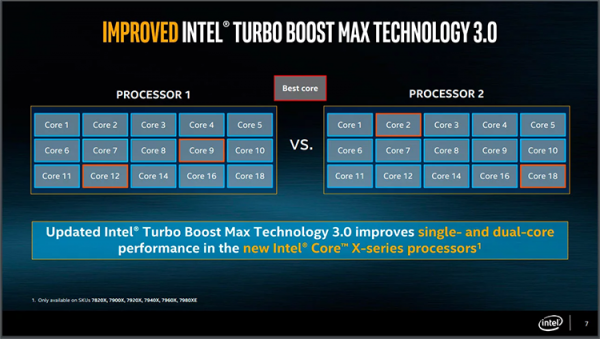
Now, however, the operating system's scheduler will be able to recognize the differences in the quality of processor cores, allowing it to allocate workloads such that cores with better frequency potential are engaged first. In an official Windows blog regarding this matter, it states: "CPUs can have multiple favored cores (logical processors of the highest available scheduling classes). To ensure better performance and reliability, we have implemented a rotation policy that distributes work more fairly among these privileged cores."
As a result, under low-thread loads, the processor will be able to operate at higher clock frequencies, providing an additional performance advantage. According to Intel, the right core selection in single-threaded scenarios can deliver a performance increase of up to 15%.
Currently, Turbo Boost 3.0 technology and the allocation of special 'lucky' cores within the CPU have been implemented in Intel's chips for the HEDT segment. However, with the emergence of the 10th generation Core processors, this technology is expected to enter the mainstream segment, making the addition of its support by standard operating system tools a logical step by Microsoft.
It is worth noting that the core ranking by the scheduler can also positively impact the performance of third-generation Ryzen processors. AMD, like Intel, marks its fortunate cores, which can achieve higher frequencies. With the release of the 19H2 update, the operating system is likely to prioritize loading these cores first, thereby achieving better performance, similar to Intel processors.
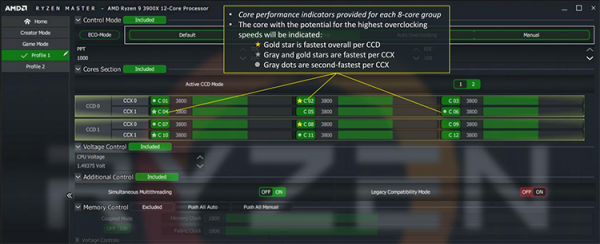
AMD has also commented on scheduler optimizations for Ryzen processors regarding the previous Windows 10 update version 1903. However, at that time, it was about the difference between cores belonging to different CCX modules. Therefore, performance improvements with the release of update 1909 can be expected by owners of AMD-based processors.
Source: 3dnews.ru
