

In early December 2018, Jarkko Sakkinen from Intel discussed the issue of cleaning the Linux kernel codebase of offensive language. He prepared 15 patches that replace the words “f*ck,” “f*cked,” and “f*cking” with “hug,” “hugged,” and “hugging,” respectively. This had By the way, many specialists opposed this initiative. They noted that such a change might render some specific jokes incomprehensible. However, there were also those who proposed much more radical regulations. Kees Cook, the former chief system administrator of kernel.org and leader of the Ubuntu Security Team, stated that the aforementioned curses should be replaced with “heck,” “hecked,” and “hecking,” and that comments should be edited accordingly.

To be fair, some programmers really do find it unpleasant to read comments with profanity; however, attempts to replace one word with another or force rewrites of comments are hardly optimal solutions.
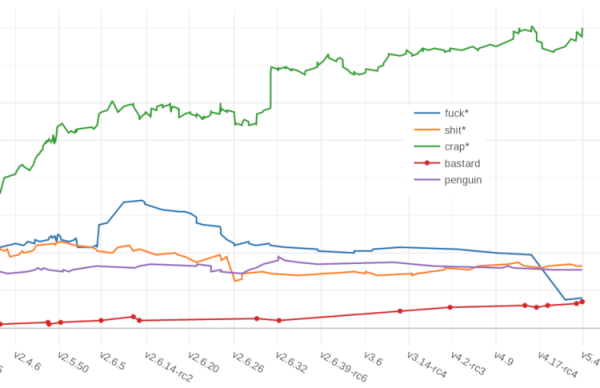
This data was obtained by analyzing the source texts of the Linux kernel. Currently, there are
about 4,000 comments labeled “TODO.” This indicates various shortcomings, planned future changes, plans, and “workarounds.” Recently, their number has been continuously rising, although a small decrease was noted in the early builds of the fifth version of the kernel. If developers start spending time fixing profanity in comments, it could significantly slow down the development process. 🥇 The kernel of high culture: Linux developers have started using fewer profanities in code comments | ProHoster
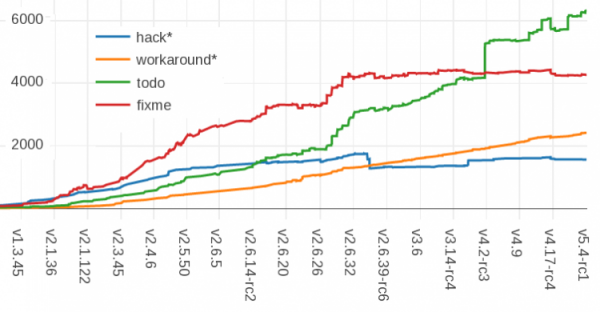
Source: 3dnews.ru
