

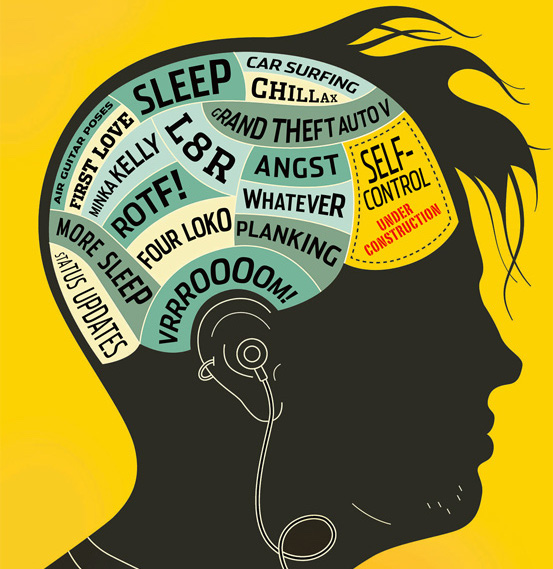
One of the most mysterious and not fully understood "phenomena" is the human brain. Surrounding this complex organ are numerous questions: why do we dream, how do emotions influence decision-making, which nerve cells are responsible for perceiving light and sound, why do some like sprats while others adore olives? All these questions pertain to the brain, as it is the central processor of the human body. For many years, scientists have paid special attention to the brains of people who somehow stand out from the crowd (from self-taught geniuses to calculating psychopaths). But there is a category of individuals whose unusual behavior is linked to their age - adolescents. Many adolescents possess an acute sense of contradiction, a spirit of adventure, and an irresistible desire to seek thrills. Researchers from the University of Pennsylvania decided to take a closer look at the mysterious brains of teenagers and the processes occurring within them. What they discovered is outlined in their report. Let's delve in.
The foundation of the research
Any device in technology and organ in the body has its own architecture that allows it to function effectively. The cortex of the human brain is organized in a functional hierarchy, starting from unimodal sensory cortex* and ending with transmodal associative cortex*.
The sensory cortex of the brain* is the part of the cerebral cortex responsible for gathering and processing information received from the sensory organs (eyes, tongue, nose, ears, skin, and vestibular system).
The associative cortex* is a part of the parietal cortex of the brain, involved in the execution of planned movements. When we intend to perform a movement, our brain must know where the body and its parts that will be moving are located at that moment, as well as where the external environment objects that we plan to interact with are situated. For example, if you want to pick up a cup, your brain already knows where the hand and the cup are located.
This functional hierarchy is determined by the anatomy of the pathways white matter*, which coordinate synchronized neuronal activity and cognition*.
White matter* If gray matter is composed of neurons, then white matter is made up of myelinated axons, through which impulses are transmitted from the cell body to other cells and organs.
Cognition* (cognition) — a set of processes associated with acquiring new knowledge about the surrounding world.
The evolution of the cerebral cortex in primates and the development of the human brain are characterized by targeted expansion and remodeling of transmodal associative areas, which are the basis for processes of sensory representation of information and abstract rules for achieving goals.
The process of brain development takes a significant amount of time, during which many processes of enhancing the brain as a system occur: Myelination*, Synaptic pruning* etc.
Myelination* — oligodendrocytes (a type of supporting cell in the nervous system) wrap around a specific part of the axon, as a result of which one oligodendrocyte connects to several neurons at once. The more active the axon, the stronger its myelination, as this increases its efficiency.
Synaptic pruning* — the reduction of the number of synapses/neuron connections to enhance the efficiency of the neural system, i.e., getting rid of unnecessary connections. In other words, it is the implementation of the principle of ‘quality over quantity.’
During the formation of the brain, a functional specification is established in the transmodal associative cortex, which directly influences the development of higher-order executive functions, such as working memory*, cognitive flexibility* and inhibitory control*.
Working memory* — a cognitive system for temporarily storing information. This type of memory is activated during ongoing thinking processes and is involved in decision-making and the formation of behavioral responses.
Cognitive flexibility* — the ability to switch from one thought to another and/or to contemplate multiple things at one moment.
Inhibitory control* (inhibition response) — an executive function that regulates an individual's ability to suppress their impulsive (natural, habitual, or dominant) behavioral reactions to stimuli in order to implement a more appropriate response to a specific situation (external stimulus).
The study of structural-functional connections in the brain began quite some time ago. With the advent of network theory, it became possible to visualize structural-functional connections in neurobiological systems and categorize them. Essentially, a structural-functional connection is the extent to which the distribution of anatomical connections in a brain area supports synchronized neuronal activity.
It has been established that there is a strong correlation between structural and functional connectivity metrics across various spatiotemporal scales. In other words, more modern methods of study have allowed for the categorization of specific brain regions based on their functional characteristics related to the age of the area and its size.
However, as scientists state, there is currently almost no data regarding how changes in the architecture of white matter during the development of the human brain support coordinated oscillations of neuronal activity.
Structural-functional connectivity forms the basis for functional communication and occurs when the profile of interregional white matter connections in the cortical region predicts the strength of interregional functional connectivity. This means that white matter activity will manifest in the activation of the brain's executive functions, thus allowing for the assessment of the strength of structural-functional connectivity.
To describe structural-functional connectivity, scientists have put forward three hypotheses that were tested during the study.
The first hypothesis posits that structural-functional connectivity will reflect the functional specialization of the cortical area. In other words, structural-functional connectivity will be strong in the somatosensory cortex, due to processes that determine the early development of specialized sensory hierarchies. In contrast, structural-functional connectivity will be low in the transmodal associative cortex, where functional communication may be weakened due to genetic and anatomical constraints resulting from rapid evolutionary expansion.
The second hypothesis is based on prolonged activity-dependent myelination during development and posits that the development of structural-functional connections will be concentrated in the transmodal associative cortex.
The third hypothesis: structural-functional connectivity reflects the functional specialization of the cortical area. Thus, it can be assumed that stronger structural-functional connectivity in the frontal-temporal associative cortex will participate in specialized computations necessary for executing executive functions.
Research Results
To characterize the development of structural-functional interactions in adolescents, researchers conducted a quantitative assessment of the extent to which structural connections between different brain regions support coordinated oscillations of neural activity.
Using multimodal neuroimaging data from 727 participants aged 8 to 23 years, probabilistic diffusion tractography was conducted along with an assessment of functional connectivity between each pair of cortical areas during the execution of the n-back task*, which is related to working memory activity.
The n-back task* is a methodology for stimulating activity in specific brain areas and testing working memory. The participant is presented with a series of stimuli (visual, auditory, etc.). They must identify and indicate whether a given stimulus appeared n positions back. For example: T L H C H S C C Q L C K L H C Q T R H K C H R (a 3-back task, where a specific letter appeared 3 positions prior).
Functional connectivity at rest reflects spontaneous fluctuations in neural activity. However, during the execution of the working memory task, functional connectivity can strengthen specific neural connections or populations involved in executive functions.
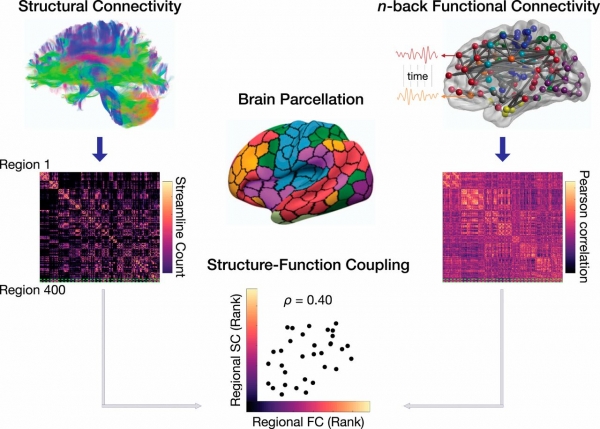
Image №1: measurement of structural-functional connectivity in the human brain.
Nodes in the structural and functional networks of the brain were identified using 400-zone cortical parcellation (division into zones) based on the functional homogeneity in the MRI data of study participants. For each participant, regional connectivity profiles were extracted from each row of the structural or functional connectivity matrix and represented as vectors of connectivity strength from one neural network node to all other nodes.
To begin with, the scientists checked whether the spatial distribution of structural-functional connections matched the fundamental properties of cortical organization.
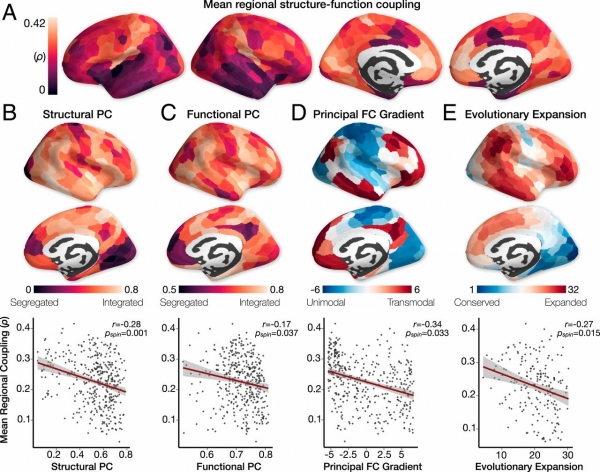
Image #2
It is worth noting that the relationship between regional profiles of structural and functional connectivity varied significantly across the cortex (2A). A stronger connection was observed in the primary sensory and medial prefrontal cortex. In contrast, the connection in the lateral, temporal, and frontotemporal regions was relatively weak.
For a clearer assessment, the relationship between structural-functional connectivity and functional specialization was evaluated using the 'participation coefficient,' which represents a graphical depiction of the quantitative measure of connectivity between functionally specialized areas of the brain. Each area of the brain was assigned to seven classical functional neural networks. Brain nodes with a high participation coefficient demonstrate diverse inter-module connectivity (connections between different areas of the brain) and, therefore, may influence the processes of information transmission between areas, as well as their dynamics. In contrast, nodes with a low participation coefficient exhibit more localized connections within the area itself rather than between multiple areas. Simply put, if the coefficient is high, different areas of the brain actively interact with each other; if it is low, activity occurs within the area without connections to neighboring areas.2C).
Next, an assessment was conducted on the relationship of variability in structural-functional connectivity and macroscopic functional hierarchy. The structural-functional connection largely aligns with the primary gradient of functional connectivity: unimodal sensory areas demonstrate relatively strong structural-functional connectivity, while transmodal areas at the top of the functional hierarchy exhibit weaker connectivity (2D).
It was also found that there is a strong correlation between structural-functional connectivity and the evolutionary expansion of the cortical surface (2E). Highly conservative sensory areas exhibited relatively strong structural-functional connectivity, whereas highly expanded transmodal areas demonstrated weaker connectivity. Such observations fully support the hypothesis that structural-functional connectivity reflects the cortical hierarchy of functional specialization and evolutionary expansion.
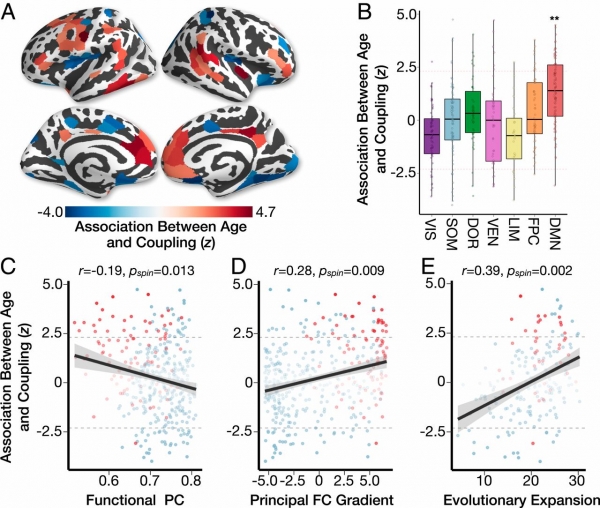
Image #3
Scientists remind us once again that previous studies have predominantly focused on examining structural-functional connectivity in the adult human brain. This work, on the other hand, emphasized the study of the brain that is still under development, i.e., the examination of the adolescent brain.
It was found that in the brains of adolescents, age-related differences in structural-functional connectivity were broadly distributed across the lateral temporal, inferior parietal, and prefrontal cortex (3A). Increases in connectivity were disproportionately distributed across cortical regions, i.e., present in a unique subset of functionally segregated cortical areas (3B), which was not observed in the adult brain.
The magnitude of age-related differences in structural-functional connectivity strongly correlated with the coefficient of functional involvement (3C) and the functional gradient (3D).
The spatial distribution of age differences in structural-functional connections also corresponded to the evolutionary expansion of the cortex. An age-related increase in connectivity was observed in the expanded associative cortex of the brain, whereas an age-related decrease in connectivity was noted in the highly conservative sensory-motor cortex (3E).
In the next phase of the study, 294 participants underwent a brain scan again 1.7 years after the initial assessment. This allowed for the determination of the relationship between age-related changes in structural-functional connectivity and intra-individual changes in development. To achieve this, an assessment of longitudinal changes in structural-functional connectivity was conducted.
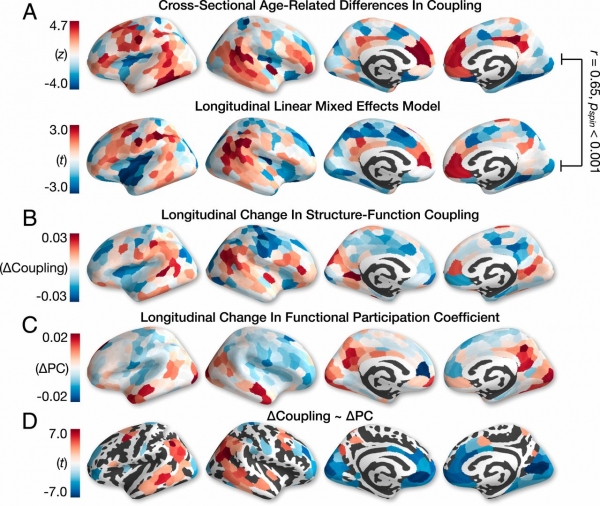
Image No. 4
A significant correspondence was found between cross-sectional and longitudinal age-related changes in structural-functional connectivity (4A).
To verify the relationship between longitudinal changes in structural-functional connectivity (4B) and longitudinal changes in the coefficient of functional participation (4C) a linear regression was used. It was discovered that longitudinal changes in connectivity corresponded to longitudinal changes in the coefficient of functional participation in high-order distributed associative areas, including the dorsal and medial prefrontal cortex, the inferior parietal cortex, and the lateral temporal cortex (4D).
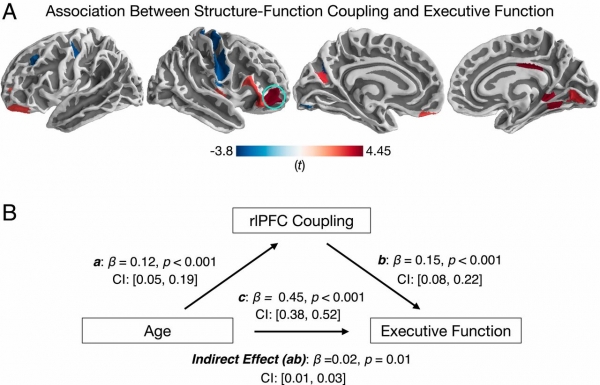
Image No. 5
Researchers then sought to understand the implications of individual differences in structural-functional connections for behavior. Specifically, whether structural-functional connectivity during a working memory task could explain executive performance. It was found that improved executive functioning was associated with stronger structural-functional connectivity in the rostrolateral prefrontal cortex, the posterior cingulate gyrus, and the medial occipital cortex (5A).
The set of observations outlined above leads to several key conclusions. First, regional changes in structural-functional connectivity are inversely proportional to the complexity of the function that a particular area of the brain is responsible for. A stronger structural-functional connection was found in parts of the brain that specialize in processing simple sensory information (for example, visual signals). Conversely, areas of the brain involved in more complex processes (executive function and inhibitory control) had lower structural-functional connectivity.
It was also established that structural-functional connectivity aligns with the evolutionary expansion of the brain observed in primates. Previous comparative studies of the brains of humans, primates, and monkeys have shown that sensory areas (for example, the visual system) are very conservative across primate species and have not significantly expanded during recent evolution. In contrast, associative areas of the brain (for example, the prefrontal cortex) have undergone significant expansion. This expansion may have directly influenced the emergence of complex cognitive abilities in humans. It has been found that brain regions that rapidly expanded during evolution had weaker structural-functional connectivity, while simpler sensory areas exhibited stronger connectivity.
In children and adolescents, structural-functional connectivity increases quite actively in the frontal areas of the brain responsible for inhibitory functions (i.e., self-control). Thus, the prolonged development of structural-functional connectivity in these areas may enhance executive function and self-control, a developmental process that continues into adulthood.
For a more detailed understanding of the nuances of the study, I recommend checking out and related to it.
Epilogue
The human brain has always been, and will continue to be, one of humanity's greatest mysteries. It is an incredibly complex mechanism that must perform numerous functions, control many processes, and store vast amounts of information. For many parents, there is nothing more mysterious than the brains of their teenage children. Their behavior is sometimes hard to call logical or constructive; however, this can be explained by their biological development and social maturation processes.
Of course, changes in the structural-functional connections of various brain areas and the influence of hormonal shifts can scientifically justify the peculiar behavior of young people, but this does not mean they don't need guidance. A person is not inherently asocial by nature. If someone distances themselves from others, it is certainly not because of our biological predisposition. Therefore, active parental involvement in their children's lives is a crucial aspect of their development.
It is also important to understand that even at the age of three, a child is already a person with their own character, desires, and perspective on the surrounding world. A parent should not become invisible to their child by letting them drift into independence, but neither should they turn into an impenetrable wall that shields them from discovering the world. Sometimes you need to give a gentle push, sometimes hold them back, sometimes grant complete freedom, and at other times, assert parental authority with a firm 'no', even if the child is displeased with it.
Being a parent is challenging, and being a good parent is even more difficult. But being a teenager is not easy either. The body changes externally, the brain evolves, the environment shifts (there was school, and now there’s university), and the pace of life alters. Nowadays, life often resembles Formula 1 racing, where there is no room for sluggishness. However, high speed comes with great risk, and an inexperienced driver may suffer. The parent’s role is to be a coach for their child, so that they can later be released into the world without fear for their future.
Some parents consider themselves smarter than others; some are ready to implement any advice heard online or from a neighbor, while some simply don’t care about the nuances of parenting. People are different, but just as communication between areas of the human brain is crucial, communication between parents and their children plays one of the most important roles in upbringing.
Thank you for your attention, stay curious, and have a great weekend, everyone! 🙂
A little advertisement 🙂
Thank you for staying with us. Do you enjoy our articles? Want to see more interesting content? Support us by placing an order or recommending us to your friends, , a unique entry-level server alternative that we have created for you: (options available with RAID1 and RAID10, up to 24 cores and up to 40GB DDR4).
Dell R730xd at half the price in the Equinix Tier IV data center in Amsterdam? Only with us in the Netherlands! Dell R420 — 2x E5-2430 2.2GHz 6C 128GB DDR3 2x960GB SSD 1Gbps 100TB — from $99! Read about how
Source: habr.com
