

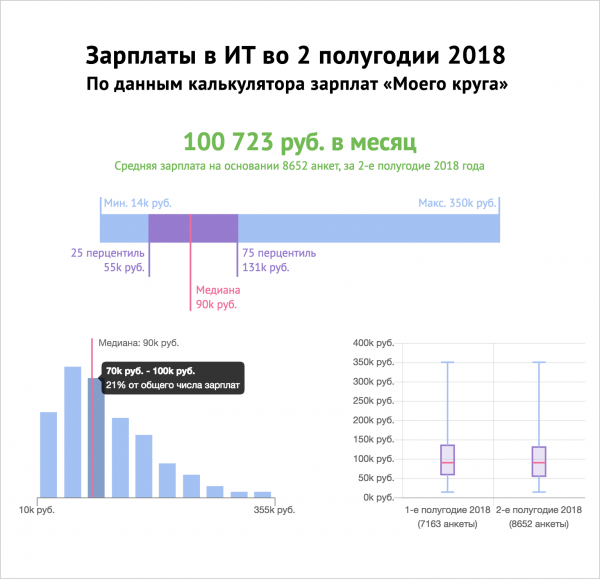
We publish the salary report for the IT industry for the second half of 2018. The report is based on data from the "My Circle" salary calculator, which collected over 8,500 salaries during this period.
Let's take a look at current salaries across all major IT specializations, as well as their annual dynamics both overall and by key regions: Moscow, St. Petersburg, and other cities. We will delve into the specialization of software developers, examining their salaries by programming languages, cities, and companies.
The data presented in our current report, as well as any others, can be obtained independently by anyone through "My Circle". If you like the information we gather through the calculator, and if you'd like to contribute to the creation of a more transparent labor market in IT, we invite you to , the data from which we will use in our next semi-annual report.
The salary service on "My Circle" was launched at the end of 2017 with the aim of regularly monitoring salaries in the IT industry. Salaries are entered by the specialists themselves, we collect them and provide them to everyone in aggregated and anonymous form.
How to read the report charts
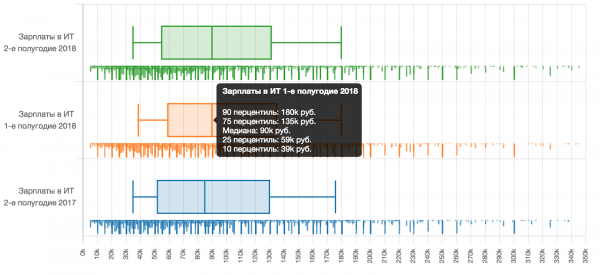
All salaries are indicated in rubles. These are the net salaries received after all taxes. Points represent specific salaries. The group of points for each sample is visualized using a "box-and-whisker plot". The central vertical line indicates the median salary (half of the salaries are below, and half are above this point, which can be considered the average salary), while the edges of the box represent the 25th and 75th percentiles (which further divide the lower and upper halves of the salaries in half again, ultimately half of all salaries lie between them). The whiskers of the box represent the 10th and 90th percentiles (which can be considered the minimum and maximum salaries, respectively). More about how the salary calculator works and how to read the data: .
The average salary in the IT industry is currently 90,000 rubles: in Moscow — 125,000 rubles, in St. Petersburg — 100,000 rubles, and in other regions — 70,000 rubles.
In the past year of 2018, in the first half, we observed a 6% increase in the median salary across the entire IT industry compared to the second half of 2017: from 85,000 RUB to 90,000 RUB. In the second half of 2018, compared to the first half, the 25th and 75th percentiles slightly decreased, but the median salary remained unchanged.
inflation in Russia was about 4%. Thus, we can state that real salaries in IT have practically not grown.
Further in this report, we will compare the salaries of the second half of 2018 and the second half of 2017 to see the overall changes in salary over the year. The box plots are clickable: the link leads to an interactive chart created in our chart editor.
Salaries across all major IT specializations
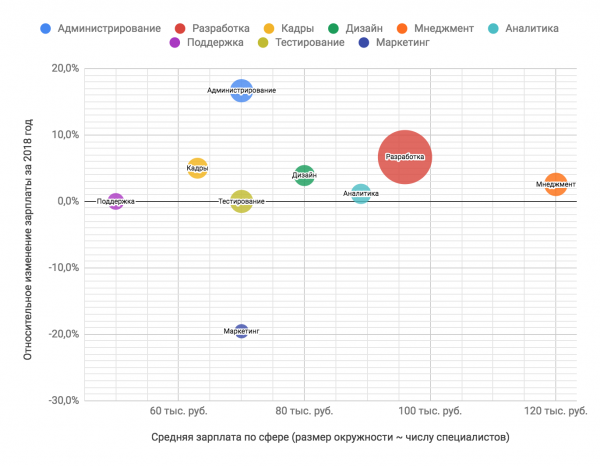
The state of salaries across major IT specializations in the second half of 2018.
Overall, across all regions, there is a growth in the median salary observed in development, administration, design, management, analytics, and HR; particularly strong growth is seen in administration. Salaries in testing and support have remained unchanged. The only decline is observed in marketing.
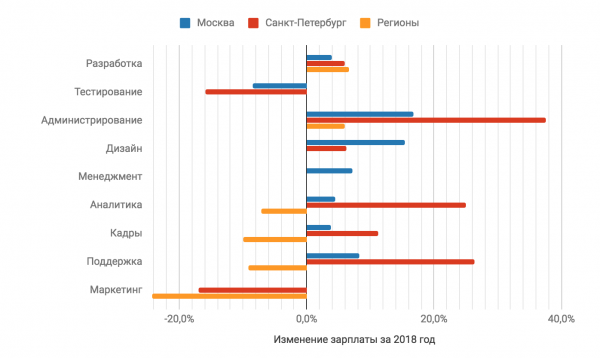
If we look at the regions separately, growth in the median salary is observed simultaneously in all regions only in development and administration. A simultaneous decline across all regions is seen only in marketing.
For other specializations in all cities, except Moscow and St. Petersburg, we see a decline in salaries (analytics, HR, support, and marketing) or no changes (testing and management).
In HR, design, and analytics, salary growth is observed only in Moscow and St. Petersburg, while in management, it is only in Moscow.
Salaries by individual IT specializations
Salaries of analysts
Salaries of designers
Salaries of quality specialists
Salaries of operational specialists
Salaries of HR specialists
Salaries of marketing specialists
Salaries of managers
Salaries of software developers
Salaries across major development specializations
Overall, we see a rise in the median salary in the development sector across all specialties except for system engineers, full-stack, and mobile developers, where salaries have remained unchanged. There has been especially strong salary growth for embedded developers.
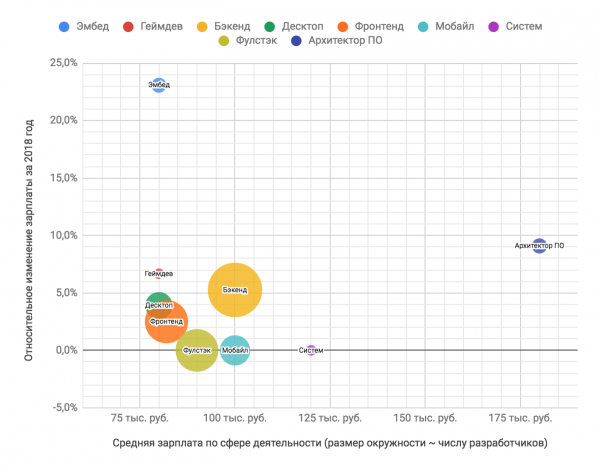
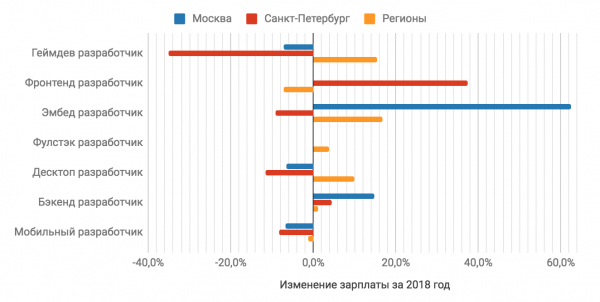
When analyzing regions individually, salary increases are observed across all regions only in back-end development. Salaries in front-end development have risen due to St. Petersburg, in embedded development due to Moscow and other regions, while desktop and game development salaries have risen due to regional factors.
Salaries of developers by programming languages
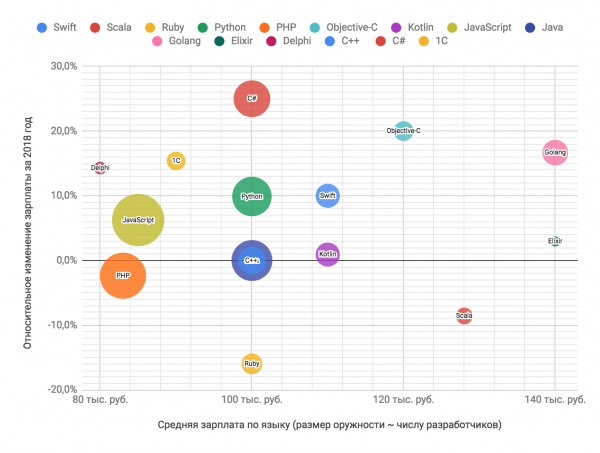
The highest salaries are still for developers using the following languages: Elixir — 140,000 RUB, Go — 140,000 RUB, Scala — 128,000 RUB, and Objective-C — 120,000 RUB.
The median salary has increased over the year for almost all programming languages, with the most significant growth occurring for C# and Objective-C. The median salary has only decreased for PHP, Scala, and Ruby, with Ruby showing the largest decline in salary.
Salaries of developers by companies
Alongside companies, we also displayed the salaries of those who indicated they work as freelance developers. It is interesting to compare these salaries with those from outsourcing companies that perform the same functions as freelancers.
Companies like Yandex, Kaspersky Lab, Mail.ru, Luxoft, and Alfa Bank remain leaders in terms of the salaries of their developers.
Salaries of developers in million-plus cities
The average salary in development is currently 98,000 RUB: in Moscow — 133,000 RUB, in St. Petersburg — 110,000 RUB, in Nizhny Novgorod — 100,000 RUB, and in other regions — 80,000 RUB.
Key observations
- The average salary in IT is now 90,000 RUB: in Moscow — 125,000 RUB, in St. Petersburg — 100,000 RUB, and in other regions — 70,000 RUB.
- In 2018, salaries in the IT industry overall increased by 6%: this growth occurred in the first half of the year, while salaries remained unchanged or slightly decreased in the second half. Considering the 4% inflation, we can state that real salaries in IT have practically not increased.
- Salary growth is observed in the areas of development, administration, design, management, analytics, and HR. Salaries in testing and support have remained unchanged. A decrease in salaries has been noted in marketing.
- The average salary in development is currently 98,000 RUB: in Moscow — 133,000 RUB, in St. Petersburg — 110,000 RUB, in Nizhny Novgorod — 100,000 RUB, and in other regions — 80,000 RUB.
- In the field of development, we observe a salary increase across all specializations except for system engineers, full-stack and mobile developers, where salaries have remained unchanged. Embedded developers, in particular, are experiencing a significant salary increase.
- Salaries are rising for almost all programming languages, with the highest gains seen in C# and Objective-C. There is a decline in salaries for PHP, Scala, and Ruby, with Ruby experiencing the most significant drop.
- The highest salaries continue to be for developers in the following languages: Elixir — 140,000 rubles, Go — 140,000 rubles, Scala — 128,000 rubles, and Objective-C — 120,000 rubles.
- Companies like Yandex, Kaspersky Lab, Mail.ru, Luxoft, and Alfa Bank remain leaders in terms of the salaries of their developers.
We thank everyone who reports their salaries on the service, contributing to the creation of a more open and structured IT market. on salaries in the first half of 2018.
Source: habr.com
