

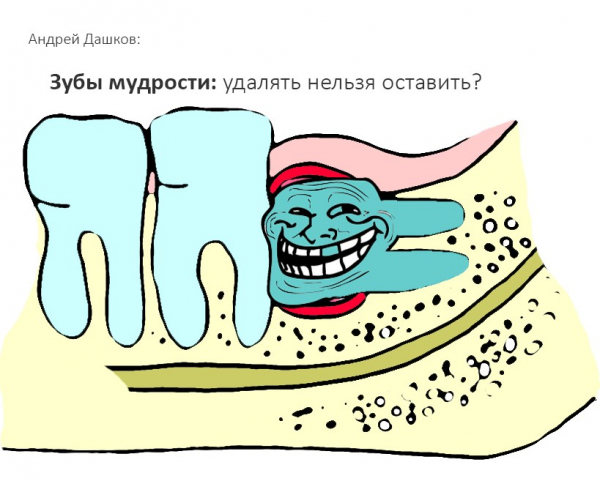
Dear friends, today I would like to talk to you about wisdom teeth. In particular, let's discuss the most complex and least understood aspect — the indications for their removal.
For ages, there have been many jokes, superstitions, legends, and quite scary stories associated with the wisdom teeth (third molars or 'wisdom teeth'). This mythology is prevalent not only among ordinary people but also in the medical community. Gradually, as we discuss, I will try to debunk these myths and show that wisdom teeth are not as much of a problem in terms of diagnosis or removal, especially when it comes to a modern doctor and a modern clinic.

Why are they called wisdom teeth?
It's quite simple. The eighth teeth typically emerge between the ages of 16 and 25. At a conscious age, relatively late compared to other teeth. Like, have you become so wise? Here are your wisdom teeth in the form of problems with your bite and pericoronitis — enjoy! Yes, sometimes a person's wisdom begins with the pain and suffering associated with wisdom teeth. No pain, no gain, as they say.
Why do wisdom teeth emerge for some people but not for others?
Because some are wise, and some are not. Just a joke.
To begin with, it's important to clarify that the vast majority of people have wisdom teeth, and being born without them is a very, very rare occurrence. Being born without wisdom teeth or their buds is like winning the jackpot — you should urgently buy a lottery ticket as you are a lucky person.

However, wisdom teeth do not emerge for everyone. This depends on the condition of the bite. More specifically, on whether there is enough space in the jaw for their emergence.
It just so happens that they start to grow at a time when the active growth of the jawbones slows down, and the dental arch seems to be already 'complete.' The tooth grows upward (or downward, if it’s in the upper jaw), encounters an obstacle in the form of an already erupted seventh tooth, and either halts or begins to reposition.
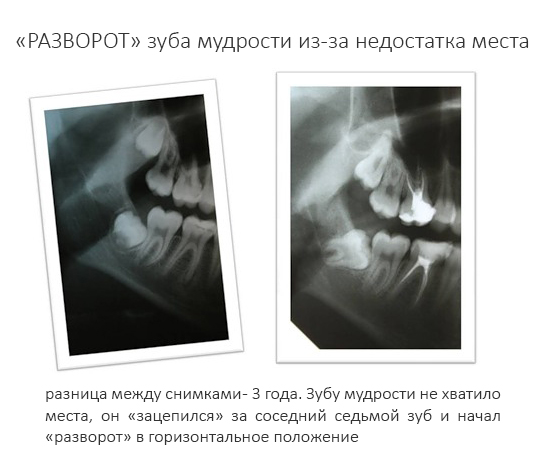
This is how not only impacted (unerupted) but also anomalously positioned (dystopic) wisdom teeth occur.
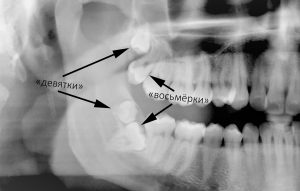
For the sake of fairness, it should be noted that there can be more than four wisdom teeth. Occasionally, not only 'eights' appear, but also 'nines' or even 'tens'. Naturally, such a variety in the mouth leads to nothing good.
If there are eights, then they must serve a purpose?
Well, most people have a belly button. And it, obviously, is also intended for something. For instance, for collecting wool lint and other materials for practical creativity.

Seriously speaking, eights are, in a way, an atavism. A reminder that millions of years ago our ancestors fed on raw meat, mammoths, and other wildlife, and even vegans were much more brutal, chewing on baobab bark instead of celery.
In this context, the jaws of our ancestors were significantly larger and wider, to the extent that even Nikolai Valuev would look a bit feminine next to them. And all thirty-two teeth fit wonderfully in such jaws; everyone was happy.
However, in the course of evolution, humans became smarter, learned to process food, fry meat, and sauté baobab broccoli. The need for large jaws and a massive chewing apparatus disappeared; people became more elegant and glamorous. Their chewing muscles and jaws did too. Yet the number of teeth remained unchanged. Sometimes, they simply don't fit into glamorous jaws. And whoever is last gets to have the dad's issue of retention or dystopia.
Thus, eights became 'unnecessary' teeth. And perhaps it would be more accurate to call them not 'wisdom teeth', but 'teeth of the australopithecines' — who knows, people might start to treat them more reasonably.
What are eights like?
You won't believe it, but primarily, eights are eighth in order.
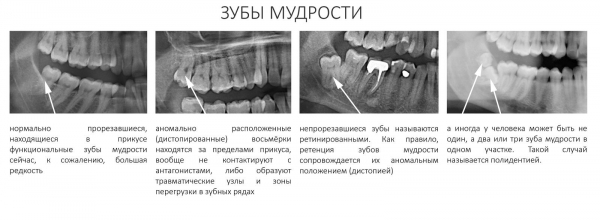
What happens if you don't bother about wisdom teeth at all?
If the eights have erupted, are in occlusion, and function normally, then nothing, of course, will happen. It's enough to carefully maintain hygiene in their area since there may be some difficulties due to the gag reflex and poor visibility, and visit the dentist periodically — and everything will be fine. Such wisdom teeth will live long and happily.
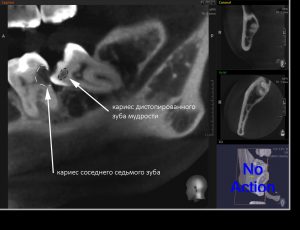
With impacted wisdom teeth, everything seems quite clear — due to their positioning, maintaining oral hygiene is difficult, and these teeth are prone to rapid decay. It gets worse if decay spreads to the adjacent molars, which, unlike the wisdom teeth, are quite important functionally. Often, decay appears on the farthest and least visible surfaces of the teeth, and a person only notices it when it starts to hurt. In other words, it's already too late.
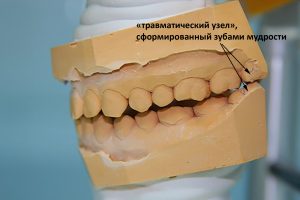
In addition, abnormally positioned wisdom teeth create what are known as 'traumatic nodes' in the bite, disrupting familiar reflex connections, which leads to issues with the masticatory muscles and joints. Subsequently, this is exacerbated by bite pathology, overstrain of the chewing muscles, and popping sounds in the temporomandibular joints, indicating the emergence of signs of muscular-articular dysfunction. Typically, the treatment of such dysfunctions begins with examining the role of the wisdom teeth in this pathology and taking the necessary measures (i.e., extraction).
It is more complex to understand what happens with retained (impacted) wisdom teeth. It may seem that since the tooth is not visible, it is not at risk of decay and could just sit there... However, there are several unpleasant consequences.
Despite the tooth not having erupted yet, it still affects the dental arch. It can cause the movement of teeth and the formation of crowding in the anterior section:
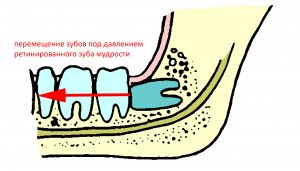
Due to the lack of a bony partition between the sockets of the seventh and eighth teeth, a deep pocket forms between them where food debris, plaque, and bacteria can accumulate, leading to inflammation. Sometimes this inflammation can be quite acute and hazardous to health.
The process of erupting retained teeth, especially from the age of 20 and older, is often accompanied by inflammation — pericoronitis.
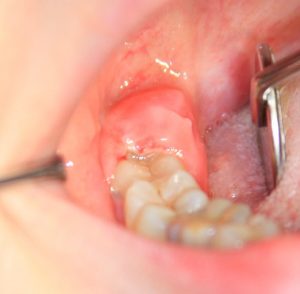
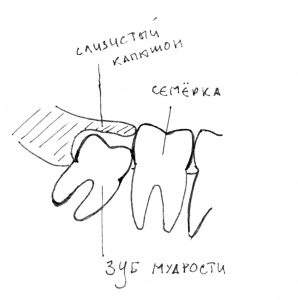
The treatment of pericoronitis is a separate topic. We will discuss it sometime, but for now, you need to know the main point — it's best not to let it get to pericoronitis, and if it's clear that there isn't enough space for the wisdom teeth and their eruption will come with difficulties — it's better to remove them in advance.
But the most unpleasant thing one can expect from retained wisdom teeth is cysts.
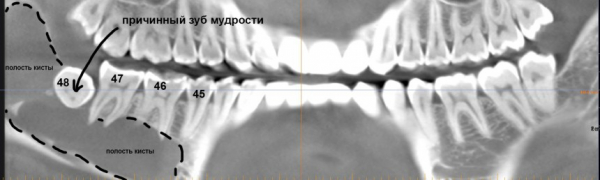
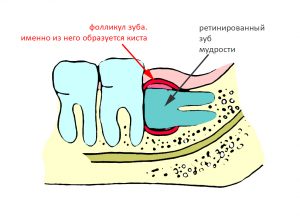
Its source is the follicle surrounding the tooth bud. When the tooth erupts, the follicle disappears, but in the case of retention, it remains and can serve as a source of tumors and cysts.
Sometimes — sufficiently large and quite dangerous to health.
And although all of this is quite treatable, agree that it is better not to let oneself reach such a state.
Why are doctors' opinions on the removal of wisdom teeth so contradictory?
Generally, it all comes down to the doctor's experience in extracting wisdom teeth. If the procedure is difficult for the doctor, takes a lot of time, and causes the patient only suffering, he is usually against extraction. Conversely, if removing the eighths, even the most complicated ones, does not pose serious challenges for the doctor, he advocates for a definitive and radical solution — extraction surgery.
When is it necessary to execute, but not to pardon, to remove, but not to leave?
Meanwhile, the criteria for extraction/non-extraction of wisdom teeth are very simple. They can all be summarized in one simple phrase:
Diseases and complications associated with wisdom teeth, or the threats of these diseases and complications, are indications for the removal of wisdom teeth.
That's all. There are no other indications/contraindications.
Let's look at some examples:
- A normal, erupted tooth functioning properly in a normal bite does not need to be removed. Moreover, such teeth can (and should) be treated in case of caries. The situation changes if caries is complicated by pulpitis or periodontitis — in such cases, it's worth considering, as root canal treatment in third molars presents certain difficulties. Perhaps, it's not worth getting involved with canals?
- An abnormally positioned (disto-positioned) wisdom tooth. It did not have enough space and either tilted to one side or remains partially in the gum. Such a tooth will never function, but it creates problems for both the bite and adjacent teeth. Should it be removed? Absolutely.
- Impacted (non-erupted) wisdom tooth. It doesn't seem to cause any trouble. It's located somewhere far back. It does not participate in chewing and never will. We already know the potential consequences of an impacted wisdom tooth. Is it worth waiting for these complications? I don't think so; it’s not worth it.
- The tooth has started to erupt, and the gums above it are inflamed. Pericoronitis, as this condition is called, indicates that there isn't enough space in the jaw for the tooth, which may lead to either misalignment or shifting of other teeth and bite issues. Is it worth treating pericoronitis with a simple excision of the flap? Probably not. It’s better to solve this problem radically by removing the problematic tooth.
Conclusion
From the above, we can conclude that wisdom tooth extractions usually occur when the patient is not particularly troubled by them. In other words, this procedure serves as a preventive measure against potential complications associated with wisdom teeth. This is correct. There is no method more effective and cheaper than prevention. The best medicine is preventive medicine.
Next time, I will tell you how wisdom teeth are actually extracted, how to prepare for this procedure, and what you need to do afterward.
Thank you for your attention! Stay tuned!
Sincerely, Andrey Dashkov.
Source: habr.com
