

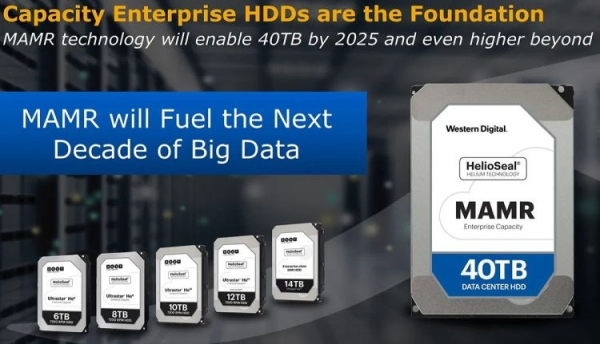
For a long time, WDC opposed the use of heated magnetic platter (HAMR) technology, which was actively, but unsuccessfully, promoted by competitor Seagate Technology. Western Digital had been relying on MAMR—a technology that uses microwave radiation to stimulate magnetic platters—to increase recording density. Now, company representatives admit that the preference for one technology over another is not so important, and both are eligible for implementation in WDC's production program.
It should be recalled that in mid-September, in comments to a German publication Western Digital representatives made it clear that the company is not yet ready for mass use of MAMR, and the previously announced 18 TB hard drives will not use this technology, but some carefully hidden alternative.
The situation changed direction again at the event Western Digital was represented at an investor conference held this week by Chief Financial Officer Bob Eulau and President of Technology and Strategy Siva Sivaram. Sivaram told the event's moderator that the 18 TB hard drives, which are about to begin mass shipping, already use a derivative of MAMR technology, combining it with a magnetic platter structure that utilizes perpendicular particle magnetic resonator (PMR). Samples of these hard drives will begin shipping to customers two to three weeks before Christmas.
Meanwhile, WDC is preparing to begin shipping 20 TB hard drive samples, which will also use a derivative of MAMR, but in combination with a shingled magnetic platter structure (SMR). Company representatives explain that MAMR is less expensive to implement in mass production, as HAMR requires different components, different magnetic platters, laser heads, and other expensive innovations.
In the long term, WDC sees no obstacles to using HAMR in its hard drives. Customers don't care which technology the hard drive they purchase uses, only the quality and specifications of the product itself. The company plans to increase its hard drive capacity to 50 TB, and it's not particularly concerned about whether it requires MAMR or HAMR technology. In the near future, however, it plans to squeeze the full potential out of the combination of PMR and MAMR.
Source: 3dnews.ru
