

Last week, The Linux Foundation announced the creation of a new fund for Open Source projects during its Open Source Leadership Summit event. This independent institute focused on the development of open and in-demand technologies aims to unite tools for DevOps engineers, specifically for organizing and implementing continuous delivery processes and CI/CD pipelines. The organization has been named: The (CDF).
To better understand the purpose of such funds under the parent organization, Linux Foundation, one needs to look at a more well-known example — the CNCF (Cloud Native Computing Foundation). This fund was established in 2015 and has since welcomed numerous Open Source projects that are truly defining the modern landscape of cloud IT infrastructure: Kubernetes, containerd, Prometheus, and more.
The organization acts as an independent platform where these projects are managed and developed in the interests of diverse market participants. For this purpose, CNCF has created technical and marketing committees and adopted certain standards and rules (if you're interested in details, we recommend reading, for example, )… And as we can see from 'live' examples, the model works: projects under CNCF's umbrella become more mature and gain popularity in the industry, both among end users and developers involved in their development.
Following this success (many 'cloud' projects from CNCF have already become part of the daily lives of DevOps engineers), and in line with general IT trends and their manifestations in the world of Open Source, The Linux Foundation decided to 'occupy' (or more accurately, to 'promote') a new niche:
'The Continuous Delivery Foundation (CDF) will serve as a vendor-independent home for essential Open Source projects focused on continuous delivery and specifications that accelerate pipeline processes. CDF will foster collaboration between leading developers, end users, and industry vendors, promote CI/CD and DevOps methodologies, define and document best practices, and create guides and training materials that enable software development teams from anywhere in the world to implement CI/CD best practices.'
Idea
The core values and principles guiding CDF today in such a way that the organization:
- … believes in the power of continuous delivery and in what it offers to developers and teams, allowing the release of high-quality software more frequently;
- … believes in open-source solutions, the collaborative use of which spans the entire software delivery lifecycle;
- … cultivates and supports an ecosystem of Open Source projects that are vendor-agnostic, through collaborative efforts and mutual compatibility;
- … promotes and encourages, among practitioners of continuous delivery, collaboration, dissemination of their practices, and their improvement.
Participants and projects
But beautiful words are the domain of marketers, which do not always align with reality. In this sense, the first impression of the organization can be formed by those companies that created it and what projects became its 'pioneers.'
The main members of CDF are , namely: the top 10 US bank Capital One and much more familiar IT engineering representatives of the industry in the person of CircleCI, CloudBees, Google, Huawei, IBM, JFrog, and Netflix. Some of them have already mentioned this significant event in their blogs, but more on that below.
CDF's participants also include the end-users of its projects — a similar category exists within CNCF, where you can find eBay, Pinterest, Twitter, Wikimedia, and many others. In the case of the new foundation, there are currently only 15 such participants, but among them are already notable names: Autodesk, GitLab, Puppet, Rancher, Red Hat, SAP, and the one that literally joined Sysdig.
Now, perhaps the main point — about the projects that CDF has been tasked with. At the time of the organization's establishment, there were four such projects:
Jenkins and Jenkins X
— a system for CI/CD that hardly needs an introduction, written in Java, existing for many years (just think: the first release — in the form of Hudson — was 14 years ago!), for which it has garnered a countless army of plugins.
The main commercial entity behind Jenkins today can be considered CloudBees., whose technical director is the original author of the project (Kohsuke Kawaguchi) and who became one of the founders of the foundation.
— this project owes a lot to CloudBees (as one can easily guess, its main developers are on the staff of the same company), however, unlike Jenkins itself, this solution is quite new — it is only a year old.
Jenkins X offers a ready-made solution for organizing CI/CD for modern cloud applications deployed within Kubernetes clusters. For this, JX provides pipeline automation, built-in GitOps implementation, release preview environments, and other features. The architecture of Jenkins X is presented as follows:
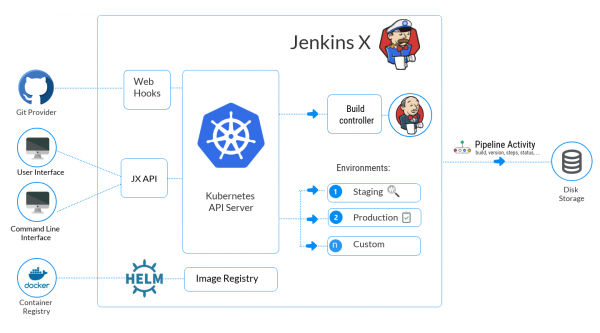
The technology stack includes Jenkins, Knative Build, Prow, Skaffold, and Helm. You can read more about the project in on Habr.
Spinnaker
— a platform for continuous delivery created at Netflix, whose source code was opened in 2015. Currently, Google is actively involved in its development: together they are evolving the product as a solution for large organizations, whose DevOps teams support multiple development teams.
Key concepts in Spinnaker for describing services are applications, clusters, and server groups, while their availability to the outside world is handled by load balancers and firewalls:
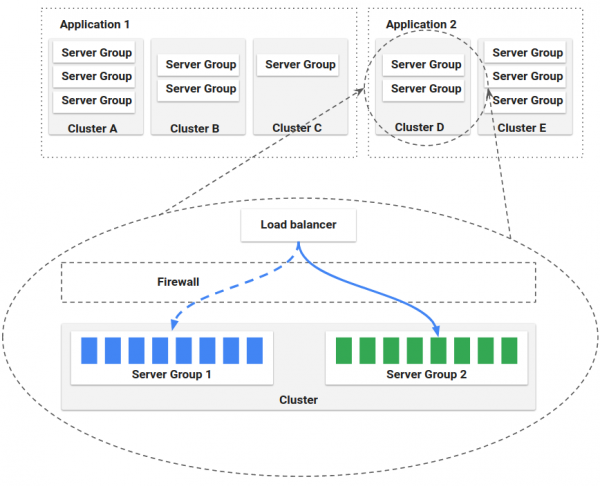
You can read more about the basic structure of Spinnaker in .
The platform allows working with multiple cloud environments including Kubernetes, OpenStack, and various cloud providers (AWS EC2, GCE, GKE, GAE, Azure, Oracle Cloud Infrastructure), as well as integrating with various products and services:
- with CI systems (Jenkins, Travis CI) in pipelines;
- with Datadog, Prometheus, Stackdriver, and SignalFx — for monitoring events;
- with Slack, HipChat, and Twilio — for notifications;
- with Packer, Chef, and Puppet — for virtual machines.
Here's what in Netflix says about including Spinnaker in the new fund:
The success of Spinnaker has largely been due to the amazing community of companies and individuals that use it and contribute to its development. Transferring Spinnaker to the CDF will strengthen this community. This move will encourage changes and investments from other companies that have been observing from the sidelines. Opening the doors to new companies will bring additional innovations to Spinnaker that will benefit everyone.
And in On the occasion of the founding of the Continuous Delivery Foundation, it is noted that "Spinnaker is a multi-component system that conceptually aligns with Tekton." Thus, we arrive at the latest project to join the new foundation.
Tekton
— a framework presented as common components for building and standardizing CI/CD systems, enabling pipelines to work across different environments, including conventional virtual machines, serverless, and Kubernetes.
These components themselves are "Kubernetes-style" resources (implemented in K8s as CRD), serving as building blocks for defining pipelines. A brief illustration of their usage in a K8s cluster is presented. .
The stack of products supported in Tekton will seem familiar: Jenkins, Jenkins X, Skaffold, and Knative. Google Cloud believes that Tekton addresses "the issue of collaboration between the Open Source community and leading vendors in modernizing CI/CD infrastructure."
…
Similar to the CNCF, a Technical Oversight Committee (TOC) has been established within the CDF, tasked with reviewing issues (and making decisions) regarding the inclusion of new projects in the foundation. Additional information about the organization can be found on is still limited, but this is a normal occurrence and just a matter of time.
Let's conclude with a quote from :
"Now, as one of the companies in the newly established Continuous Delivery Foundation, we will take our commitment to [creating technology that is universally supportive of other CI/CD solutions] to a new level. This new organization will, following the principles of collaboration and openness, manage future standards of continuous delivery that will accelerate the software release cycle. With the inclusion of Jenkins, Jenkins X, Spinnaker, and other technologies under this foundation, we foresee a bright future for CI/CD!"
P.S.
Also read in our blog:
- «»;
- «»;
- «»;
- «».
Source: habr.com
