

Application with allows automating the management of virtual private networks. It requires no system administration skills to use.
When choosing a VPN provider, trust plays a more significant role than the price of services. Free services often of lacking reliable encryption and , while commercial providers may bow to regulators and start blocking access to forbidden resources or may themselves end up on the Roskomnadzor blacklist. The ideal option for ensuring anonymity is considered to be a personal server, but few want to deal with its setup. MyVPN greatly simplifies its creation.
Why does an average user need their own VPN?
Usually, users connect to a VPN to ensure secure operations with public wireless hotspots or to bypass blocks imposed by regulators in several countries over recent years. Streaming video services may restrict access to content based on geographic location — the need to encrypt traffic or virtually move to a different location arises quite frequently.
For security issues, any reputable commercial provider will suffice, but bypassing blocks is more complicated. Last year, Roskomnadzor demanded that major VPN providers begin complying with domestic legislation. While the parties have merely exchanged pleasantries so far, popular foreign services could be blocked at any moment. Replacing them is not easy: users can only get the low price (2-3 dollars per month) if they pay for a subscription of at least a year, or even three. If Roskomnadzor reaches the service provider, that subscription in Russia will turn into a pumpkin.
Here it is worth considering the experience of our Chinese counterparts and not to pay more than for a month, but monthly tariffs from large providers range from $7 to $12. At such prices, the idea of launching your own VPN looks attractive, and from the standpoint of anonymity, this option is more interesting: who knows what data VPN providers collect about us? Ordinary users are stopped only by the need to configure and administer the server — this problem is what the MyVPN project addresses.
How does MyVPN work?
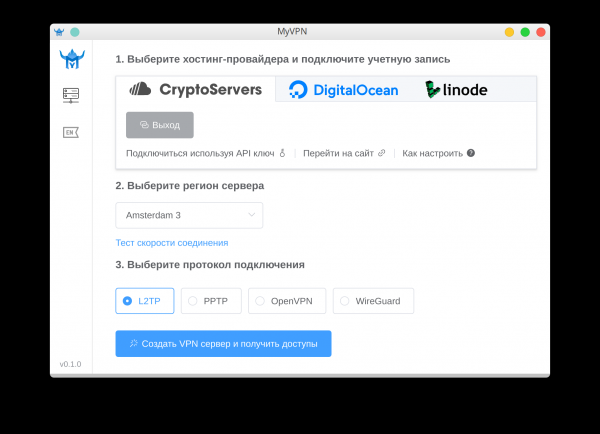
It is important to emphasize that MyVPN is not a service, but an application for Windows, macOS, GNU/Linux, and Android that operates through the API of a hosting provider. It automates the processes of creating and deleting VPN servers in the cloud infrastructure. , or . The user needs to install the application on their computer or mobile device, log into their chosen hosting account (if there is no account, registration will be required), and specify the desired region and protocol. To launch your server, simply press one button.
Creating a VPN server takes just a few minutes, after which the application will prompt you to save the access credentials. This step is mandatory, as the program does not save data for security purposes.
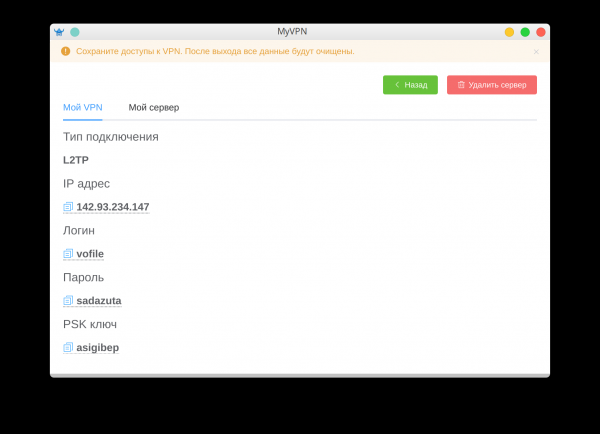
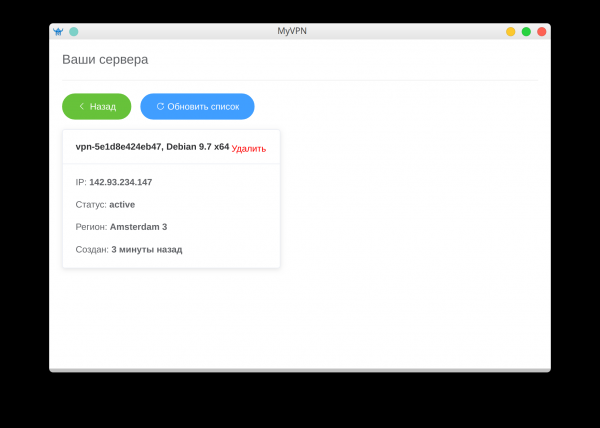
There is no ability to automatically configure VPN connections in desktop OS applications (only the Android version is an exception): to connect to the server, you will have to use the system tools. This is also done for security reasons, but the process is not particularly complicated — detailed instructions are available on the MyVPN website. You can create multiple servers, and they can be deleted with just one click.
Why is MyVPN safe?
The MyVPN application with open source runs on the user's device, does not transmit private data to developers, and does not store access to the VPN servers created in your hosting provider account. Of course, the program requires authorization in the hosting provider's personal account, but without it, you cannot access the API and create/delete servers, and the open source allows you to be confident that the login data will not be sent elsewhere. Additionally, in the desktop versions, you can enter the API key from the chosen provider's account.
The integration with is implemented the best. This host takes privacy seriously; its features include completely anonymous VPS and the ability to pay in Bitcoin. DigitalOcean and Linode have also not been involved in spy scandals, but, in addition to a valid credit card, they sometimes request scans of identity verification documents. In any case, only the user knows the server's IP and has access keys to it—essentially, these are ordinary VPS, and what services are running on them is a separate matter. This option surpasses specialized VPN services in terms of privacy protection, which could potentially do anything with your data.
How much does MyVPN cost?
The MyVPN app does not require a license purchase and does not charge a usage fee: you only pay for the hosting provider's services. For instance, at a VPN virtual machine with a 1 Gbps channel costs $0.02 per hour, and this channel is intended for one subscriber. The app's development is monetized through affiliate programs, and the hosts pay its creators for attracting clients. A simple and logical scheme, comparable in price to the plans of major VPN providers: when paying for a year upfront, you can find cheaper options, but with the risk of losing your funds due to sudden blocking by Roskomnadzor. With MyVPN, only the server uptime is charged—you can delete it at any moment and recreate it.
Only registered users can participate in the survey. , please.
Do you use your VPN?
59,3%Yes, I use it48
30,9%I plan to use it25
14,8%I do not use a VPN12
81 users voted. 24 users abstained.
Source: habr.com
