

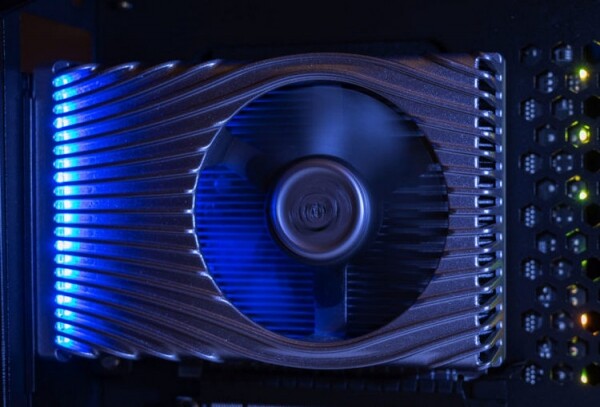
This year, Intel plans to release its new 12th generation Intel Xe graphics processors. Now, the first entries for testing this graphics card have started appearing in various benchmark databases, including both the integrated version in Tiger Lake processors and the discrete version.
In the Geekbench 5 (OpenCL) benchmark database, three entries were found regarding testing of the 12th generation Intel graphics, with one linked to the Tiger Lake-U processor, and the other two related to desktop Coffee Lake Refresh. It's clear that the discrete accelerator was tested with the desktop Core i5-9600K and Core i9-9900K, while the Tiger Lake test could have involved either the integrated or discrete Intel Xe DG1 version.
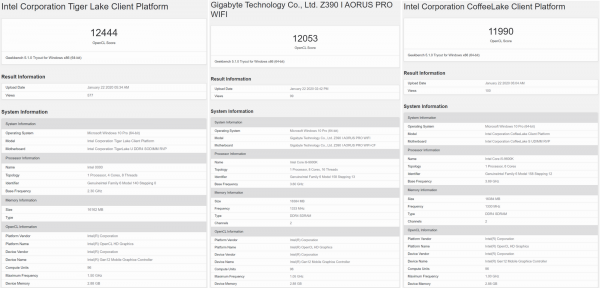
Regardless, the test confirmed that the Intel Xe graphics processor features 96 execution units (Execution Units, EU), with a clock frequency ranging from 1.0 to 1.5 GHz in various tests. This GPU achieved scores between 11,990 and 12,444 points. So, even if both the integrated and discrete versions of Intel Xe DG1 were actually tested, the difference between them is minimal.
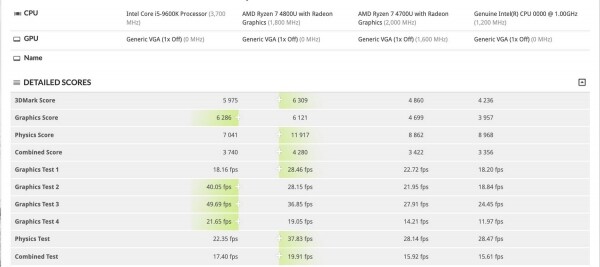
The results from the 3DMark testing look even more interesting, as we can almost confidently say that both integrated and discrete versions of the new Intel graphics were tested here. In one test, again with the Core i5-9600K, the discrete Intel Xe DG1 version scored 6,286 points, slightly exceeding the result of the integrated graphics of the Ryzen 7 4800U (6,121 points). In another test, the integrated version of the Tiger Lake-U processor scored 3,957 points, noticeably lower than the Vega graphics in the Ryzen 7 4700U (4,699 points).
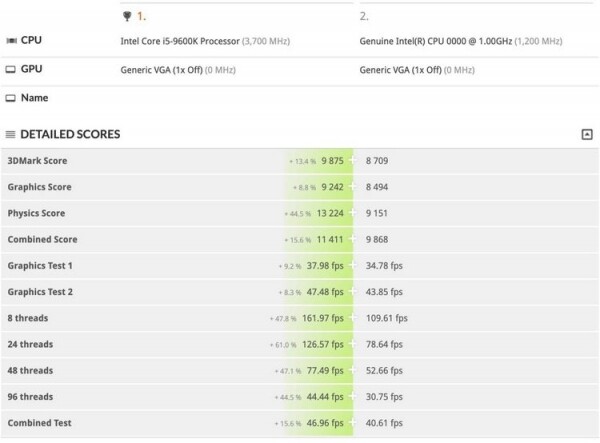
Finally, results for the Intel Xe DG1 graphics testing were found in the 3DMark TimeSpy benchmark. It's almost certain that both the integrated and discrete versions of the graphics processor were tested here. The GPU clock frequencies are not specified; however, the discrete version was nearly 9% faster than the integrated version, likely due to higher frequencies.
Of course, all of this is just preliminary data, and it's clearly too early to assess the performance of the new generation Intel graphics processors, both integrated and discrete. By the time of release, Intel will undoubtedly optimize its GPUs much better and is likely to increase their frequencies.
Source: 3dnews.ru
