

Robotics is one of the most exciting and groundbreaking school activities. It teaches algorithm creation, gamifies the learning process, and introduces children to programming. In some schools, students start learning computer science as early as the 1st grade, building robots and creating flowcharts. To help children easily understand robotics and programming, as well as delve deeper into mathematics and physics in middle school, we have released a new educational set, LEGO Education SPIKE Prime. Details about it will be shared in this post.
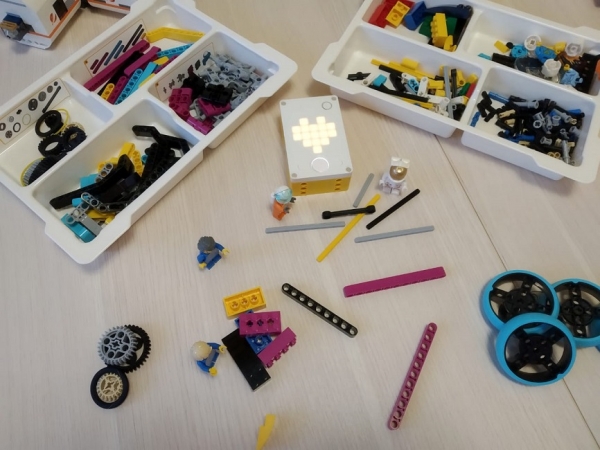
LEGO Education SPIKE Prime is designed for teaching children in grades 5-7 in schools and robotics clubs. The set allows building algorithms using flowcharts and watching as pictures on the screen transform into movements and actions. For modern schoolchildren, visual clarity and a WOW effect are important, and SPIKE Prime serves as a captivating tool that can engage children in programming and the sciences.
Set Overview
The set comes in a minimalist yellow-and-white plastic box. Under the lid, there is a cardboard insert with instructions on getting started and a layout diagram for organizing the parts in the trays. The set is designed for ease of use so that educators require minimal additional preparation.
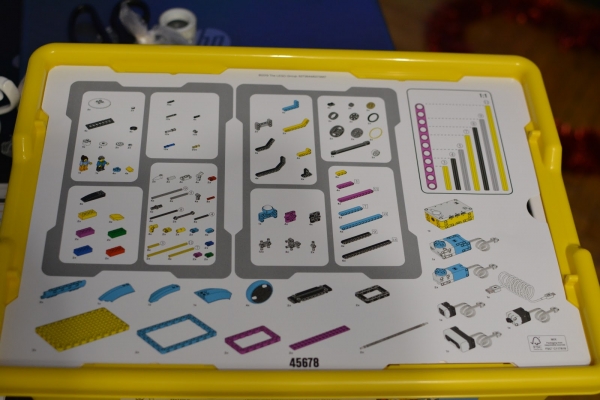
The parts are sorted into numbered bags corresponding to the storage cell numbers in the trays.
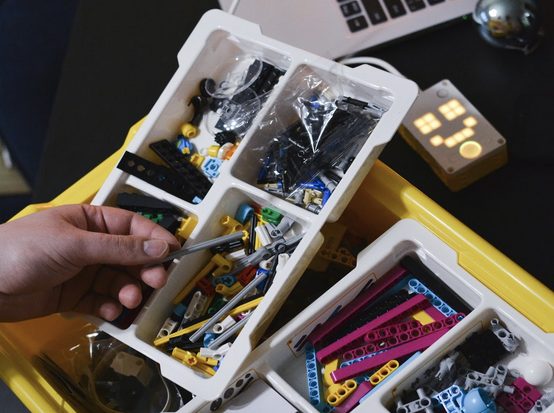
The Basic set includes over 500 LEGO elements, including new ones.
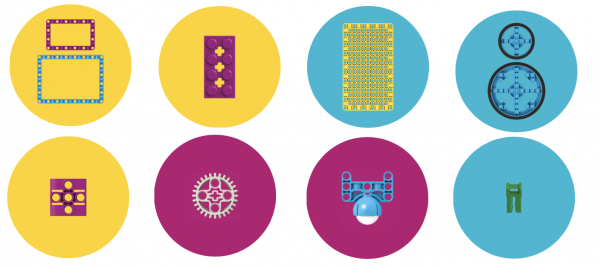
- Several new frames that reduce assembly time for prototypes and allow for the creation of large models.
- A new 2×4 brick with a hole for Technic axles. It enables the integration of Technic elements and LEGO System in one project.
- The base plate from the Technic range has been updated.
- New narrow wheels that provide precision control and enhance the maneuverability of models.
- A new pivot wheel designed as a support roller.
- New wire clamps are available in several colors, allowing for neatly securing cables.
In addition to the parts, there are three motors inside—a large and two medium ones—as well as three sensors: distance, color, and force.
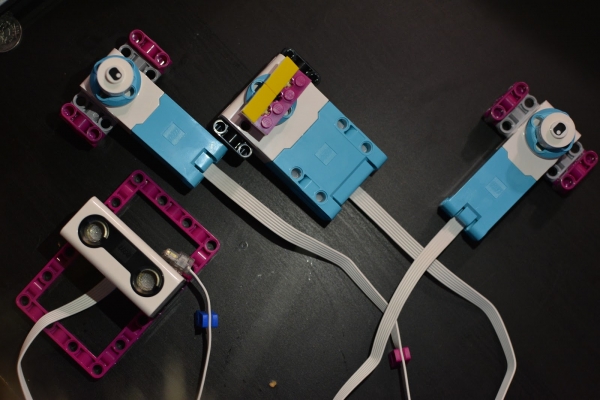
The motors connect directly to the hub and have rotation sensors accurate to 1 degree. This feature is designed for synchronizing motor operation, allowing them to move simultaneously at a constant speed. Additionally, the sensor can also be used to measure speed and distance of the model's movement.
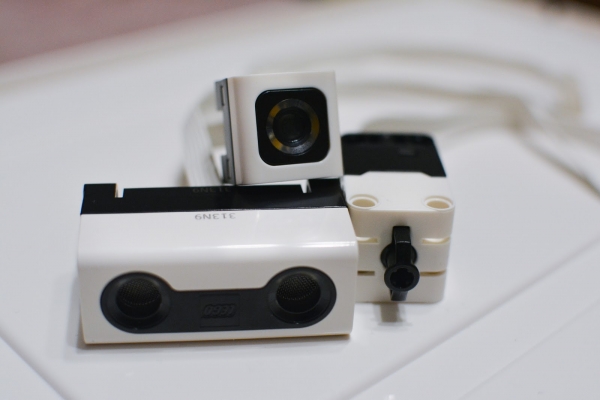
The color sensor distinguishes up to 8 colors and can also be used as a light sensor. It also features a built-in infrared sensor that can detect things like light reflection.
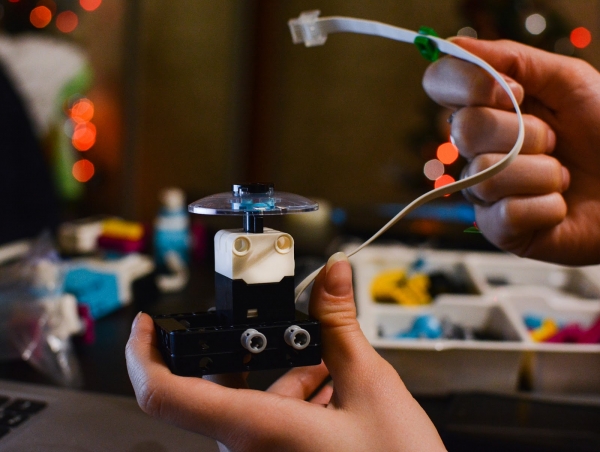
The touch sensor recognizes the following situations: button pressed, released, strong press. The sensor detects the pressure force in newtons or as a percentage.
The IR sensor is used to determine the distance from the robot to a specific point or to prevent collisions. It can measure distance in percentages, centimeters, and inches.
You can expand the basic set with a resource pack consisting of 603 pieces. It includes: an additional large set and a light sensor, two large wheels, large conical gears that enable the construction of large rotating platforms.
Hub
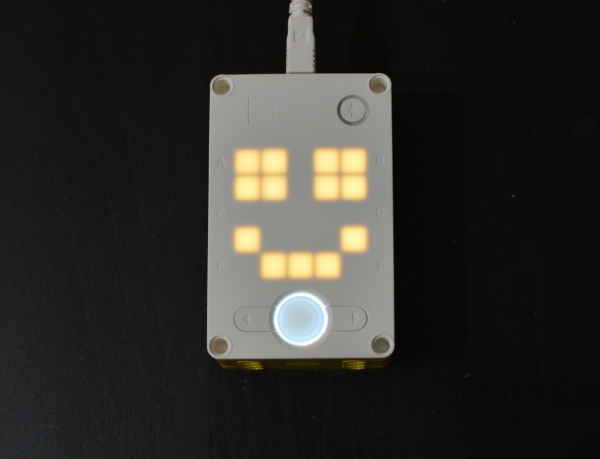
The hub has a built-in gyroscope that can determine its position in space: orientation, tilt, roll, top face identification, drop state of the hub, etc. The built-in memory allows you to load and store up to 20 programs. The program number is displayed on a 5x5 pixel screen, where user images and the hub's operational status are also shown.
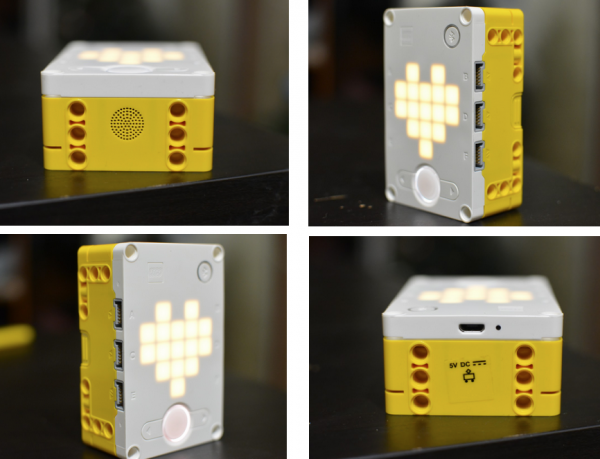
Also located on the hub are:
- A microUSB port for charging the battery or connecting to a PC.
- A Bluetooth synchronization button, which allows wireless connection with a PC for programming the hub.
- 6 ports (A-F) for executing commands or receiving information from sensors.
- Three control buttons for the hub.
- A built-in speaker.
Software
The LEGO Education SPIKE software is available for Windows, Mac OS, Android, iOS, and Chromebook, and can be downloaded . The programming environment is based on the child-friendly programming language Scratch. It consists of a set of commands, each represented as a graphical block of a specific shape and color with parameters that can be manually altered, such as speed and distance of movement, rotation angle, etc.
In this way, command sets related to various components of the solution (motors, sensors, variables, operators, etc.) are highlighted in different colors, allowing for quick intuitive understanding of how to program what is needed.
The application also contains numerous lesson plans, as well as about 30 different instructions for model assembly.
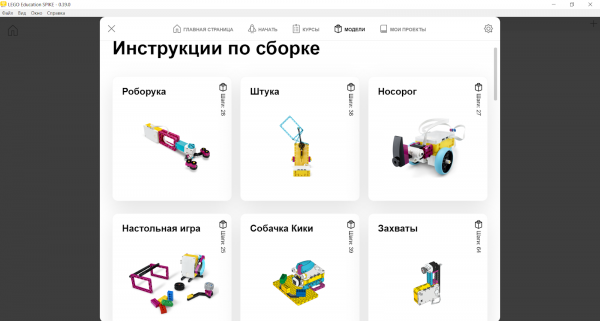
First Steps
After launching the application and selecting a language, three starting steps are immediately offered:
1) Program the hub to display a smiley face on the screen;
2) Get acquainted with how motors and sensors work;
3) Build the 'Flea' model and program it to move.
Getting started with SPIKE Prime begins with a description of connection capabilities (via microUSB or Bluetooth) and how to work with the pixel display.
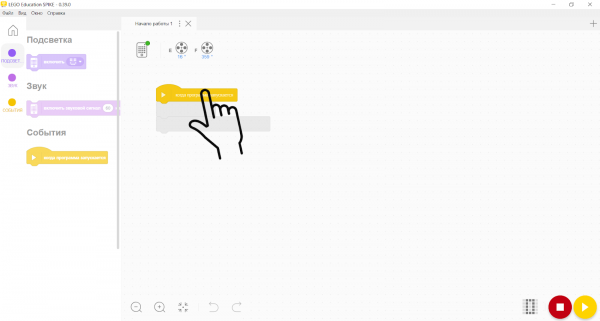
First, you need to set the sequence of commands that should be executed after the program starts, as well as select specific pixels that will light up on the hub's screen.
The second step involves assembling and programming the motors' reactions to various signals from the sensors. For example, you can program the motor to start rotating when a hand or any object is brought close to the distance sensor.
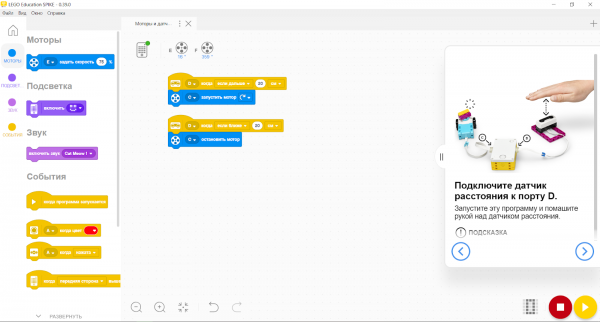
To do this, we create a command sequence: if an object is within n centimeters of the sensor, the motor starts to work.
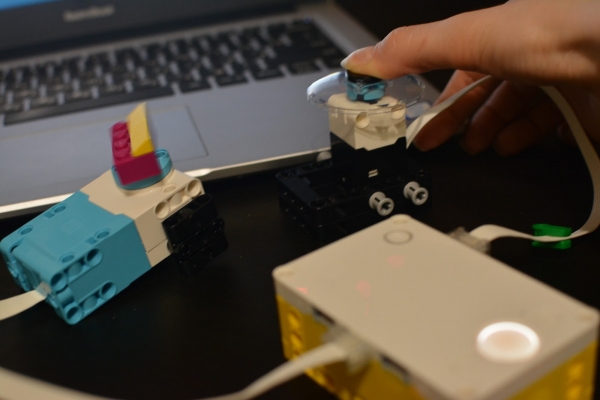
The third and most interesting step: build the flea robot and program it to jump on command. For this, you first need to assemble the robot from parts and two motors.
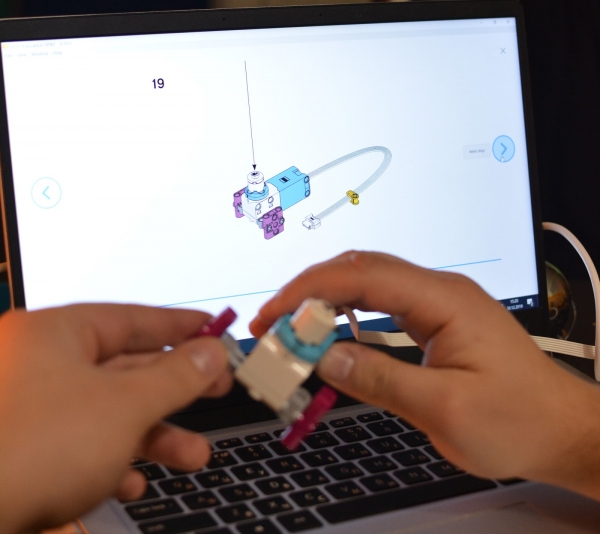
Then we proceed to programming. To do this, we set the following algorithm: when the program is started, the 'flea' should jump forward twice, so both motors should make two full rotations simultaneously. We will set the rotation speed to 50% so the robot doesn't jump too hard.
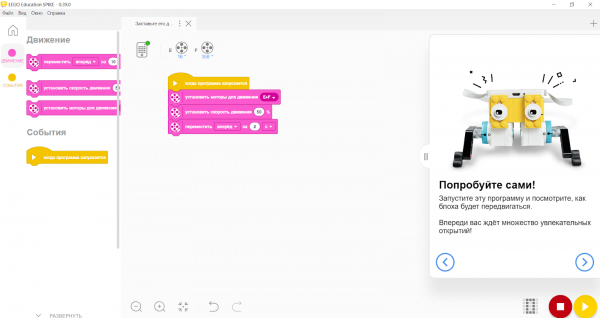
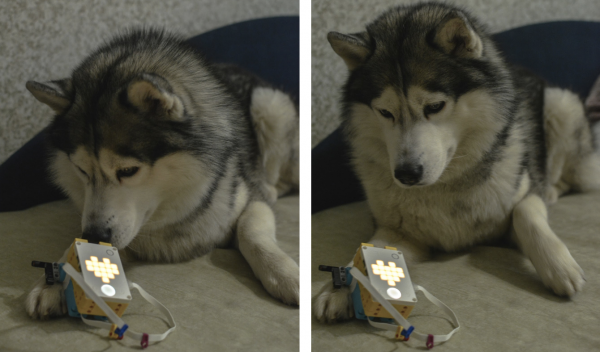
In the end, we have a small robot that bounces forward when the program starts. Beautiful!
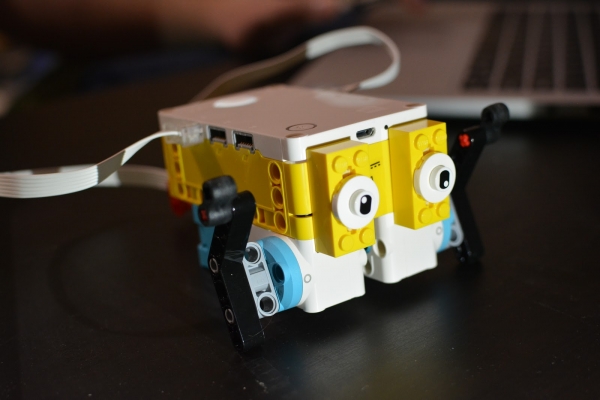
The flea robot swiftly rushed forward, found its first target, but something went wrong.
After this, training is complete, and you can start on more complex projects: the application contains over 60 flowcharts for various components of the kit (motors, hubs, sensors, etc.). Each flowchart can be slightly modified using parameters. Additionally, the software includes the ability to create variables and custom flowcharts.
For Teachers
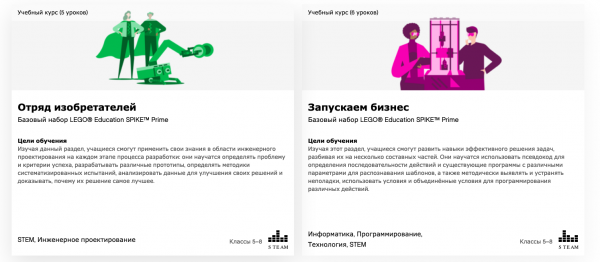
The kit includes for teachers. These contain lesson plans, tasks with ready-made solutions, and assignments that require creative problem-solving. This allows teachers to quickly start using the kit and build educational programs.
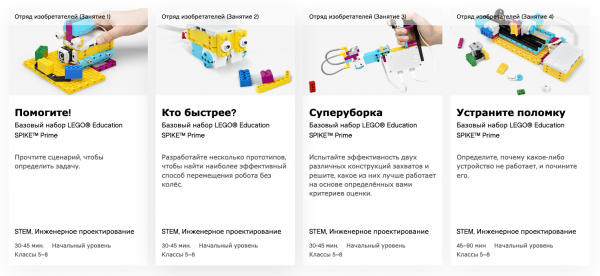
There are a total of 4 courses available on the site. "Inventors' Squad" is a technology lesson course that reinforces students' understanding of project-based activity. Two courses are related to computer science. "Launching a Business" provides basic programming and algorithm skills, while "Useful Devices" introduces the principles of the Internet of Things. The fourth course, "Ready for Competitions," is designed for competition preparation and requires both a basic kit and a resource kit.
Each course contains 5 to 8 lessons, which include ready-made methodological solutions that can be integrated into the educational process to reinforce STEAM competencies.
Comparing with other kits
LEGO Education SPIKE Prime is part of the LEGO Education robotics line, which includes kits for children of different ages:
- Express “Young Programmer” for preschool education.
- WeDo 2.0 for primary school.
- LEGO Education SPIKE Prime for middle school.
- LEGO MINDSTORMS Education EV3 for high school students and first-year college students.
The functions of SPIKE Prime overlap with LEGO WeDo 2.0, which has added Scratch support this year. However, unlike WeDo 2.0, which allows modeling physical experiments, SPIKE Prime is more suitable for creating robots. It is designed for introductory robotics education in grades 5-7.
Using this solution, students can learn the principles of algorithmization in a playful manner, develop problem-solving skills, and familiarize themselves with the basics of robotics. After SPIKE Prime, students can move on to LEGO MINDSTORMS Education EV3, which offers the ability to work with MycroPython and is suitable for studying more complex concepts in robotics and programming.
P.S. No robots or Huskies were harmed in the writing of this article.
Source: habr.com
