

Yesterday, Intel showcased its new discrete graphics accelerator; however, no specifics were provided about it. In conjunction, TechPowerUp released new details about the architectural features of Intel's 11th generation integrated graphics (Gen11). Notably, this architecture, in a somewhat modified form, will also be utilized in Intel's discrete GPUs.
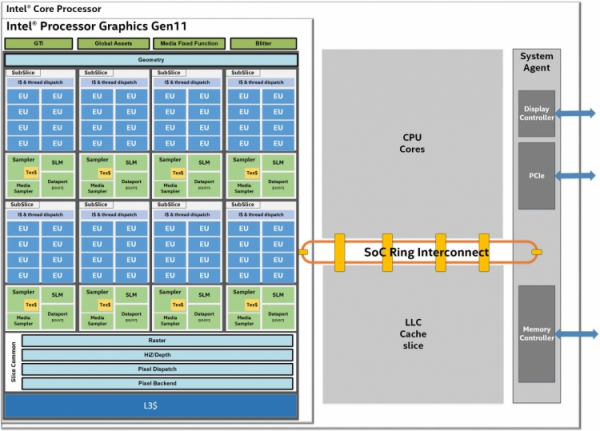
The published illustrations from Intel's technical documentation refer to the GT2 version of the 11th generation graphics. This class of integrated GPUs usually sees the most widespread use, as it is found in Intel Core S and U series desktop and mobile processors, targeting the mass market.
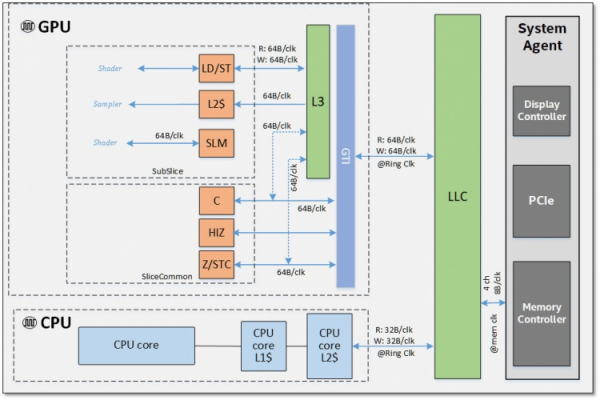
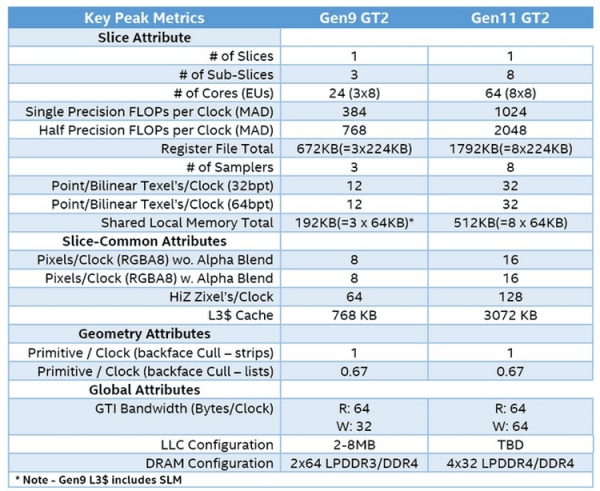
According to the published information, Intel will continue to use its ring bus in Ice Lake processors, despite the increase in the number of cores. This is somewhat surprising since Intel has transitioned to a Mesh connection in its multi-core high-performance and server processors. Nevertheless, the general user will be offered a well-proven connection. Additionally, the new graphics architecture suggests that the integrated GPU will have priority access to the ring bus. For graphics, a bandwidth of 64 bytes per cycle is provided for both reading and writing, whereas each CPU core has only 32 bytes per cycle for reading and writing.
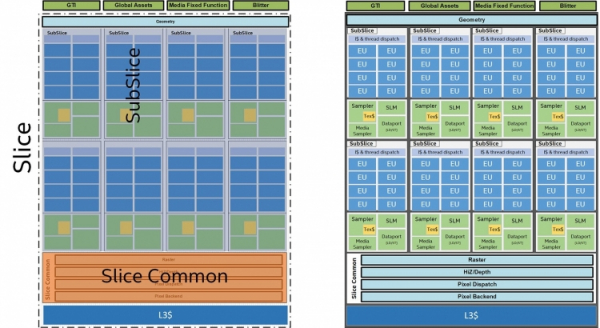
The Intel graphics will access memory through a component called GTI (Graphics Technology Interface). This interface interacts with two components of the integrated GPU: Slice Common and the level three cache. Importantly, the graphics will have its own L3 cache with a volume of 3 MB, separate from the CPU cache. The connection between GTI and what Intel refers to as SubSlice — indivisible compute blocks that contain shaders, texture blocks, instruction caches, and other components — will be established via the third-level cache. The structure somewhat resembles the streaming multiprocessors found in NVIDIA.
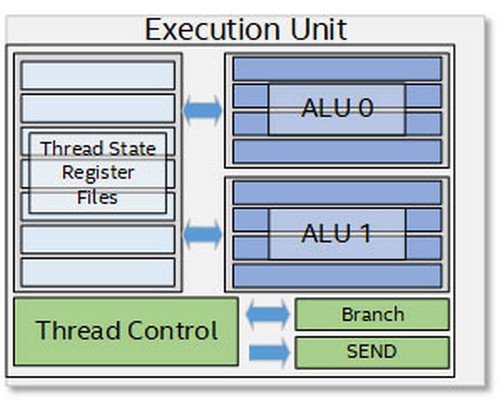
Each computing block in the SubSlice has eight execution units (EUs). Each execution unit has a pair of ALUs, each with four processing pipelines. In total, the new GT2 graphics will offer 64 EUs. Current integrated versions like GT2 have only 24 EUs, meaning a 166% increase. This will certainly positively impact the performance of Intel's integrated graphics. Additionally, the new Intel architecture includes dedicated hardware for geometry processing, as well as updated external interfaces.
Source: 3dnews.ru
