

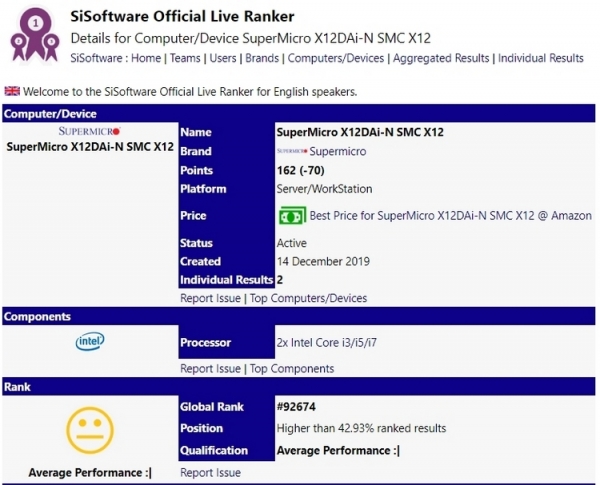
Performance test database SiSoftware has recorded a server or workstation tested on two mysterious six-core Intel processors. These processors are primarily interesting because they have a very unusual amount of L2 cache — 1.25 MB per core.
This is five times more compared to the 256 KB L2 cache of Coffee Lake Refresh desktop processors, and two and a half times more than the latest Ice Lake-U chips, which have 512 KB per core. It is also 25% more than current HEDT Core-X processors or Xeon Scalable servers, which have 1 MB of L2 cache per core.
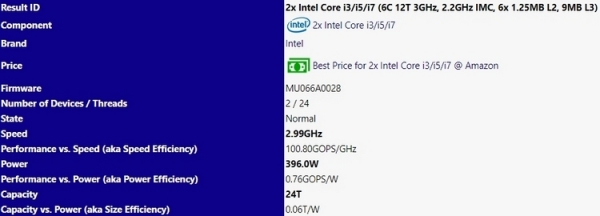
Therefore, it is reasonable to conclude that this processor uses one of Intel's new architectures. These could be the 10-nm Ice Lake or Tiger Lake, or the 14-nm Rocket Lake. There is not much known about the last two architectures at the moment, but one of about Tiger Lake specifically indicated it has 1.25 MB of L2 cache per core.
At the same time, suggested that the Tiger Lake family will only feature mobile processors with no more than four cores. In turn, Rocket Lake chips will offer up to eight cores. Moreover, the six-core chips tested in SiSoftware have less L3 cache than the previously leaked Tiger Lake.
Here, it can be assumed that the smaller L3 cache may be the result of less dense transistor placement, that is, a more 'coarse' manufacturing process. It is possible that we are witnessing a transfer of architecture from the more 'fine' 10-nm process to the good old 14-nm one. Recently, it was reported There is another possibility: everything described in the previous two paragraphs may not hold true, and we are looking at a system with two 10-nm Ice Lake-SP server processors. They could very well have the same cores as the mobile Ice Lake-U, but there will be more L2 cache per core. For Intel, such practice is no stranger.
On olemas ka teine variant: kõik eelnev kirjeldatu ei õigustu ja meie ees on süsteem kahe 10-nanomeetrise Ice Lake-SP serveriprotsessoriga. Need võivad tõepoolest omada samu tuumi kui mobiilsed Ice Lake-U, kuid iga tuuma kohta on rohkem teise taseme vahemälu. Inteli jaoks pole selline praktika enam uus.
Üldiselt on selle tulemuse põhjal raske teha mingeid konkreetseid järeldusi. Nähtusi on palju, kuid tõendeid on vähe. Ainus, mille osas võib kindel olla, on see, et need kuue tuumaga protsessorid ei põhine Skylakel.
Allikas: 3dnews.ru
