

James Morris, a maintainer of the Linux kernel security subsystem and head of the ‘Linux Emerging Technologies’ team at Microsoft, introduced the Litebox project, positioned as a security-focused operating system in the form of a Library OS. Litebox can be used in applications or kernels as an additional isolation layer, blocking access to excessive functionality of kernels or APIs to reduce the attack surface. The project's code is written in Rust and is open-sourced under the MIT license.
The idea of a ‘Library OS’ is that operating system services are directly integrated into the application instead of calling an external OS kernel via system calls. In the context of Litebox, an isolating layer is connected to applications, providing a minimal platform that translates requests to an external fully functional API. Such external interfaces may include the Linux kernel, secure isolated environments like OP-TEE (Open Portable Trusted Execution Environment), WebAssembly environments, or the standard Rust library RustStd.
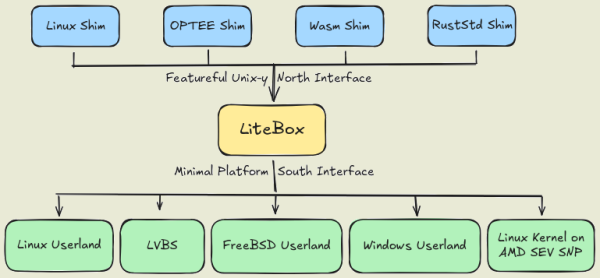
The minimal platform formed through Litebox is applicable for running Linux, Windows, and FreeBSD applications, nested Linux kernels, and LVBS (Linux Virtualization Based Security). Potential use cases for Litebox include enabling the launch of unmodified Linux programs on Windows, isolating the execution of Linux applications on systems with a Linux kernel, running programs over AMD SEV SNP for memory encryption, executing OP-TEE programs in Linux, and isolation using the LVBS concept.
The LVBS project, whose representatives are involved in the development of Litebox, enhances methods to protect components of the Linux kernel, utilizing the capabilities of hypervisors and hardware virtualization. For instance, the hypervisor can isolate authentication operations of modules, verification, and access control to passwords, keys, kernel structures, and other critical resources. In the event of an exploitation of vulnerabilities and kernel compromise, an attacker would not be able to access such resources, as their handlers are executed outside the current privilege level. Litebox is considered in the context of the LVBS project as a ‘secure kernel’ that protects the regular kernel of the guest system through hardware virtualization.
Forrás: opennet.ru
