

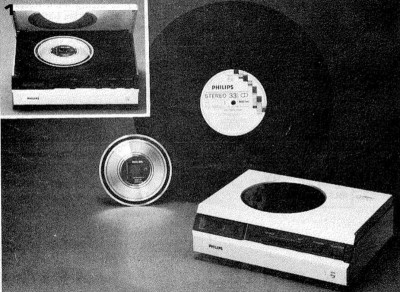
A Philips player prototype, Elektuur magazine No. 188, June 1979,
A compact disc is 40 years old, and for those of us who remember its inception, it remains a mysterious achievement of high technology even now, when this medium has had to make way under the pressure of streaming services.
If one were to pinpoint the moment when digital technology began to displace analog in consumer electronics, the arrival of the CD can certainly be considered such a moment. In the mid-seventies, the most desired electronic devices were the analog video cassette recorder and the CB radio station, but with the release of the first home computers and laser players, the dreams of those striving to be 'ahead of the curve' suddenly changed. The CD player turned out to be the first household electronic device to contain a small but genuine laser, which at the time seemed something fantastic, simply unreal. Today, new technologies entering the market do not create such an effect; they are regarded as something that appears and disappears 'in its own time.'
Where did it come from?
A CD format's origins can be traced back to the latest video recording methods of its time, which developers also aimed to adapt for high-quality audio recording. At Sony, they attempted to modify a video tape recorder for digital audio recording, while Philips worked on recording audio in an analog format on optical discs similar to those already being used for video storage. Subsequently, engineers from both companies concluded that recording on optical discs in a digital format was the better approach. Today, this conclusion seems obvious, but it was not reached easily back then. After developing two incompatible but very similar formats, Sony and Philips began to collaborate, and by 1979, they unveiled prototypes of a player and a 120-millimeter disc that could hold more than an hour of 16-bit stereo sound with a sampling frequency of 44.1 kHz. Scientific and popular literature attributed an incredible futuristic quality to this new technology, exaggerating its capabilities. Television programs promised that these discs would be "indestructible" compared to vinyl records, further fueling interest in them. The dazzling silver-cased Philips player with top-loading looked stunning, but the first models of these devices only reached store shelves in 1982.
Hogyan működik?
Although users felt that the operating principle of the CD player was excessively complex and incomprehensible, in reality, everything was surprisingly simple and clear. Especially when compared to the analog video tape recorders that many of these players were positioned alongside. By the late eighties, various topics were explained to future electronic engineers using the example of the CD player. Many were already familiar with the format, but not everyone could afford to buy such a player.
A CD drive's reading head contains surprisingly few moving parts. The module, which includes both a source and a receiver for the emission, is moved by a small electric motor through a worm gear. The IR laser shines into a prism that reflects the beam at a 90° angle. The lens focuses the beam, and after reflecting off the disk, it returns through the same lens back to the prism, this time maintaining its direction and reaching an array of four photodiodes. The focusing mechanism consists of a magnet and windings. With proper tracking and focusing, the highest intensity of emission is achieved at the center of the array, while tracking errors cause a displacement of the spot and focusing errors lead to its expansion. The automation regulates the position of the reading head, focusing, and rotation speed to produce an analog signal from which digital data can be extracted at the required rate.
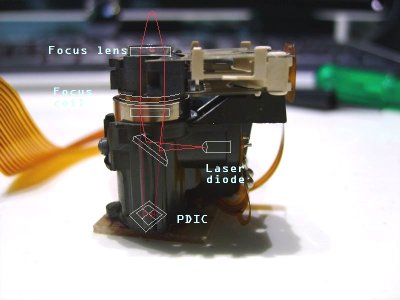
A reading head device with explanations,
Bits are combined into frames, to which modulation was applied during recording, , which helps to avoid solitary zeros and ones; for example, the sequence 000100010010000100 is transformed into 111000011100000111. After passing the frames through a lookup table, a stream of 16-bit data is obtained, which undergoes Reed-Solomon correction and is then fed to the DAC. Although different manufacturers have made various enhancements to this system over the years, the main part of the device remained a quite simple optoelectronic module.
What happened to it afterwards?
A kilencvenes években a formátum a nagyszerűből és előkelőből tömegek számára elérhetővé vált. Az lejátszók árban jelentősen csökkentek, és megjelentek a hordozható modellek. A lemezlejátszók kezdték kiszorítani a kazettásokat a zsebekből. Ugyanez történt a CD-ROM-mal is, és a kilencvenes évek második felében nehéz volt elképzelni egy új számítógépet CD-író nélkül és egy multimédiás enciklopédiával a csomagolásban. A Vist 1000HM sem volt kivétel – egy stílusos számítógép beépített hangszórókkal, FM rádióval és kompakt IR billentyűzettel, beépített joystick-kal, ami óriási távirányítóra emlékeztetett egy zenei központtól. Összességében minden megjelenésével azt kiáltotta, hogy az irodába nem való, hanem otthoni környezetbe kívánkozik, és a zenei központ helyére pályázik. Járt hozzá a „Nautilus Pompilius” együttes lemeze, 4 bites monofonikus WAV fájlokkal, amelyek kis helyet foglaltak el. Volt speciálisabb technika is, mely CD-t használt adathordozóként, mint például a Philips CD-i és a Commodore Amiga CDTV, valamint a Video CD lejátszók, a Sega Mega CD eszköz a Mega Drive/Genesis konzolokhoz, a 3DO és a Play Station (az első)…
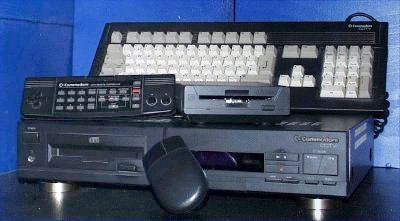
Commodore Amiga CDTV,
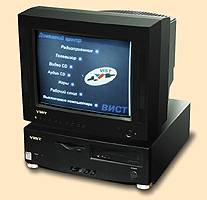
A Vist Black Jack II számítógép, amely külsejére nem különbözik a Vist 1000HM-tól,
Miközben a gazdagok mindezt felfedezték, napirenden volt egy új téma: a lehetőség, hogy otthon CD-t írjunk. Megint csak fantasztikusnak tűnt. Néhány szerencsés, író meghajtóval rendelkező ember megpróbálta visszahozni a befektetését azzal, hogy hirdetéseket ragasztott ki: „Készítek biztonsági mentést a merevlemezedről CD-re, olcsón”. Ez egybeesett a tömörített audioformátum, az MP3 megjelenésével, és megjelentek az első MPMan és Diamond Rio lejátszók. De ezek még drága flash memóriát használtak, míg a Lenoxx MP-786 CD-lejátszó igazi sláger lett — és tökéletesen olvasta mind az égetett, mind a kész MP3-fájlokat tartalmazó CD-ket. A Napster és hasonló weboldalak hamarosan a lemezkiadók áldozataivá váltak, akik ugyanakkor figyelemmel kísérték az új formátumot is. Az első licencelt MP3 lemezt a „Krematórium” zenekar adta ki, és legtöbbet éppen ezen a lejátszón hallgatták. A fordítónak egyszer meg kellett néznie egy ilyen lejátszó belsejét, hogy megszüntesse a CD és a fedél közötti súrlódást. Az Apple első iPod-jainak megjelenése, amelyek lehetővé tették az albumok vásárlását a számítógép képernyőjén egy kényelmes interfészen keresztül, arra ösztönözte a zenei kiadókat, hogy végleg áttérjenek a tömörített audioformátumokkal való harcból a belőlük származó kereskedelmi nyereség kiaknázására. Aztán a mobiltelefonok szinte gyorsabban kiszorították a különálló MP3 lejátszókat, mint azok korábban a CD-ket, és a vinyl lemezek és kazetták most újjáélednek. Halott a kompakt lemez? Valószínűleg nem, hiszen a meghajtók és a médiák gyártása teljesen nem szűnt meg. Elképzelhető, hogy egy új nosztalgia hullám újjáéleszti ezt a formátumot is.
Forrás: habr.com
