

A Phoronix resource published the results of a performance comparison of gaming applications running in environments based on Wayland and X.org in Ubuntu 21.10 on a system with an AMD Radeon RX 6800 graphics card. The testing involved games such as Total War: Three Kingdoms, Shadow of the Tomb Raider, HITMAN 2, Xonotic, Strange Brigade, Left 4 Dead 2, Batman: Arkham Knight, Counter-Strike: Global Offensive, and F1 2020. The tests were conducted at screen resolutions of 3840×2160 and 1920×1080 for both native Linux builds of the games and for Windows games launched using the Proton + DXVK combination.
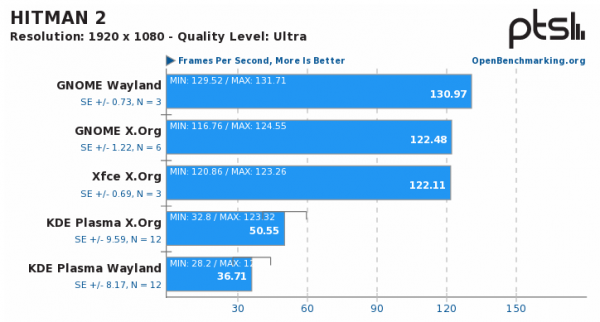
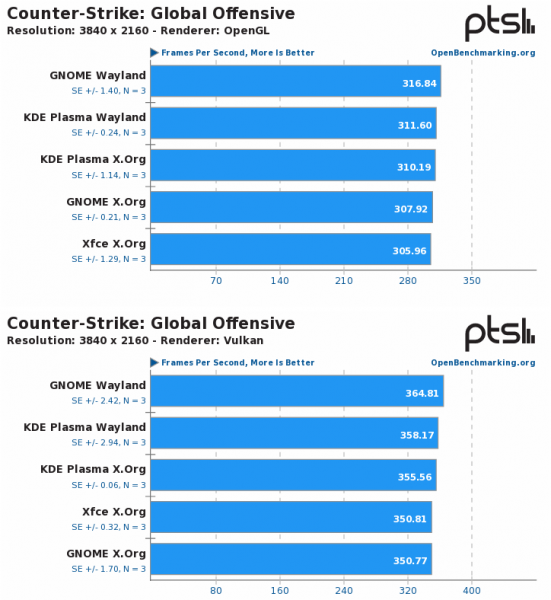
On average, games in GNOME sessions based on Wayland demonstrated FPS that was 4% higher than in GNOME sessions running on top of X.org. In most tests, KDE 5.22.5 slightly lagged behind GNOME 40.5 when using Wayland, but outperformed it when using X.Org in the majority of game tests (Counter-Strike: Global Offensive, F1 2020, Shadow of the Tomb Raider, Left 4 Dead 2, Xonotic, Total War: Three Kingdoms, Strange Brigade).
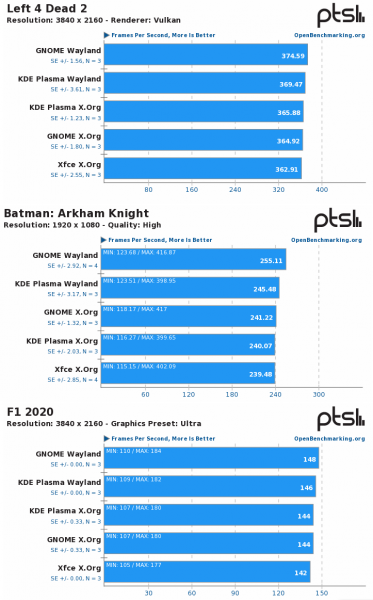
For the games 'Total War: Three Kingdoms' and 'Shadow of the Tomb Raider', it was not possible to conduct KDE tests on Wayland due to game crashes. In the game HITMAN 2 when using KDE, regardless of the graphics subsystem, there was an abnormal more than twofold lag compared to GNOME and Xfce.
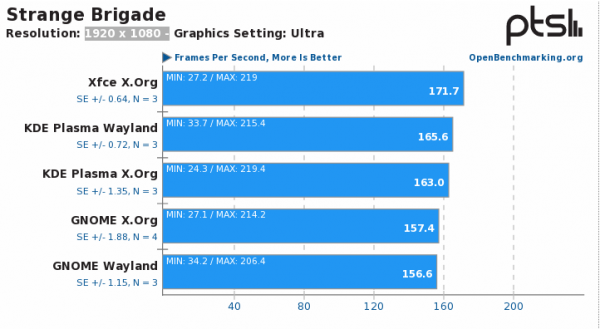
Xfce was tested only with X.org and ranked last in most measurements, except for the tests of the game Strange Brigade at a resolution of 1920×1080, where Xfce took first place both when launching native game builds and when using the Proton layer. However, in the test with the resolution of 3840×2160, Xfce was last. This test was also notable in that the KDE Wayland session surpassed GNOME.
In games supporting OpenGL and Vulkan, using Vulkan led to FPS being approximately 15% higher.
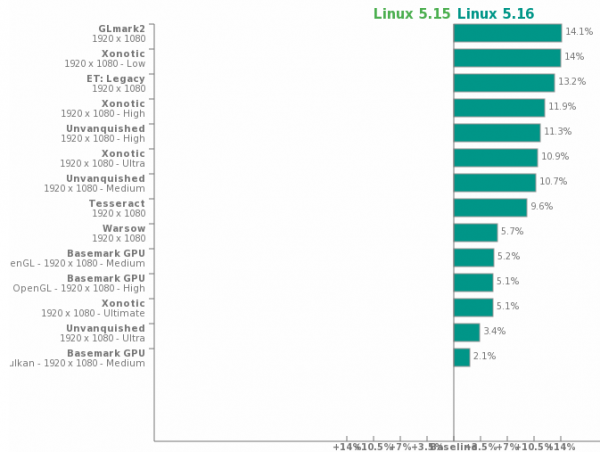
Furthermore, results have been published comparing the performance of various games and benchmarking applications using Linux kernels 5.15.10 and 5.16-rc on laptops with Ryzen 7 PRO 5850U and Ryzen 5 5500U processors. The tests showed a significant performance increase (from 2 to 14%) when using the Linux kernel 5.16, which was consistent regardless of the Mesa version (the final test used the 22.0-dev branch). The release of kernel 5.16 is expected on January 10. It is not clear which specific change in kernel 5.16 led to the performance increase; it is assumed to be a combination of improvements related to CPU usage in the task scheduler and optimizations for Radeon Vega GPU support in the AMDGPU driver.
Továbbá érdemes megemlíteni az AMDVLK grafikus meghajtó kiadását, amely Vulkan grafikus API implementációt kínál, és amelyet az AMD fejleszt. A meghajtó kódja nyílt forrású lett, miután a korábbi, az AMDGPU-PRO zárt meghajtócsomag részeként került bemutatásra, és versenytársa volt a Mesa projekt által fejlesztett nyílt forráskódú Vulkan meghajtónak, az RADV-nek. 2017 óta az AMDVLK meghajtó kódja MIT licenc alatt érhető el. Az új kiadás kiemelkedő, mivel támogatja a Vulkan 1.2.201 specifikációt, megvalósítja a VK_EXT_global_priority_query Vulkan kiterjesztést és megoldja a teljesítménnyel kapcsolatos problémákat a Wayland alapú környezetekben (az Ubuntu 21.04 Wayland session-jén 40%-os teljesítménycsökkenést tapasztaltak az Ubuntu 20.04 X.Org session-hoz képest).
Forrás: opennet.ru
