

Petr Hosek, a leader at Google responsible for the team's build systems, compilers, and developer tools, unveiled the first device to be equipped with the Fuchsia operating system. The Fuchsia-based firmware will start to be delivered to smart photo frames for the Nest Hub as part of an experimental update for participants in the Google Preview Program.
If no unforeseen issues arise during the trial implementation, the Fuchsia-based firmware will be applied to the devices of other Nest Hub users, who will not notice any differences, as the interface built on the Flutter framework will remain the same; only the low-level components of the operating system will change. Previously, the devices sold since 2018, which combine the functions of a photo frame, multimedia system, and smart home management interface, used firmware based on the Cast shell and Linux kernel.
It is worth recalling that since 2016, Google has been developing a universal operating system as part of the Fuchsia project, capable of running on any type of device, from workstations and smartphones to embedded and consumer electronics. The development takes into account the experience gained in creating the Android platform and addresses shortcomings in scalability and security.
The system is based on the Zircon microkernel, which is derived from the LK project, extended for use across various classes of devices, including smartphones and personal computers. Zircon expands LK with support for processes and shared libraries, user-level operations, an object handling system, and a capability-based security model. Drivers are implemented as user-space dynamic libraries loaded by the devhost process and managed by the device manager (devmg, Device Manager).
A Fuchsia saját grafikus felületet készített Dart nyelven, a Flutter keretrendszer használatával. A projekt részeként fejlesztik a Peridot felhasználói felület építő keretrendszert, a Fargo csomagkezelőt, a libc standard könyvtárat, az Escher renderelő rendszert, a Magma Vulkan-illesztőprogramot, a Scenic összeállító menedzsert, a MinFS, MemFS, ThinFS (Go nyelven írt FAT) és Blobfs fájlrendszereket, valamint az FVM partíciókezelőt. Az alkalmazásfejlesztéshez támogatott nyelvek közé tartozik a C/C++, Dart, a rendszerszintű komponensekben pedig Rust, a hálózati veremben Go, a build rendszerben pedig Python használata is megengedett.
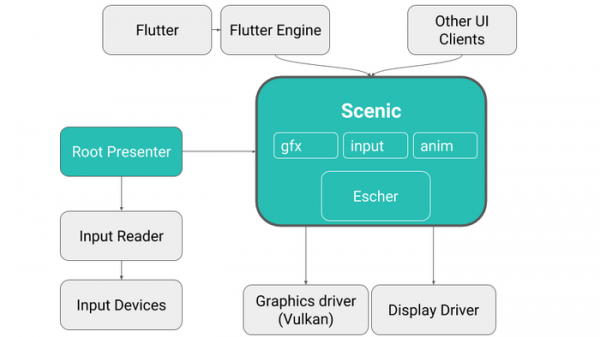
A betöltés során egy rendszermenedszer működik, amely tartalmazza az appmgr-t az alap programkörnyezet létrehozásához, a sysmgr-t a betöltési környezet kialakításához és a basemgr-t a felhasználói környezet beállításához és a rendszerbe való belépés szervezéséhez. A biztonság érdekében egy fejlett sandbox-izolációs rendszert kínál, amelyben az új folyamatok nem férnek hozzá a kernel objektumaihoz, nem tudnak memóriát allokálni és nem tudnak kódot futtatni; az erőforrásokhoz való hozzáférést egy névtér rendszer határozza meg, amely meghatározza a rendelkezésre álló jogosultságokat. A platform keretrendszert biztosít a sandboxban futó programokat képviselő komponensek létrehozásához, amelyek más komponensekkel IPC-n keresztül léphetnek interakcióba.
Forrás: opennet.ru
