

A Linux kernel development series of patches has been proposed by the developers, created by the Multikernel project, which has recently transitioned to open-source status and will now be developed in collaboration with the community. Multikernel allows multiple independent instances of the Linux kernel to run on a single physical computer, having direct access to hardware resources and being able to launch several isolated system environments. The project was developed by Multikernel Technologies, founded and led by Cong Wang, who manages the traffic control subsystem (TC) in the Linux kernel.
An enhanced kexec call has been proposed for launching and managing kernels, which, unlike the classic kexec, is not limited to replacing the currently running kernel and allows additional parallel kernel instances to be launched. An interface '/proc/multikernel' has been implemented for monitoring and debugging running kernel instances, and a communication framework called Multikernel IPI has been proposed for messaging between kernels and coordinating their operations.
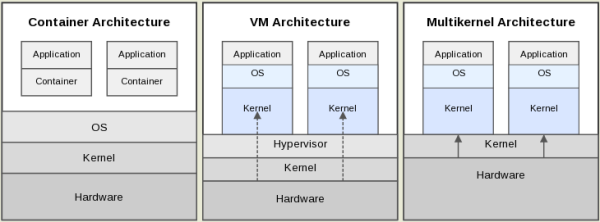
Multikernel is presented as a new isolation architecture that occupies a niche between virtualization using hypervisors and container-based isolation with a shared kernel. Unlike virtualization, Multikernel does not require the use of a hypervisor, simplifies the creation of environments for isolated application launches, and allows achieving high performance without the overhead tied to virtualization. In contrast to containers, Multikernel provides a high level of isolation and allows the use of a separate kernel in each isolated environment.
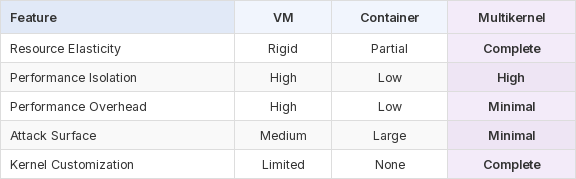
The performance when using Multikernel is assessed as being close to the performance of running on separate hardware. This has been achieved by eliminating the overheads inherent in virtualization that arise from VM exits, IOMMU translation, and hypervisor intervention in the execution of privileged operations. Dynamic resource allocation for launched environments and predictable performance provisioning are supported.
A párhuzamos végrehajtás több magot virtualizáció nélkül, SMP-processzor használatával történik, amely a rendelkezésre álló CPU-t a Linux magok példányai között osztja el. Minden Linux magpéldány egy vagy több, végrehajtására kijelölt CPU maghoz van rendelve, míg a többi hardverforrást közösen használják.
A Multikernel fő előnyei:
- Javított elkülönítés a futó környezetek meghibásodása ellen.
- Fokozott biztonság a magszintű elválasztás révén.
- Hatékonyabb erőforráskihasználás a hagyományos hipervizoros virtuális gépekkel összehasonlítva, mint pl. KVM és Xen.
- Potenciális lehetőség a mag frissítésére a munka megszakítása nélkül a KHO (Kernel Hand Over) mechanizmus használatával.
- Támogatja a standard felhőinfrastruktúrákkal való integrációt, valamint a hagyományos virtualizációs és konténeres elszigetelési rendszerekről való átlátható átmenetet.
- Teljes körű kompatibilitás a meglévő alkalmazásokkal és a Linux rendszeri interfészekkel. A Multikernel csak konkrétan módosítja a magot, megőrizve a teljes API-szintű kompatibilitást.
Forrás: opennet.ru
