

Stéphane Graber, a Linux Containers project leader, co-creator of the LXC tools, member of the Ubuntu Technical Board, and participant in the teams responsible for releasing Ubuntu, presented a new Linux distribution, IncusOS. IncusOS provides an atomically updatable system image for server creation, which is centrally managed using the Incus tool (a fork of LXD). The distribution is developed under the auspices of the Linux Containers project, which is responsible for the development of the LXC and Incus tools. The project is written in Go and is distributed under the Apache 2.0 license.
System images are provided for x86_64 and ARM64 architectures, based on a trimmed-down environment of Debian 13 and a Linux kernel from the Zabbly repository, which creates packages with 'vanilla' kernel versions for Debian and Ubuntu, supplemented with patches and configuration changes to optimize container startup in an Incus-based environment. ZFS is used as the file system.
Builds are created using the mkosi tool, developed by Lennart Poettering. The base system environment is mounted in read-only mode. Additional applications are installed using the systemd-sysext utility, which allows distributing applications in the form of system extension images, the contents of which overlay the hierarchy /usr/ using OverlayFS. Backup and restoration of the main system settings and individual application data are supported, as well as a factory reset for the entire OS or selected applications.
To update the system, the systemd-sysupdate component is used, employing an atomic partition replacement mechanism—there are two independent partitions, where one contains the working system and the other is used for the next update, after which the partitions swap places. To ensure the integrity of the boot environment, booting is done using UEFI Secure Boot and full disk encryption (LUKS), with decryption key information stored in TPM 2.0 (Trusted Platform Module).
A rendszer környezete minimalizálva van, és csak az Incus futtatásához szükséges elemeket tartalmaz. A környezetben nincs parancssori felület és hagyományos lehetőségek a parancssoros vezérléshez vagy SSH-n keresztüli távoli csatlakozáshoz. Ehelyett minden vezérlési és beállítási műveletet kizárólag az Incus rendszer REST API-ján keresztül végeznek el, ügyfél TLS tanúsítvány authentikációval vagy OIDC (OpenID Connect) segítségével. Minden szerver központosítottan kezelhető a webes Operations Center felületen vagy az Incus CLI felületen. Konténerek és virtuális gépek átvitelére más rendszerekből, mint például VMware vCenter, a Migration Manager áll rendelkezésre.
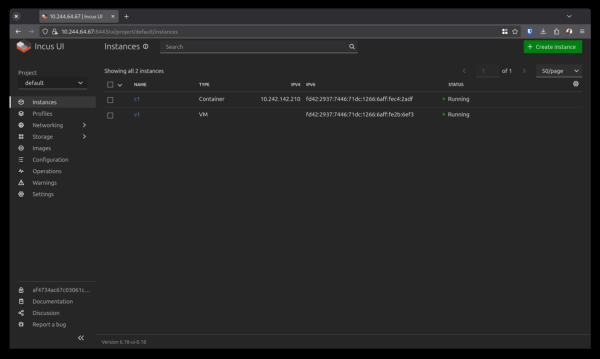
A bootolható képet online generátor segítségével készítheti el, amely lehetővé teszi a kép előkészítését a megadott paraméterek és a seed-archívum konfigurációi alapján, mint például TLS-tanúsítvány ügyfélelérhetőség, a blokk eszköz azonosítója a telepítéshez, és a hálózat konfigurálása (alapértelmezés szerint a hálózat DHCPv4 vagy SLAAC (Stateless Address Autoconfiguration) segítségével van konfigurálva). Az interaktív telepítési mód nem támogatott – minden telepítési és kezdeti beállítási paramétert egy beépített konfigurációs blokk határoz meg, amely az első indításkor kerül továbbításra. Az IncusOS képe telepíthető közvetlenül a hardverre, valamint a libvirt, Incus, Proxmox, VirtualBox és VMware platformon futó virtuális gépek alatt.
Tárhelyhez kapcsolódó lehetőségek:
- helyi ZFS medence automatikus kiépítése;
- bonyolult ZFS medencék létrehozása további lemezeken;
- NVME-over-TCP, iSCSI, fiberchannel és multipath támogatása;
- klaszter konfigurációk létrehozása LVM rétegek felett fiberchannel, NVME-over-TCP vagy iSCSI segítségével;
- szoftveres tárolók létrehozása a Ceph elosztott fájlrendszerén alapulva.
Hálózati lehetőségek:
- automatikus VLAN támogatás a hálózati híd üzemmódban, megkönnyítve a virtuális gépek csatlakozását bármely hálózati interfészhez;
- kapcsolt csatornák aggregálásának támogatása;
- LLDP (Link Layer Discovery Protocol) támogatása;
- vállalati proxy támogatása (beleértve a Kerberos általi authentikációt);
- NTP (Network Time Protocol) támogatása;
- naplók tárolásának lehetősége külső szerveren syslog-on keresztül;
- OVS/OVN támogatása szoftverhatározott OVS (Open vSwitch) és OVN (Open Virtual Network) hálózatok számára;
- beépített támogatás VPN- a Tailscale hálózat számára (tervek között szerepel a Netbird támogatása).
Forrás: opennet.ru
