

Barry Kauler, a founding member of the Puppy Linux project, has released the experimental distribution EasyOS 4.5, combining Puppy Linux technologies with container isolation for running system components. Management of the distribution is carried out through a set of graphical configurators developed by the project. The size of the boot image is 825 MB.
Az új kiadásban:
- The Linux kernel has been updated to version 5.15.78. Configuration settings have been included to improve support during compilation. KVM and QEMU, along with the inclusion of TCP syncookies for protection against SYN packet flooding.
- The panel used for viewing IP TV on the desktop has been updated to version MK8.
- The development of the woofQ build system has been moved to GitHub.
- Package versions have been updated, including Firefox 106.0.5, QEMU 7.1.0, and Busybox 1.34.1.
- Preparation has been made for revising the system operation model under the root user only (as the current operating model under the root user with privilege reset at the launch of each application is too complicated and insecure, experiments are being conducted to allow operation under a non-privileged user).
- The OpenEmbedded (OE) environment used for repackaging packages has been updated to version 3.1.20.
- The script for launching Pulseaudio has been moved to /etc/init.d.
- The system installation process has been changed and separated from the bootloader. Previously used loaders rEFInd/Syslinux have been replaced with Limine, which supports booting on systems with both UEFI and BIOS.
- SFS packages have been added with Android Studio, Audacity, Blender, Openshot, QEMU, Shotcut, SmartGit, SuperTuxKart, VSCode, and Zoom.
- The utility ‘deb2sfs’ for converting deb packages to sfs has been added. The utility ‘dir2sfs’ has been improved.
- The ability to print from applications built with GTK3 has been established.
- Compiler support for the Nim language has been added.
A disztribúció jellemzői:
- Minden alkalmazás, valamint a munkafelület külön konténerekben futtatható, amelyeket az Easy Containers saját mechanizmusa izolál.
- Alapértelmezett működés rendszergazdaként, a privilegiumok visszaállításával minden egyes alkalmazás indításakor, mivel az EasyOS egy felhasználós live rendszereként pozicionálja magát.
- The distribution installs in a separate subdirectory and can coexist with other data on the storage device (the system is installed in /releases/easy-4.5, user data is saved in the /home directory, and additional application containers are placed in the /containers directory).
- Támogatott az almappák titkosítása (például a /home).
- Lehetséges SFS formátumú meta-csomagok telepítése, amelyek montálható Squashfs képek, több hagyományos csomagot egyesítenek, és lényegében appimages, snaps és flatpak formátumokhoz hasonlítanak.
- A rendszer atomikus módban frissül (az új verzió egy másik mappába kerül másolásra, és az aktív könyvtár a rendszert váltja) és támogatja a frissítések utáni problémák visszavonását.
- Van egy RAM-ból való indítási mód, ahol a rendszer a töltés során a memóriába másolódik, és lemezekhez való hozzáférés nélkül működik.
- A disztribúció összeállításához a WoofQ eszköz és az OpenEmbedded projekt csomagjainak forráskódja használatos.
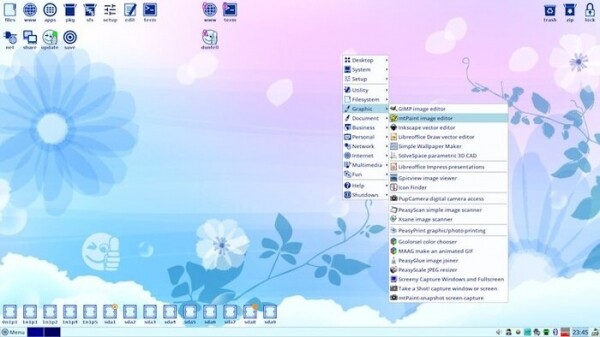
- A munkafelület a JWM ablakkezelőn és a ROX fájlkezelőn alapul.

- Az alapcsomagba olyan alkalmazások tartoznak, mint a Firefox, LibreOffice, Scribus, Inkscape, GIMP, mtPaint, Dia, Gpicview, Geany szövegszerkesztő, Fagaros jelszókezelő, HomeBank személyes pénzügyi nyilvántartó, DidiWiki személyes Wiki, Osmo szervező, Planner projektmenedzser, Notecase jegyzetkezelő, Pidgin, Audacious zenelejátszó, Celluloid, VLC és MPV médialejátszók, LiVES videószerkesztő és OBS Studio streaming rendszer.
- A fájlok egyszerűsítése és a nyomtatók közös használatának szervezése érdekében saját EasyShare alkalmazás készült.
Forrás: opennet.ru
