

Inleiding
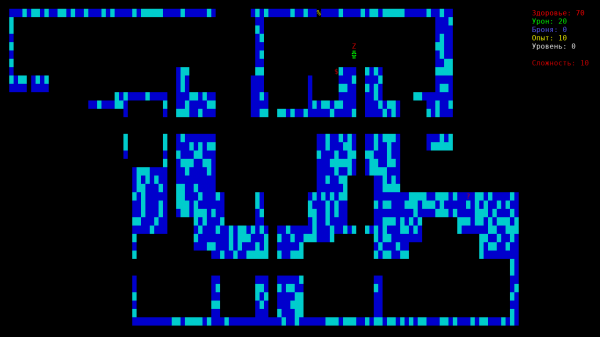
«Linux is not for gaming!» — an outdated phrase: now there are many wonderful games specifically for this amazing system. Yet, sometimes you want something special, something that fits you perfectly… So I decided to create that something special.
Basis
I won't show and explain all the code (that's not very interesting) — just the main points.
1. Character
Here are all the character parameters listed (health, armor, experience, etc.). The focus is on rendering and movement direction (which is currently absent).
int x = 5, y = 5;
    hp = 100,
    maxhp = 100,
    dm    = 20,
    armor = 0,
    xp    = 0,
    level = 0,
    diff  = 10, // difficulty
    pos   = 0; // direction

bool reg = 0,
       Mdm = 0, // bonuses
       ght = 0;

string color; // color will be used as a hero's status indicator

void hero() // this is where the hero moves to coordinates (x; y)
{
  cout << "e[u " << "e[0;0H"; // restore cursor position, erase with space
  for (int i = 0; i <= x; i++)
    cout << RIGHT;              // macro "e[1C"
  for (int i = 0; i <= y; i++)
    cout << DOWN;             // macro "e[1B"
  cout << "e[s" << color << "╬"; // save cursor position
}
2. Control
How to move the character is clear (x—++, y—++). However, handling the keyboard is more interesting:
char key;
char getkey()
{
  system("stty raw");
  key = getchar();
  system("stty cooked");
  return key;
}
We just need to set the "control characters". You can do this with a switch, but I hate that.
switch(...) case .. : ... ; break better like this
#define KEY if (key ==
#define I ){
#define J ;}else

void keys()
{
  getkey();
    KEY 'a' I x-- ; pos = 1 J
    KEY......
}
Beauty! We loop functions and run around the screen! But it feels a bit abrupt… The cursor flickers, and letters… Let’s fix that!
//До цикла
  cout << "e[?25l"; //отключаем отображение курсора
  system("stty -echo"); //отключаем эхо-ввод
  system("xset r rate 120 10"); // изменяем задержку на более плавную
//После цикла
//-------Return_normal_system_settings--------
  cout << "e[00m";
  system("reset");
  system("xset r rate 200 20");
Whew! One percent done!
3. The Surrounding World
Here we create arrays for x, y pieces of the world and the pieces themselves (char o[N]), the same for monsters and bonuses.
We create a function world(int objx[N] .... objy[N] ... obj[N], ... objcolor[N]) in navolging van hero(), but with parameters and an additional loop to display the array… for fun, we draw only in the field of vision (vis) (if (ox[k] < vis && oy[k]....))
Now we cover the screen with bits of the world using a straightforward for loop while procedurally carving out rooms and corridors, not forgetting to insert enemies and items for complete randomness srand(time(NULL));
//------------------GENERATION---------------
void rooms()
{
  for (int i = 0; i <= 50; i++)
  {
    px[i] = rand() % 115 + 2;
    py[i] = rand() % 34 + 2;
    pl[i] = rand() % 5 + 5;
    ph[i] = rand() % 5 +  5;

    if (px[i] + pl[i] > 117) px[i] = 50 - pl[i] / 2; else
    if (px[i] < 2)           px[i] = 50 - pl[i] / 2; else
    if (py[i] < 1)           py[i] = 15 - ph[i] / 2; else
    if (py[i] + ph[i] > 37)  py[i] = 15 - ph[i] / 2;

    for (int j = 0; j <= i; j++)
    {
      while (px[i] > px[j] && px[i] < px[j] + pl[j])
        (px[i]+pl[i]/2 >= 55) ? px[i]++ : px[i]-- ;

      while (py[i] > py[j] && py[i] < py[j] + ph[j])
        (py[i]+ph[i]/2 >= 18) ? py[i]++ : py[i]-- ;

      while (px[i]+pl[i] > px[j] && px[i]+pl[i] < px[j] + pl[j])
        (px[i]+pl[i]/2 >= 55) ? px[i]++ : px[i]-- ;

      while (py[i]+ph[i] > py[j] && py[i]+ph[i] < py[j] + ph[j])
        (py[i]+ph[i]/2 >= 18) ? py[i]++ : py[i]-- ;
    }

    for (int j = 0; j <= i; j++)
    {
      while (px[j] + pl[j] >= 116) px[j]-- ;
      while (px[j] < 2)            px[j]++ ;
      while (py[j] < 1)            py[j]++ ;
      while (py[j] + ph[j] >= 37)  py[j]-- ;
    }
    tx[i] = px[i]+10; ty[i] = py[i]-3;

    if (i <= diff)
    {
      ex[i]  = px[i];
      ey[i]  = py[i];
      while (ex[i] < 10){ ex[i]++ ; epos[i] = 3 ;}
      while (ey[i] < 10){ ey[i]++ ; epos[i] = 1 ;}
      e[i]   = evar[pl[i]];
      ecolor[i] = "e[00me[31m";

      edm[i] = edmvar[pl[i]];
      ehp[i] = ehpvar[pl[i]];
      exp[i] = expvar[pl[i]];
    }
    rect(px[i], py[i], pl[i], ph[i]);
  }
}

void corrs()
{
  int pc, px, py;
  for (int i = 0; i <= 4; i++)
  {
    if (i < 2){
      px = 3;
      py = rand() % 33 + 3;
      pc = 110;
      line(px, py, pc, true);
      line(px, py+1, pc, true);
    } else {
      px = rand() % 100 + 3;
      py = 3;
      pc = 33;
      line(px, py, pc, false);
      line(px+1, py, pc, false);
    }
  }
}
4. Interaction
Now we need to ensure we don’t walk through walls and monsters and gain bonuses from items.
Our beloved for and #define
#define TOUCH if (x == ox[i] && y == oy[i] && pos ==
#define HIT   x == ex[i] && y == ey[i] && pos ==
 for (int i = 0; i <= n; i++)
  {
    if (i <= diff)
    {
     if (Mdm) ehp[i]-=2 ; // если бонус "массовый урон" включен
     epos[i] = 0;

     if (ex[i] < x+5 && ex[i] > x-5 &&
         ey[i] < y+5 && ey[i] > y-5  )
     {
       edel(i); // функция переписывающая предыдущее положение противника
       if (ex[i] < x I ex[i]++ ; epos[i] = 1 J
       if (ex[i] > x I ex[i]-- ; epos[i] = 2 J
       if (ey[i] < y I ey[i]++ ; epos[i] = 3 J
       if (ey[i] > y I ey[i]-- ; epos[i] = 4 ;}
     }
   for (int j = 0; j <= n; j++) // столкновение моба со стенками
       while (ex[i] == ox[j] && ey[i] == oy[j] || ex[i] == ex[j] && ey[i] == ey[j] && j != i)
       {
         if (epos[i] == 1) ex[i]-- ; else
         if (epos[i] == 2) ex[i]++ ; else
         if (epos[i] == 3) ey[i]-- ; else
         if (epos[i] == 4) ey[i]++ ;
       }

     if (x == ex[i] && y == ey[i]) //  "битва"
      {
       if (ehp[i] > 1)
       {
         ehp[i] -= dm;
         (edm[i] < armor) ?
         hp -= 0 :
         hp -= edm[i]-armor;
       } else {
         ex[i] = ey[i] = -1;
         xp += exp[i];
         ehp[i] = 12;
       }
     }
     if (!ght) // если не призрак проверять столкновение игрока с врагами
     {
       if (HIT 1) y++ ;else
       if (HIT 2) x-- ;else
       if (HIT 3) y-- ;else
       if (HIT 4) x++ ;
     }
    }
    if (!ght) // то же, но со стенами
    {
      TOUCH 1 I y++ J
      TOUCH 2 I x-- J
      TOUCH 3 I y-- J
      TOUCH 4 ) x++ ;
    }
  }
5. Menu
We display the menu on the screen, numbering the items, and process the player's selection using getkey(). We write the character's status bar, implement the leveling menu, write the backstory, and get what I called "Subsoil".
Conclusie
This is something. You can play it by , unpacking, and launching it as follows:
$ sudo chmod +x Subsoil-1.0/Subsoil$ Subsoil-1.0/Subsoil, or, finally inspired, write an adventure to your taste. I warn you in advance: my game is not easy!
Links
, .
Bron: habr.com
