

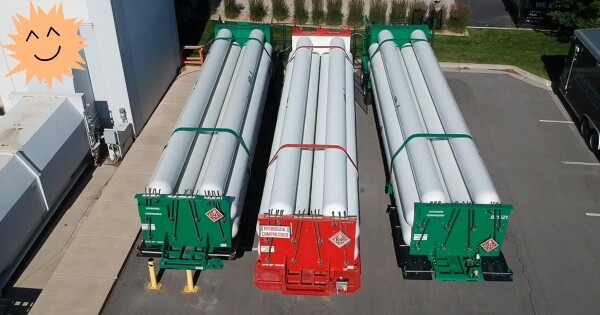
Microsoft about the world's first large-scale experiment using hydrogen fuel cells for powering servers in the data center.
The installation of 250 kW was carried out by the company . In the future, a similar 3-megawatt installation will replace traditional diesel generators currently used as a backup power source in data centers.
Hydrogen is considered an environmentally friendly fuel because the only byproduct of its combustion is water.
Microsoft has set the goal .
Like in other data centers, diesel generators are used as backup power sources in Azure data centers when electricity is lost from the main channel. This equipment is idle 99% of the time, but the data center still keeps it operational to ensure it runs smoothly in case of rare failures. In practice, Microsoft conducts only monthly functionality checks and annual load testing when power is actually supplied to servers. Main power failures do not occur every year.
However, Microsoft specialists have calculated that the latest hydrogen fuel cell models are already more cost-effective than diesel generators.
Additionally, current backup power (UPS) uses batteries that provide power in a small interval (from 30 seconds to 10 minutes) between the network disconnection and the startup of diesel generators. The latter can operate continuously until the fuel runs out.
A hydrogen fuel cell replaces both the UPS and the diesel generator. It consists of hydrogen storage tanks and an electrolysis unit that splits water molecules into hydrogen and oxygen. Here’s what the 250 kW Power Innovations model actually looks like:
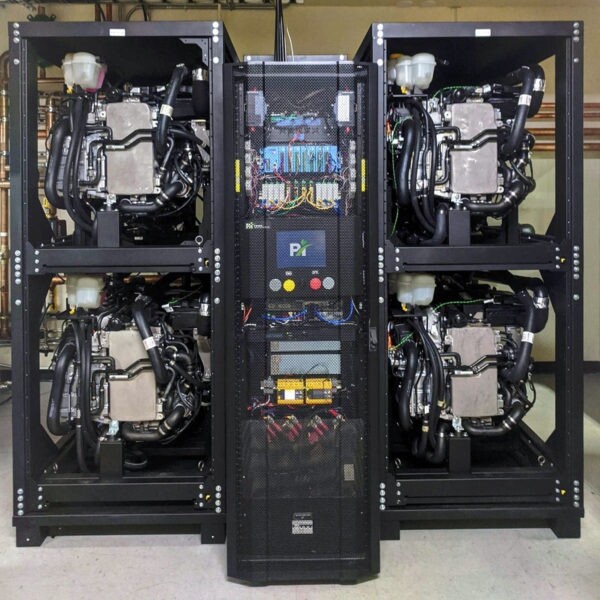
The installation simply connects to the existing electrical network— and does not require fuel delivery from outside, unlike a diesel generator. It can be integrated with solar panels or wind stations, which will generate enough hydrogen to fill the tanks. Thus, hydrogen is used as a chemical battery for electricity from solar and wind stations.
In 2018, researchers from the National Renewable Energy Laboratory in Colorado (USA) conducted the first successful experiment powering server racks with PEM (proton exchange membrane) fuel cells, meaning .
PEM is a relatively new technology for hydrogen production. These systems are gradually replacing traditional alkaline electrolysis. The core of the system is the electrolysis cell. It features two electrodes, a cathode and an anode. A solid electrolyte, which is a high-tech polymer-based proton exchange membrane, is located between them.
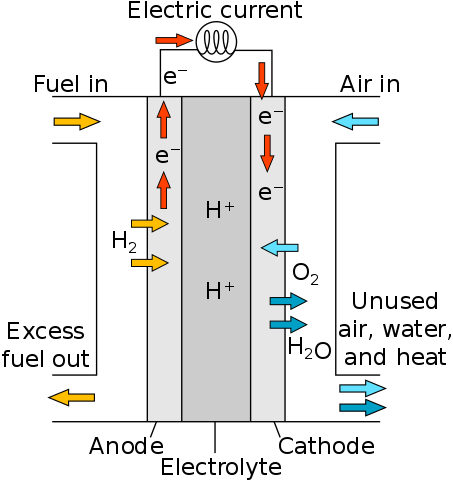
Technologically, protons flow stably through the membrane, while electrons travel through an external circuit. Deionized water enters the anode, where it is split into protons, electrons, and gaseous oxygen. Protons pass through the membrane, and electrons move through the external electric circuit. At the cathode, protons and electrons recombine to form gaseous hydrogen (H2).
This is an extremely high-performance, reliable, and cost-effective method of producing hydrogen directly at the point of consumption. When hydrogen and oxygen combine, water vapor is produced, and electricity is generated.
In September 2019, Power Innovations began experimenting with a 250-kilowatt fuel cell that powers 10 full server racks. In December, the system underwent a 24-hour reliability test, and in June 2020, a 48-hour test.
During the last experiment, four such fuel cells operated automatically. :
- 48 hours of continuous operation
- 10,560 kWh of electricity generated
- 814 kg of hydrogen used
- 7,000 liters of water produced
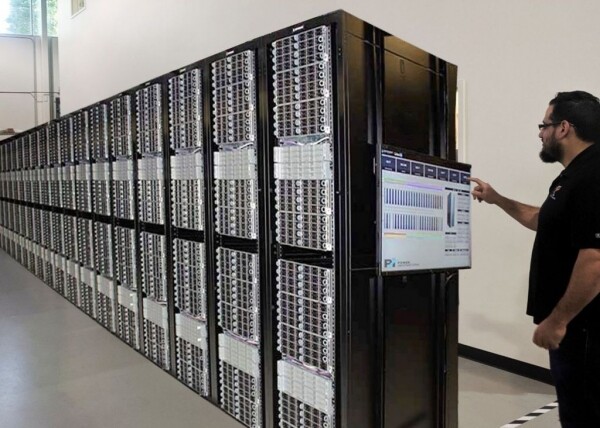
Now the company plans to construct a 3-megawatt fuel cell using the same technology. This will match the capacity of diesel generators installed in Azure data centers.
The promotion of hydrogen as fuel is handled by an international organization , die fabrikanten van apparatuur, transportbedrijven en grote klanten verenigt — Microsoft heeft al een vertegenwoordiger in deze raad aangesteld. In principe zijn alle technologieën voor de productie van waterstof en de opwekking van elektriciteit al beschikbaar. De taak van de organisatie is om ze op te schalen. Hier is nog veel werk aan de winkel.
Specialisten zien een grote toekomst voor PEM-brandstofcellen. In de afgelopen twee jaar is hun prijs met ongeveer vier keer gedaald. Ze zijn uitstekende aanvullingen op fotovoltaïsche en windcentrales, die energie opslaan tijdens periodes van maximale generatie — en deze terugleveren aan het netwerk tijdens piekbelastingen.
Nogmaals, ze kunnen worden gebruikt voor brokering op de energiemarkt, wanneer het systeem energie koopt in perioden van minimaal of zelfs — en deze teruglevert tijdens momenten van maximale kosten. Dergelijke brokersystemen kunnen automatisch werken, zoals handelsbots.
Adverteervermelding
Reserve-energiebronnen van onze datacentra werken misschien niet op waterstof, maar de betrouwbaarheid is hoog! Onze epische servers zijn krachtige , die gebruikmaken van moderne processoren van AMD.
Over hoe we de cluster voor deze dienst hebben gebouwd in op Habr.
Bron: habr.com
