

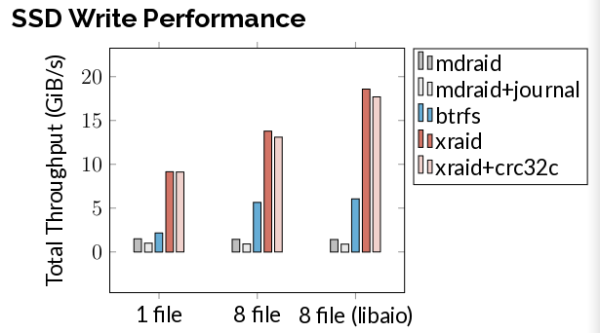
Christoph Hellwig, maintainer of the DMA subsystem, KVM, Slab Allocator and PowerPC architecture in the Linux kernel, has introduced the first public release of XRAID, an implementation of declustered RAID with parity control, integrated into the XFS filesystem. The project aims to enable the use of RAID on zoned storage devices, such as SMR (Shingled Magnetic Recording) disks, and to provide a high-performance RAID implementation for maintaining data integrity. In addition to zoned devices, XRAID also works on traditional hard drives and SSDs, demonstrating a significant performance boost on the latter compared to mdraid (up to 20 times during writes).
For distributing information across drives in XRAID, a declustered parity control is used, similar to dRAID in OpenZFS, where no separate drives are allocated for hot spare; instead, data, parity information, and free spare space are evenly distributed across all drives. The read, write, and recovery processes, in case of failures, cover all available drives, which increases bandwidth, reduces load on individual disks, avoids noticeable performance degradation during failures, and significantly speeds up the process of reconstructing the array after adding or replacing drives.
Declustered RAIDs also simplify the creation of fault-tolerant arrays with a very large number of disks. During recovery from failures, XRAID dynamically determines the order of reconstruction of the drives, prioritizing zones with the greatest loss of redundant information and reconstructing data zones before those with parity information.
XRAID is originally developed with an eye toward the possibility of using zoned storage devices, where the storage space is divided into zones that make up groups of blocks or sectors. In such devices, only sequential data additions are allowed, updating the entire group of blocks. For example, zoned recording is employed in Shingled Magnetic Recording (SMR) drives, where the track width is less than the magnetic head width, and the recording is done with partial overlap of the adjacent track, meaning any rewriting necessitates rewriting the entire group of tracks.
To support zoned devices, XRAID employs a zoned block allocator implemented in XFS and the Linux kernel, which uses the RealTime subvolume for organizing separate storage of data and metadata (in zones with sequential writing, only the file contents are stored, while the filesystem metadata is placed in regular zones or on additional SSDs).
In XRAID, RAID parity mechanisms are applied only to file contents, while redundancy for metadata is achieved through utilizing the existing Linux kernel drivers, such as mirroring with MD RAID, which is more efficient for small objects updated in place. The RAID implementation is integrated into XFS up to the zoned I/O handlers, representing the physical zones of the underlying storage as logical zones, similar to a multi-layer block device.
Work on XRAID has been ongoing for a year and a half, and although the implementation is not yet ready for integration into the main kernel, it is already suitable for testing by a wide audience. In the proposed implementation, support for 0 to 2 levels of parity is provided (code for supporting 3 or more levels is in development). A new utility 'xraid' has been added to the xfsprogs toolkit for managing XRAID, and support for XRAID has been implemented in mkfs. Additionally, the Zonar utility for inspecting zoned storage devices has been enhanced with capabilities for visualizing the mapping of logical zones to physical zones.
De resultaten van de prestatietests van XRAID vergeleken met mdraid en btrfs zijn gepubliceerd, uitgevoerd voor de XRAID-array in een configuratie van twee WD DC-SN650 SSD's voor metadata (spiegel op basis van mdraid), zes normale WD DC-HC590 SATA-schijven van 26 TB en 6-21 gezoneerde WD DC-HC690-schijven van 30 TB (SMR).
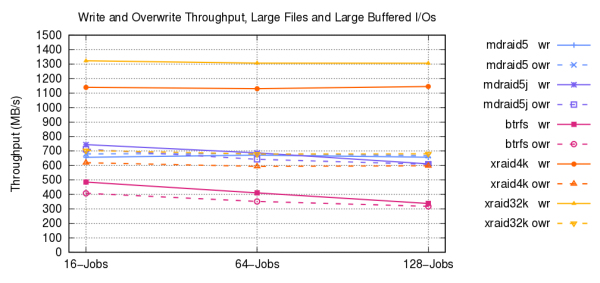
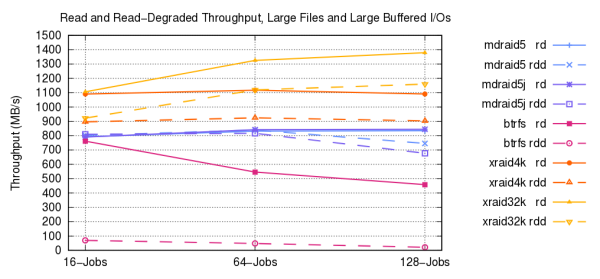
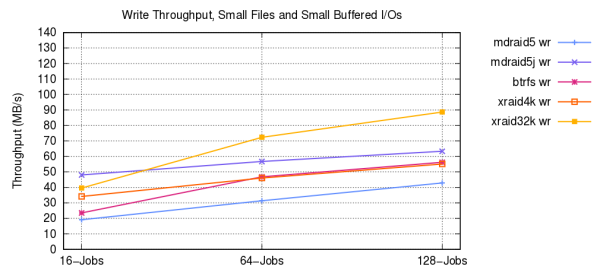
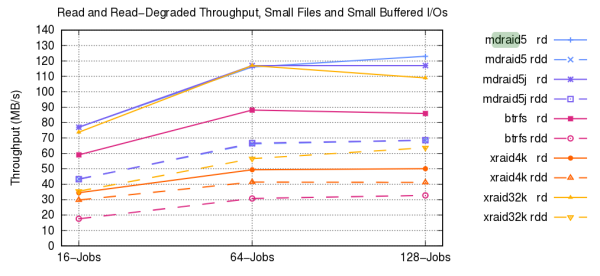
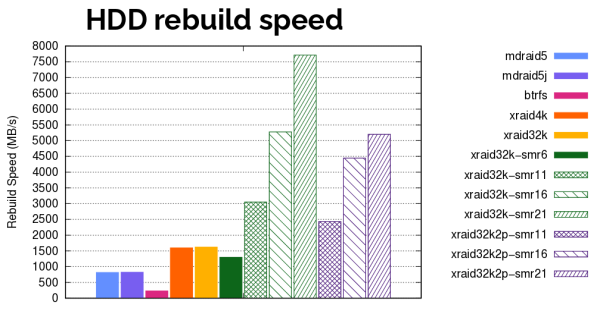
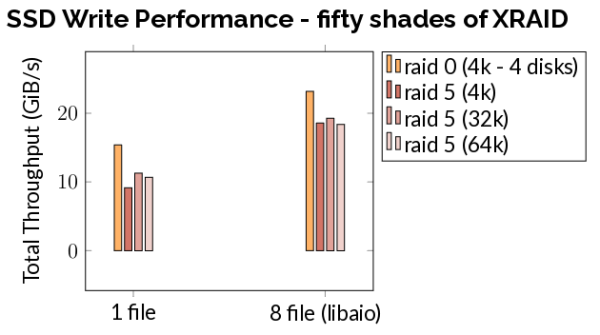
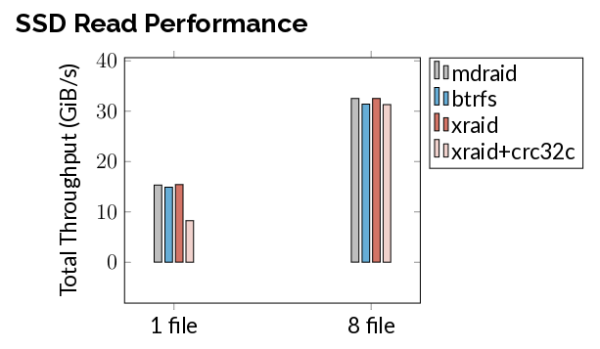
Er zijn ook tests uitgevoerd met XRAID op gewone ongezoneerde SSD's in een configuratie met één 4 TiB Samsung PM9D3a voor metadata en vijf 4 Tib Samsung PM9D3a voor RAID (4 + 1).
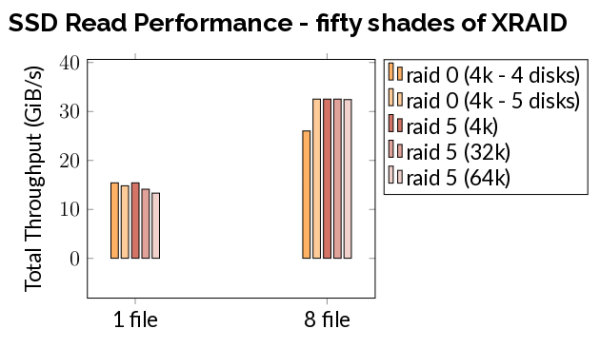
Bron: opennet.ru

 Russian
 Italian
 German
 Polish
 Estonian
 Albanian
 Bulgarian
 Croatian
 Czech
 Danish
 Dutch
 English
 Finnish
 French
 Hungarian
 Latvian
 Lithuanian
 Norwegian
 Portuguese
 Romanian
 Slovak
 Slovenian
 Spanish
 Swedish