

— slang term commonly used among American sailors, referring to rumors and gossip. Node.js developer Dominic Tarr, who lives on a sailboat off the coast of New Zealand, used this word for the name of a p2p network intended for sharing news and personal messages. Secure Scuttlebutt (SSB) allows information sharing with only occasional access to the Internet or even without it altogether.
SSB has been operational for several years. The social network's functionalities can be tested using two desktop applications ( i ) and an Android application (). For geeks, there is . Are you curious about how an offline-first p2p network works without ads and registration? Please read more below.
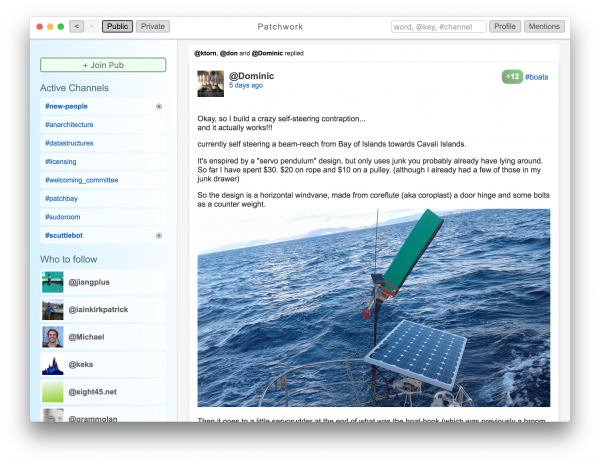
To operate Secure Scuttlebutt, it is sufficient to have two computers connected in a local network. Applications based on the SSB protocol broadcast UDP messages and can automatically discover each other. Finding nodes on the Internet is somewhat more complex, and we will return to this issue in a few paragraphs.
A user's account is a linked list of all their entries (the journal). Each subsequent entry includes a hash of the previous one and is signed by the user's private key. The public key serves as the user's identifier. Deleting and editing entries is not possible for the author or anyone else. The owner can add entries to the end of the journal. Other users can read it.
Applications on the same local network can see each other and automatically request updates from their neighbors about the journals they are interested in. It does not matter from which node you download the update, as you can verify the authenticity of each entry using the public key. No personal information is exchanged during synchronization except for the public keys of the journals you are interested in. As you switch between different WiFi/LAN networks (at home, in a café, at work), copies of your locally saved journals will be automatically transmitted to other users' devices nearby. This is akin to how : Vasja opowiedział Maszy, Masza — Piotrowi, a Piotr — Walentynie. Istotna różnica w porównaniu do "radia szeptanego" polega na tym, że podczas kopiowania dzienników informacja w nich nie jest zniekształcana.
"Mieć kogoś w gronie znajomych" nabiera tutaj konkretnego fizycznego znaczenia: moi znajomi przechowują kopię mojego dziennika. Im więcej mam znajomych, tym bardziej dostępny jest mój dziennik dla innych. W opisie zwarcia , aplikacja Patchwork synchronizuje dzienniki, które znajdują się w odległości do 3 kroków (znajomi znajomych znajomych) od ciebie. W większości przypadków pozwala to na odczytywanie długich dyskusji z wieloma uczestnikami będąc offline.
Dziennik użytkownika może zawierać wpisy różnych typów: publiczne wiadomości, podobne do postów na ścianie w VKontakte, prywatne wiadomości, szyfrowane kluczem publicznym odbiorcy, komentarze do wpisów innych użytkowników, polubienia. To otwarta lista. Obrazy i inne duże pliki nie są umieszczane w dzienniku bezpośrednio. Zamiast tego zapisywany jest skrót pliku, dzięki któremu można zażądać tego pliku oddzielnie od samego dziennika. Widoczność komentarzy dla autora oryginalnej wiadomości nie jest gwarantowana: jeśli między wami nie ma wystarczająco krótkiej drogi przez wspólnych znajomych, prawdopodobnie takich komentarzy nie zobaczysz. Tak więc, nawet jeśli wojownicy upęczki spróbują przejąć twój post, to jeśli nie byli to twoi znajomi ani znajomi znajomych znajomych, nic nie zauważysz.
Secure Scuttlebutt nie jest pierwszą siecią p2p ani nawet pierwszą p2p siecią społecznościową. Dążenie do komunikacji bez pośredników i wyjścia z wpływów dużych firm istnieje od dawna i ma kilka oczywistych powodów. Użytkowników irytuje narzucanie przez dużych graczy zasad gry: mało kto chce widzieć na swoim ekranie reklamy lub być zablokowanym i czekać kilka dni na odpowiedź od obsługi klienta. Nieograniczony zbór danych osobowych i ich przekazywanie osobom trzecim, prowadzące w końcu do tego, że dane te czasami są sprzedawane w darknecie, wciąż przypomina o konieczności stworzenia innych sposobów interakcji, w których użytkownik miałby większą kontrolę nad swoimi danymi. I sam ponosiłby odpowiedzialność za ich dystrybucję i przechowywanie.
Dobrze znane zdecentralizowane sieci społecznościowe, takie jak lub , and the protocol are not peer-to-peer, as they always involve a client and a server component. Instead of a common Facebook database, you can choose your 'home' server where your data will be hosted, which is already a significant step forward. However, the administrator of your 'home' server still has many powers: they can share your data without your knowledge, delete or block your account. Furthermore, they might lose interest in maintaining the server and not notify you about it.
Secure Scuttlebutt also has intermediary nodes that facilitate synchronization (they are called 'pubs'). However, using pubs is optional, and they are interchangeable. If your usual node is unavailable, you can use others without losing anything, as you always have a complete copy of all your data. An intermediary node does not store irreplaceable data. A pub, if you ask it, will add you as a friend and will update its copy of your feed when connected. When your followers connect to it, they can download your new posts, even if you have already disconnected. For a pub to befriend you, you must get an invite from the pub administrator. Most often, this can be done yourself through the web interface (). If you get banned by all pub administrators, your feed will be distributed as described earlier, i.e., only among those you meet in person. Transferring updates on a flash drive is also possible.
Although the network has been operational for quite some time, it has few users. According to André Staltz, the developer of the Android app , in June 2018 there were . In comparison, in Diaspora — , in Mastodon — about 1 million.
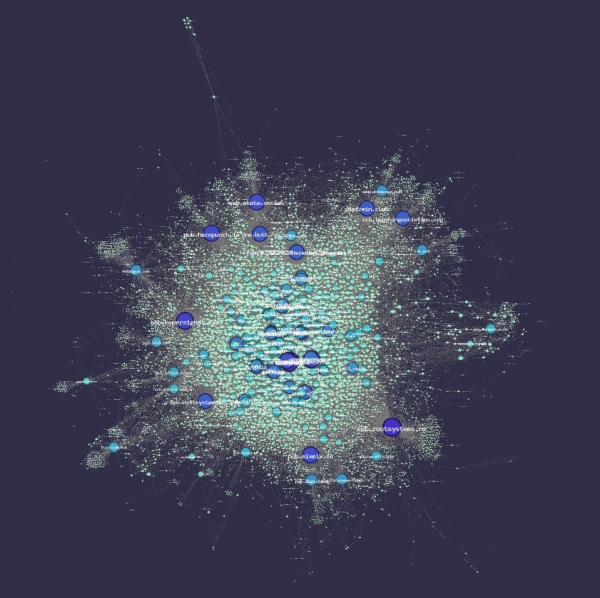
A beginner's guide is available . The main steps are: install the app, create a profile, get an invite from the pub's website, and copy this invite into the app. You can connect to several pubs simultaneously. You will need to be patient: the network operates much slower than Facebook. The local cache (folder .ssb) will quickly grow to several gigabytes. Interesting posts can be conveniently found by hashtags. You can start reading with Dominik Tarr ( @EMovhfIrFk4NihAKnRNhrfRaqIhBv1Wj8pTxJNgvCCY=.ed25519 ).
Wszystkie zdjęcia pochodzą z artykułu André Staltz i jego .
Przydatne linki:
[1]
[2] (aplikacja na Windows/Mac/Linux)
[3] (aplikacja na Androida)
[4]
[5] („Przewodnik po protokole Scuttlebutt — jak węzły Scuttlebutt się odnajdują i komunikują”)
Źródło: habr.com
