

Recent Eurostat results of a survey of citizens from member countries regarding their possession of 'digital' skills. The survey was conducted in 2019, before the entire coronavirus pandemic situation. However, this does not diminish its value, as it is better to be prepared for troubles in advance, and as European officials found out, having children in the family increased adults' digital skills.

Thus, in 2019, in the European Union (EU), 64% of citizens aged 16 to 74 with children under 16 years of age had a basic or higher level of skills in using digital technologies. This is 1% more than in 2017 and 3% more than in 2015. About 28% of citizens in the same age group reported low digital skills, among whom there were also children under 16.
The percentage of those who are 'basically literate' in IT, among families without children, turned out to be 11% lower (53% overall) than those living with children. Probably, there was no one to pick up smart jargon to impress during the survey. However, seriously, having children encourages citizens to engage in various activities online and learn to use gadgets.
Among EU member states, Finland had the highest percentage of individuals aged 16 to 74 living in households with children under 16, who reported having basic or above-basic overall skills in digital technology (88%). Following Finland are the Netherlands (83%), Sweden (81%), Germany and Estonia (each at 80%).
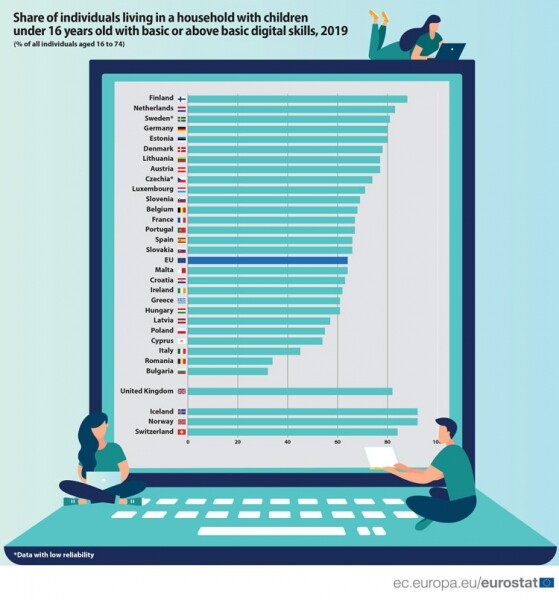
The lowest rates were observed in Bulgaria (32%), Romania (34%), Italy (45%), Cyprus (54%), and Poland (55%). The complete list of countries and their respective shares of citizens trained in digital skills can be studied in the table above. Knowledge is power!
Sursa: 3dnews.ru
