

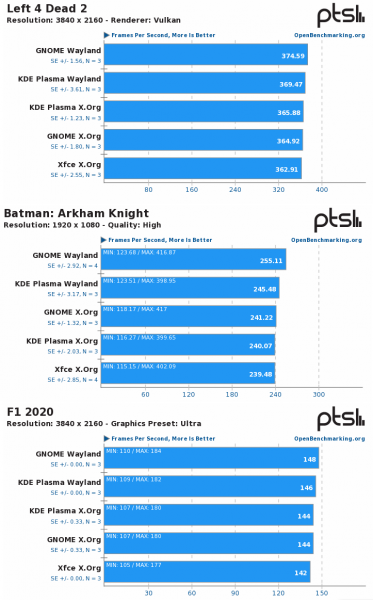
Resource Phoronix has published the results of a performance comparison of gaming applications running in environments based on Wayland and X.org in Ubuntu 21.10 on a system with an AMD Radeon RX 6800 graphics card. The testing involved games such as Total War: Three Kingdoms, Shadow of the Tomb Raider, HITMAN 2, Xonotic, Strange Brigade, Left 4 Dead 2, Batman: Arkham Knight, Counter-Strike: Global Offensive, and F1 2020. Tests were conducted at screen resolutions of 3840×2160 and 1920×1080, both for native Linux game builds and for Windows games launched using the Proton + DXVK framework.
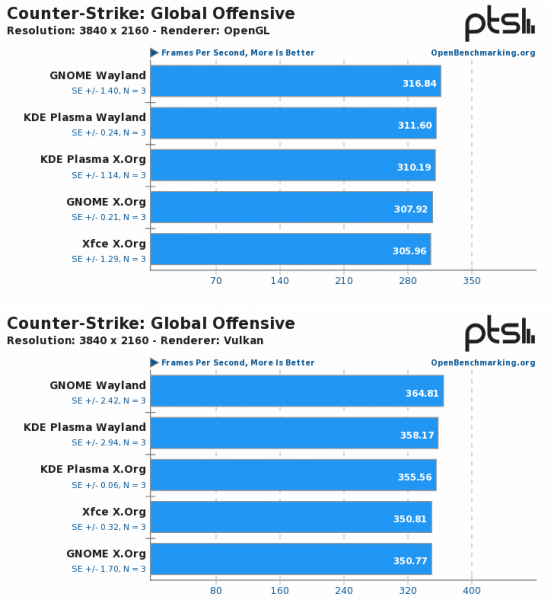
On average, games in the GNOME session based on Wayland displayed FPS that was 4% higher than in the GNOME session running over X.org. In most tests, KDE 5.22.5 lagged slightly behind GNOME 40.5 when using Wayland, but outperformed it when using X.org in tests of most games (Counter-Strike: Global Offensive, F1 2020, Shadow of the Tomb Raider, Left 4 Dead 2, Xonotic, Total War: Three Kingdoms, Strange Brigade).
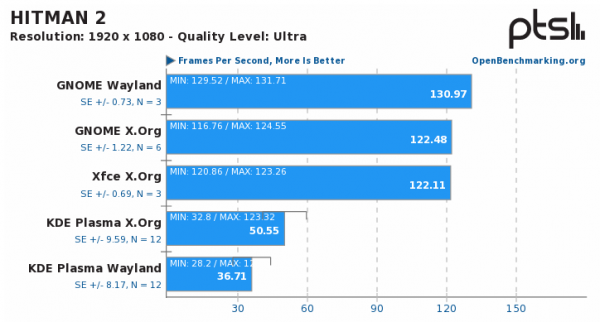
For the games 'Total War: Three Kingdoms' and 'Shadow of the Tomb Raider', it was not possible to conduct tests with KDE based on Wayland due to crashes during the games. In the game HITMAN 2 using KDE, regardless of the graphics subsystem, an anomalous more than twofold lag was observed compared to GNOME and Xfce.
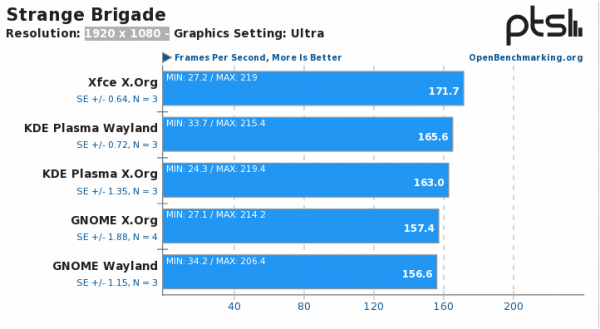
Xfce was tested only with X.org and, in most measurements, was found in last place, except for tests of the game Strange Brigade at a resolution of 1920×1080, where Xfce surged to first place both when launching native game builds and when using the Proton layer. Meanwhile, in the test with a resolution of 3840×2160, Xfce ended up in last place. This test was also notable for the fact that the KDE Wayland session outperformed GNOME.
In games that support OpenGL and Vulkan, using Vulkan resulted in FPS being approximately 15% higher.
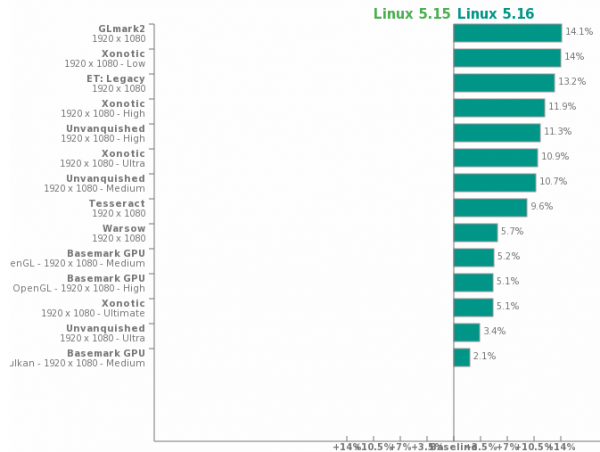
Additionally, results comparing the performance of various games and test applications using Linux kernels 5.15.10 and 5.16-rc on laptops with Ryzen 7 PRO 5850U and Ryzen 5 5500U processors were published. The tests showed a noticeable performance increase (from 2% to 14%) when using the Linux 5.16 kernel, which persisted regardless of the Mesa version (the final test used the 22.0-dev branch). The kernel 5.16 release is expected on January 10. It is not clear exactly what change in kernel 5.16 led to the performance increase, though it is assumed to be a combination of improvements related to CPU usage in the task scheduler and optimizations for Radeon Vega GPU support in the AMDGPU driver.
În plus, se poate menționa lansarea driverului grafic AMDVLK, care oferă o implementare a API-ului grafic Vulkan, dezvoltată de compania AMD. Până la deschiderea codului, driverul era livrat ca parte a setului de drivere proprietar AMDGPU-PRO și concura cu driverul Vulkan deschis RADV, dezvoltat de proiectul Mesa. Din 2017, codul driverului AMDVLK este deschis sub licența MIT. Noua versiune este notabilă pentru suportul specificației Vulkan 1.2.201, implementarea extensiei Vulkan VK_EXT_global_priority_query și soluționarea problemelor de performanță în medii bazate pe Wayland (în Ubuntu 21.04, sesiunea bazată pe Wayland a prezentat o scădere a performanței de 40% comparativ cu Ubuntu 20.04 cu sesiunea X.Org).
Sursa: opennet.ro
