

Excavator operators are familiar with a trick that allows them to send the bucket's contents beyond the reach of the boom. A robo-excavator equipped with a neural network has proven to be a diligent student who also targeted stone throwing beyond the boom's reach. Next up is throwing bulk materials and improving precision for bucket work at different heights.
Researchers from Switzerland (ETH Zürich) reported on the training process of the robo-excavator's neural network for precise manipulation of bucket contents. The reinforcement learning-based neural network was trained to throw balls and stones to a specified point that was beyond the boom's reach (up to 9.5 m when the boom's grab range is 7.5 m). Such operations will help robotics tackle a broader range of tasks with lower energy costs for movements, as well as make their work safer.
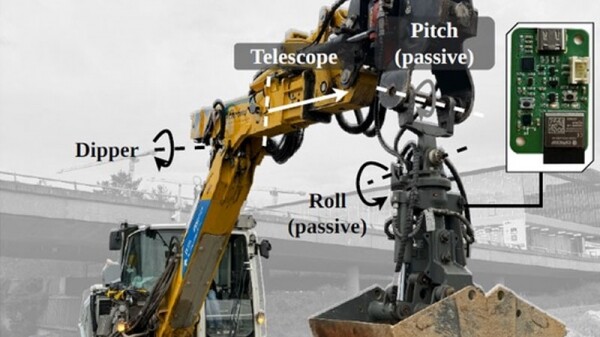
The excavator performed grabbing and throwing with two degrees of freedom, which was not rigidly fixed to the boom. Throws were made both in a straight line, using only the boom, and with cabin rotation. In the latter case, accuracy was slightly less, but in any case, the projectile deviated from the target point by no more than 30–40 cm.
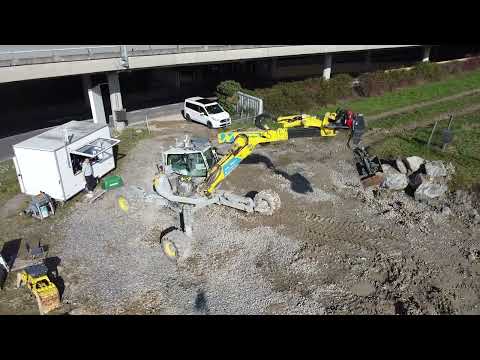
Researchers trained the neural network on a modified 12-wheeled Menzi Muck M545 excavator. Previously, they had trained the excavator on a number of non-trivial operations, such as teaching it to build a stable wall from unprepared stone blocks. The excavator independently assessed the balance of the stones and constructed a sturdy stone barrier. For precise autonomous work in the field, the excavator uses sensors installed on it to build a model of the surrounding space in which it performs assigned tasks.
Sursa:
Sursa: 3dnews.ru
