


Ka arrived the task to configure the IP address distribution for subscribers. The task conditions:
- We won’t provide a separate server for authorization — you’ll have to manage 😉
- Subscribers must receive network settings via DHCP.
- The network is heterogeneous. This includes both PON equipment and regular switches with Option 82 configured, as well as WiFi bases with access points.
- If none of the IP distribution conditions are met, an IP from the 'guest' network must be issued.
On the good side: there is indeed server on FreeBSD, which can 'work', but it’s 'far away' ;), not 'right in this network'.
There is also a wonderful device Mikrotik. The general network scheme is approximately as follows:
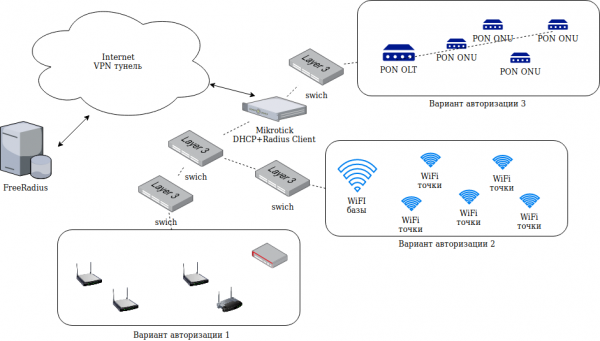
After some contemplation, the decision was made to use FreeRadius for issuing network settings to subscribers. The scheme is quite standard: on Mikrotik, we enable the DHCP server, and on it, we have the Radius Client. We configure the link DHCP server -> Radius Client -> Radius server.
It doesn’t seem complicated. But! The devil is in the details. Namely:
- When authorizing PON OLT through this scheme, a request with User-Name equal to the MAC address of the main station, Agent-Circuit-Id equal to the MAC of PON Onu and an empty password arrives at FreeRadius.
- When authorizing from switches with Option 82, a request with an empty User-Name equal to the MAC address of the subscriber's device arrives at FreeRadius, along with additional attributes Agent-Circuit-Id and Agent-Remote-Id containing, respectively, again, the MAC of the relay switch and the port to which the subscriber is connected.
- Some subscribers with WiFi points are authorized via PAP-CHAP protocols.
- Some subscribers with WiFi points are authorized with User-Name equal to the MAC address of the WiFi point, without a password.
Historical note: what is 'Option 82' in DHCP?
These are additional options in the DHCP protocol that allow for the transmission of supplementary information, for example, in the fields Agent-Circuit-Id and Agent-Remote-Id. It is usually used to transmit the MAC address of the relay switch and the port to which the subscriber is connected. In the case of PON equipment or WiFi base stations, the Agent-Circuit-Id field does not carry useful information (no subscriber port). The general scheme of DHCP operation in this case is as follows:
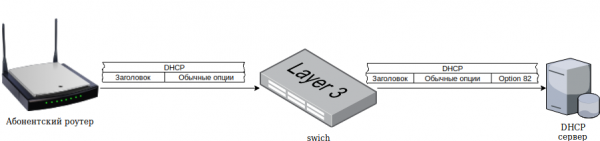
Step by step, this scheme works like this:
- Subscriber equipment makes a broadcast DHCP request to obtain network settings.
- Dispositivi (p.sh. switch, bazë stacioni WiFi ose PON) në të cilën lidhet direkt pajisja e abonentit "kap" këtë paketë dhe e ndryshon, duke futur opsionet shtesë Option 82 dhe adresën IP të agjentit të ndihmës, dhe e dërgon më tej në rrjet.
- Serveri DHCP pranon kërkesën, formulon një përgjigje dhe ia dërgon pajisjes ndihmëse.
- Pajisja ndihmëse përcjell paketën e përgjigjes në pajisjen e abonentit.
Sigurisht, gjithë kjo nuk funksionon aq thjesht, nevojitet konfiguracion i duhur i pajisjeve rrjet.
Instalimi i FreeRadius.
Me konfigurimet e FreeRadius, natyrisht që është e mundur të arrihet gjithçka, por është e komplikuar dhe e paqartë… sidomos kur hyn aty pas N muajsh "gjithçka funksionon". Prandaj u mor vendimi për të shkruar modul të vetin të autorizimit për FreeRadius në Python. Të dhënat për autorizim do t’i marrim nga një bazë MySQL. Nuk ka kuptim ta përshkruaj strukturën e saj, pasi çdo njeri do ta bëjë "sipër". Unë veçanërisht kam marrë strukturën që ofrohet me modul sql për FreeRadius, dhe e kam ndryshuar pak, duke shtuar fushën MAC dhe port për secilin abonent, përveç emrit dhe fjalëkalimit.
Kështu, për fillim, instalojmë FreeRadius:
cd /usr/ports/net/freeradius3
make config
make
install clean
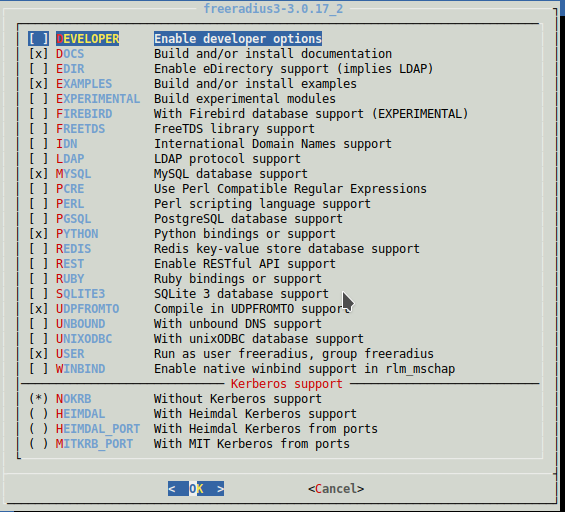
Në konfigurime shënojmë për instalim:
Bëjmë një lidhje simbolike për modulin Python (dmth. "e aktivizojmë"):
ln -s /usr/local/etc/raddb/mods-available/python /usr/local/etc/raddb/mods-enabledInstalojmë një modul shtesë për Python:
pip install mysql-connectorNë konfigurimin e modulit Python për FreeRadius, duhet të shkruajmë rrugët e kërkimit të moduleve në variablin python_path. Për shembull, kjo është:
python_path="/usr/local/etc/raddb/mods-config/python:/usr/local/lib/python2.7:/usr/local/lib/python27.zip:/usr/local/lib/python2.7:/usr/local/lib/python2.7/plat-freebsd12:/usr/local/lib/python2.7/lib-tk:/usr/local/lib/python2.7/lib-old:/usr/local/lib/python2.7/lib-dynload:/usr/local/lib/python2.7/site-packages"
Rrugët mund të merret duke nisur interpretuesin Python dhe duke futur komandat:
root@phaeton:/usr/local/etc/raddb/mods-enabled# python
Python 2.7.15 (default, Dec  8 2018, 01:22:25)
[GCC 4.2.1 Compatible FreeBSD Clang 6.0.1 (tags/RELEASE_601/final 335540)] on freebsd12
Type "help", "copyright", "credits" or "license" for more information.
>>> import sys
>>> sys.path
['', '/usr/local/lib/python27.zip', '/usr/local/lib/python2.7', '/usr/local/lib/python2.7/plat-freebsd12', '/usr/local/lib/python2.7/lib-tk', '/usr/local/lib/python2.7/lib-old', '/usr/local/lib/python2.7/lib-dynload', '/usr/local/lib/python2.7/site-packages']
>
Nëse nuk e bëni këtë hap, skriptet e shkruara në python dhe të lëshuara nga FreeRadius nuk do të gjejnë ato module që janë përmendur në import. Përveç kësaj, është e nevojshme të çaktivizoni komentet në konfigurimin e modulit të funksionit të autorizimit dhe akountimit. Për shembull, moduli im duket kështu:
python {
    python_path="/usr/local/etc/raddb/mods-config/python:/usr/local/lib/python2.7:/usr/local/lib/python2.7/site-packages:/usr/local/lib/python27.zip:/usr/local/lib/python2.7:/usr/local/lib/python2.7/plat-freebsd12:/usr/local/lib/python2.7/lib-tk:/usr/local/lib/python2.7/lib-old:/usr/local/lib/python2.7/lib-dynload:/usr/local/lib/python2.7/site-packages"
    module = work
    mod_instantiate = ${.module}
    mod_detach = ${.module}

    mod_authorize = ${.module}
    func_authorize = authorize

    mod_authenticate = ${.module}
    func_authenticate = authenticate

    mod_preacct = ${.module}
    func_preacct = preacct

    mod_accounting = ${.module}
    func_accounting = accounting

    mod_checksimul = ${.module}
    mod_pre_proxy = ${.module}
    mod_post_proxy = ${.module}
    mod_post_auth = ${.module}
    mod_recv_coa = ${.module}
    mod_send_coa = ${.module}

}
Skriptin work.py (dhe të gjitha skriptet e tjera) duhet të vendosen në /usr/local/etc/raddb/mods-config/python. Numri total i skripteve që kam është tre.
work.py:
#!/usr/local/bin/python
# coding=utf-8
import radiusd
import func
import sys
from pprint import pprint

mysql_host="localhost"
mysql_username="укацук"
mysql_password="ыукаыукаыук"
mysql_base="ыукаыкуаыу"

def instantiate(p):
  print ("*** instantiate ***")
  print (p)
  # return 0 for success or -1 for failure

def authenticate(p):
    print ("*** Аутенфикация!!***")
    print (p)
def authorize(p):
  radiusd.radlog(radiusd.L_INFO, '*** radlog call in authorize ***')
  conn=func.GetConnectionMysql(mysql_host, mysql_username, mysql_password, mysql_base);
  param=func.ConvertArrayToNames(p);
  pprint(param)
  print ("*** Авторизация ***")
  reply = ()
  conf = ()
  cnt=0
  username="";mac="";
  # сначала проверяем "как положено", по связке логин/пароль
  if ("User-Name" in param) and ("User-Password" in param) :
      print ("Вариант авторизации (1): есть логин-пароль")
      pprint(param["User-Name"])
      pprint(param["User-Password"])
      pprint(conn)
      print(sys.version_info)
      print (radiusd.config)
      sql="select radreply.attribute,radreply.value from radcheck inner join radreply on radreply.username=radcheck.username where radcheck.username=%s and radcheck.value=%s"
      print(sql)
      cursor = conn.cursor(dictionary=True,buffered=True)
      cursor.execute(sql,[param["User-Name"], param["User-Password"]]);
      row = cursor.fetchone()
      while row is not None:
                cnt=cnt+1
                username=row["username"]
                reply = reply+((str(row["attribute"]),str(row["value"])), )
                row = cursor.fetchone()
 # вариант, что User-Name - это МАС адрес БС,пароля и порта нет
  if ("User-Name" in param)  and ("User-Password" in param) and (cnt==0):
    if param["User-Password"] =='':
        if ":" in param["User-Name"]:
              pprint(param["User-Name"])
              print ("Вариант авторизации (2): User-Name - это MAC адрес базовой станции, порта и пароля нет")
              sql="select radreply.username,radreply.attribute,radreply.value from radcheck inner join radreply on radreply.username=radcheck.username where REPLACE(radcheck.mac,':','') = REPLACE(REPLACE('"+str(param["User-Name"])+"','0x',''),':','') and radcheck.sw_port=''"
              print (sql)
              cursor = conn.cursor(dictionary=True,buffered=True)
              cursor.execute(sql);
              row = cursor.fetchone()
              while row is not None:
                        cnt=cnt+1
                        username=row["username"]
                        mac=param["User-Name"]
                        reply = reply+((str(row["attribute"]),str(row["value"])), )
                        row = cursor.fetchone()
  if ("Agent-Remote-Id" in param)  and ("User-Password" in param) and (cnt==0):
    if param["User-Password"] =='':
              pprint(param["Agent-Remote-Id"])
              print ("Вариант авторизации (2.5): Agent-Remote-Id - это MAC адрес PON оборудования")
              sql="select radreply.username,radreply.attribute,radreply.value from radcheck inner join radreply on radreply.username=radcheck.username where REPLACE(radcheck.mac,':','') = REPLACE(REPLACE('"+str(param["Agent-Remote-Id"])+"','0x',''),':','') and radcheck.sw_port=''"
              print (sql)
              cursor = conn.cursor(dictionary=True,buffered=True)
              cursor.execute(sql);
              row = cursor.fetchone()
              while row is not None:
                        cnt=cnt+1
                        username=row["username"]
                        mac=param["User-Name"]
                        reply = reply+((str(row["attribute"]),str(row["value"])), )
                        row = cursor.fetchone()

#Вариант, что Agent-Remote-Id - это МАС адрес БС,пароля и порта нет и предыдущие варианты поиска IP результата не дали
  if ("Agent-Remote-Id" in param)  and ("User-Password" not in param) and (cnt==0):
          pprint(param["Agent-Remote-Id"])
          print ("Вариант авторизации (3): Agent-Remote-Id - МАС базовой станции/пон. Порта в биллинге нет")
          sql="select radreply.username,radreply.attribute,radreply.value from radcheck inner join radreply on radreply.username=radcheck.username where REPLACE(radcheck.mac,':','') = REPLACE(REPLACE('"+str(param["Agent-Remote-Id"])+"','0x',''),':','') and radcheck.sw_port=''"
          print(sql)
          cursor = conn.cursor(dictionary=True,buffered=True)
          cursor.execute(sql);
          row = cursor.fetchone()
          while row is not None:
                    cnt=cnt+1
                    mac=param["Agent-Remote-Id"]
                    username=row["username"]
                    reply = reply+((str(row["attribute"]),str(row["value"])), )
                    row = cursor.fetchone()
#Вариант, что предыдущие попытки результата не дали, но есть Agent-Remote-Id и Agent-Circuit-Id
  if ("Agent-Remote-Id" in param)  and ("Agent-Circuit-Id" in param) and (cnt==0):
          pprint(param["Agent-Remote-Id"])
          pprint(param["Agent-Circuit-Id"])
          print ("Вариант авторизации (4): авторизация по Agent-Remote-Id и Agent-Circuit-Id, в биллинге есть порт/мак")
          sql="select radreply.username,radreply.attribute,radreply.value from radcheck inner join radreply on radreply.username=radcheck.username where upper(radcheck.sw_mac)=upper(REPLACE('"+str(param["Agent-Remote-Id"])+"','0x','')) and upper(radcheck.sw_port)=upper(RIGHT('"+str(param["Agent-Circuit-Id"])+"',2)) and radcheck.sw_port<>''"
          print(sql)
          cursor = conn.cursor(dictionary=True,buffered=True)
          cursor.execute(sql);
          row = cursor.fetchone()
          while row is not None:
                    cnt=cnt+1
                    mac=param["Agent-Remote-Id"]
                    username=row["username"]
                    reply = reply+((str(row["attribute"]),str(row["value"])), )
                    row = cursor.fetchone()
 # если так до сих пор IP не получен, то выдаю иего из гостевой сети..
  if cnt==0:
      print ("Ни один из вариантов авторизации не сработал, получаю IP из гостевой сети..")
      ip=func.GetGuestNet(conn)
      if ip!="":
          cnt=cnt+1;
          reply = reply+(("Framed-IP-Address",str(ip)), )
 # если совсем всё плохо, то Reject
  if cnt==0:
    conf = ( ("Auth-Type", "Reject"), )
  else:
    #если авторизация успешная (есть такой абонент), то запишем историю авторизации
    if username!="":
            func.InsertToHistory(conn,username,mac, reply);
    conf = ( ("Auth-Type", "Accept"), )
    pprint (reply)
  conn=None;
  return radiusd.RLM_MODULE_OK, reply, conf

def preacct(p):
  print ("*** preacct ***")
  print (p)
  return radiusd.RLM_MODULE_OK

def accounting(p):
  print ("*** Аккаунтинг ***")
  radiusd.radlog(radiusd.L_INFO, '*** radlog call in accounting (0) ***')
  print (p)
  conn=func.GetConnectionMysql(mysql_host, mysql_username, mysql_password, mysql_base);
  param=func.ConvertArrayToNames(p);
  pprint(param)
  print("Удалим старые сессии (более 20 минут нет аккаунтинга)");
  sql="delete from radacct where TIMESTAMPDIFF(minute,acctupdatetime,now())>20"
  cursor = conn.cursor(dictionary=True,buffered=True)
  cursor.execute(sql);
  conn.commit()
  print("Обновим/добавим информацию о сессии")
  if (("Acct-Unique-Session-Id" in param) and ("User-Name" in param) and ("Framed-IP-Address" in param)):
      sql='insert into radacct (radacctid,acctuniqueid,username,framedipaddress,acctstarttime) values (null,"'+str(param['Acct-Unique-Session-Id'])+'","'+str(param['User-Name'])+'","'+str(param['Framed-IP-Address'])+'",now()) ON DUPLICATE KEY update acctupdatetime=now()'
      print(sql)
      cursor = conn.cursor(dictionary=True,buffered=True)
      cursor.execute(sql)
      conn.commit()
  conn=None;
  return radiusd.RLM_MODULE_OK

def pre_proxy(p):
  print ("*** pre_proxy ***")
  print (p)
  return radiusd.RLM_MODULE_OK

def post_proxy(p):
  print ("*** post_proxy ***")
  print (p)
  return radiusd.RLM_MODULE_OK

def post_auth(p):
  print ("*** post_auth ***")
  print (p)
  return radiusd.RLM_MODULE_OK

def recv_coa(p):
  print ("*** recv_coa ***")
  print (p)
  return radiusd.RLM_MODULE_OK

def send_coa(p):
  print ("*** send_coa ***")
  print (p)
  return radiusd.RLM_MODULE_OK

def detach():
  print ("*** На этом всё детишечки ***")
  return radiusd.RLM_MODULE_OK
func.py:
#!/usr/bin/python2.7
# coding=utf-8

import mysql.connector
from mysql.connector import Error

# Функция возвращает соединение с MySQL
def GetConnectionMysql(mysql_host, mysql_username, mysql_password, mysql_base):
    try:
        conn = mysql.connector.connect(host=mysql_host,database=mysql_base,user=mysql_username,password=mysql_password)
        if conn.is_connected(): print('---cоединение с БД '+mysql_base+' установлено')
    except Error as e:
        print("Ошибка: ",e);
        exit(1);
    return conn

def ConvertArrayToNames(p):
    mass={};
    for z in p:
      mass[z[0]]=z[1]
    return mass
# Функция записывает историю соединения по известным данным
def InsertToHistory(conn,username,mac, reply):
    print("--записываю для истории")
    repl=ConvertArrayToNames(reply)
    if "Framed-IP-Address" in repl:
        sql='insert into radpostauth (username,reply,authdate,ip,mac,session_id,comment) values ("'+username+'","Access-Accept",now(),"'+str(repl["Framed-IP-Address"])+'","'+str(mac)+'","","")'
        print(sql)
        cursor = conn.cursor(dictionary=True,buffered=True)
        cursor.execute(sql);
        conn.commit()
# Функция выдает последний по дате выдачи IP адрес из гостевой сети
def GetGuestNet(conn):
    ip="";id=0
    sql="select * from guestnet order by dt limit 1"
    print (sql)
    cursor = conn.cursor(dictionary=True,buffered=True)
    cursor.execute(sql);
    row = cursor.fetchone()
    while row is not None:
            ip=row["ip"]
            id=row["id"]
            row = cursor.fetchone()
    if id>0:
        sql="update guestnet set dt=now() where id="+str(id)
        print (sql)
        cursor = conn.cursor(dictionary=True,buffered=True)
        cursor.execute(sql);
        conn.commit()
    return ip
radiusd.py:
#!/usr/bin/python2.7
# coding=utf-8

# from modules.h

RLM_MODULE_REJECT = 0
RLM_MODULE_FAIL = 1
RLM_MODULE_OK = 2
RLM_MODULE_HANDLED = 3
RLM_MODULE_INVALID = 4
RLM_MODULE_USERLOCK = 5
RLM_MODULE_NOTFOUND = 6
RLM_MODULE_NOOP = 7
RLM_MODULE_UPDATED = 8
RLM_MODULE_NUMCODES = 9

# from log.h
L_AUTH = 2
L_INFO = 3
L_ERR = 4
L_WARN = 5
L_PROXY = 6
L_ACCT = 7

L_DBG = 16
L_DBG_WARN = 17
L_DBG_ERR = 18
L_DBG_WARN_REQ = 19
L_DBG_ERR_REQ = 20

# log function
def radlog(level, msg):
    import sys
    sys.stdout.write(msg + 'n')
    level = level
Sipas kodit, ne po përpiqemi në çdo mënyrë të mundshme të identifikojmë abonentin sipas adresave të tij të njohura MAC ose me kombinimin e Opsionit 82, dhe nëse kjo nuk funksionon, ne lëshojmë adresën më të vjetër IP që është përdorur ndonjëherë nga rrjeti "mikpritës". Mbetet të konfigurojmë skriptin default në dosjen sites-enabled, në mënyrë që funksionet e nevojshme nga skripti në python të thirren në momentet e duhur. Në fakt, është mjaft të sjellim skedarin në formën:
default
server default {
listen {
    type = auth
    ipaddr = *
    port = 0
    limit {
          max_connections = 16
          lifetime = 0
          idle_timeout = 30
    }
}
listen {
    ipaddr = *
    port = 0
    type = acct
    limit {
    }
}

listen {
    type = auth
    port = 0
    limit {
          max_connections = 1600
          lifetime = 0
          idle_timeout = 30
    }
}

listen {
    ipv6addr = ::
    port = 0
    type = acct
    limit {
    }
}

authorize {
    python
    filter_username
    preprocess
    expiration
    logintime
}

authenticate {
    Auth-Type PAP {
	pap
	python
    }
    Auth-Type CHAP {
	chap
	python
    }
    Auth-Type MS-CHAP {
	mschap
	python
    }
    eap
}


preacct {
    preprocess
    acct_unique
    suffix
    files
}

accounting {
    python
    exec
    attr_filter.accounting_response
}

session {

}

post-auth {
    update {
	&reply: += &session-state:
    }
    exec
    remove_reply_message_if_eap
    Post-Auth-Type REJECT {
attr_filter.access_reject
	eap
remove_reply_message_if_eap
    }
    Post-Auth-Type Challenge {
    }
}

pre-proxy {
}

post-proxy {
    eap
}
}
Provojmë ta lëshojmë dhe të shohim se çfarë vjen në log-un e debugging-ut:
/usr/local/etc/rc.d/radiusd debugÇfarë tjetër. Kur konfiguroni FreeRadius, është e lehtë të testoni funksionimin e tij me mjetin radclient. Për shembull, autorizim:
echo "User-Name=4C:5E:0C:2E:7F:15,Agent-Remote-Id=0x9845623a8c98,Agent-Circuit-Id=0x00010006" | radclient -x 127.0.0.1:1812 auth testing123OSE llogaritë:
echo "User-Name=4C:5E:0C:2E:7F:15,Agent-Remote-Id=0x00030f26054a,Agent-Circuit-Id=0x00010002" | radclient -x 127.0.0.1:1813 acct testing123Dua të paralajmëroj se përdorimi i një skeme të tillë dhe skriptesh "pa ndryshime" në shkallë "industriale" nuk është aspak i përshtatshëm. Të paktën bien në sy:
- është e mundshme "falsifikimi" i adresës MAC. Mjafton që aboneneti të shkruajë adresën MAC të dikujt tjetër dhe do të kenë probleme
- logjika e shpërndarjes së rrjeteve mysafir është poshtë çdo kritike. Nuk ka as një verifikim "mos ka tashmë klientë me një adresë IP të tillë të dhënë?"
Kjo është thjesht "një zgjidhje e improvizuar", që funksionon nën kushtet e mia specifike, asgjë më shumë. Mos e gjykoni ashpër 😉
Burimi: habr.com
