


Parathënie
Ekziston një utilitar kaq i thjeshtë dhe shumë i dobishëm në botë — , dhe ndodhi që ai e ka gjetur rrugën e tij në procesin tonë të prodhimit (sidoqoftë, nuk arrita të instaloj versionin e saj, por ishin absolutisht jo versionet më të fundit). E përdorim atë për qëllimin e saj të drejtpërdrejtë — ndërtimin e patches binarë. Nëse e shikoni se çfarë është atje në depo, bëhet pak trishtues: në thelb, ajo është braktisur që shumë kohë dhe shumë gjëra aty janë shumë të vjetruara (për një herë, kolegu im i mëparshëm bëri disa ndryshime, por kjo ishte shumë kohë më parë). Pra, vendosa ta ringjall këtë projekt: bëra fork, hodha jashtë atë që nuk planifikoj të përdor, dhe e kalova projektin në , inkorporova mikrofunksionet "e nxehta", hoqa nga staku masat e mëdha (dhe masat e ndryshueshme, nga të cilat më vinte sinqerisht keq), dhe e kalova përsëri profiler-in — dhe zbulova se rreth 40% e kohës shpenzohej për …
Çfarë ndodhi me fwrite?
Në këtë kod fwrite (në rastin tim të veçantë: ndërtimi i patch-it midis dy skedarëve të afërt me 300 MB, të dhënat hyrëse krejtësisht në memorie) thirret miliona herë me një buffer të vogël. Është e qartë se ky gjë do të ngadalësojë punën, dhe prandaj do t'ia dalim që të ndikojmë në këtë situatë pa dëshiruar të implementojmë lloje të ndryshme burimesh të dhënash, ose hyrje-dalje asinkron. E para që më erdhi në mendje — të rrisja madhësinë e buffer-it
setvbuf(file, nullptr, _IOFBF, 64 * 1024)por nuk kam marrë ndonjë përmirësim të rëndësishëm (tani fwrite merrte rreth 37% të kohës) — kështu që problemi nuk është në shkrimin e shpeshtë të të dhënave në disk. Duke shqyrtuar "nën kapak" fwrite mund të shohim se brenda ndodhin një bllokim/zhbllokim i strukturës FILE në mënyrë të tillë (pseudokod, gjithë analiza u krye nën Visual Studio 2017):
size_t fwrite (const void *buffer, size_t size, size_t count, FILE *stream)
{
   size_t retval = 0;
   _lock_str(stream);   /* blloko rrjedhën */
   __try
   {
      retval = _fwrite_nolock(buffer, size, count, stream);
   }
   __finally
   {
       _unlock_str(stream);   /* zhblloko rrjedhën */
   }
   return retval;
}
Nëse i besoj profiler-it, në _fwrite_nolock ndodhin vetëm 6% e kohës, për pjesën tjetër — overhead. Në rastin tim të veçantë, siguria e rrjedhës është një e tepricë e dukshme, prandaj do ta sakrifikoj atë, duke e zëvendësuar thirrjen fwrite me — as even with arguments, there's no need to complicate things. In conclusion: this simple manipulation drastically reduced the costs of recording the result, which, in the original version, accounted for almost half of the time spent. By the way, there is a similar function in the POSIX world — . Generally speaking, the same goes for fread. Thus, using a couple of #define, you can achieve a fairly cross-platform solution without unnecessary locks when they are not needed (and this happens quite often).
fwrite, _fwrite_nolock, setvbuf
Let's abstract from the original project and focus on testing a specific case: writing a large file (512 MB) in extremely small portions — 1 byte at a time. Test system: AMD Ryzen 7 1700, 16 GB RAM, HDD 7200 rpm with 64 MB cache, Windows 10 1809, 32-bit binary built, optimizations enabled, library statically linked.
Sample for conducting the experiment:
#include <chrono>
#include <cstdio>
#include <inttypes.h>
#include <memory>

#ifdef _MSC_VER
#define fwrite_unlocked _fwrite_nolock
#endif

using namespace std::chrono;

int main()
{
    std::unique_ptr<FILE, int(*)(FILE*)> file(fopen("test.bin", "wb"), fclose);
    if (!file)
        return 1;

    constexpr size_t TEST_BUFFER_SIZE = 256 * 1024;
    if (setvbuf(file.get(), nullptr, _IOFBF, TEST_BUFFER_SIZE) != 0)
        return 2;

    auto start = steady_clock::now();
    const uint8_t b = 77;
    constexpr size_t TEST_FILE_SIZE = 512 * 1024 * 1024;
    for (size_t i = 0; i < TEST_FILE_SIZE; ++i)
        fwrite_unlocked(&b, 1, sizeof(b), file.get());

    auto end = steady_clock::now();
    auto interval = duration_cast<microseconds>(end - start);
    printf("Time: %lldn", interval.count());

    return 0;
}
The variables will be TEST_BUFFER_SIZE, and for a couple of cases, we will replace fwrite_unlocked with fwrite. Let's start with the fwrite case without explicitly setting the buffer size (let's comment out setvbuf and related code): time 27048906 µs, write speed — 18.93 MB/s. Now let's set the buffer size to 64 KB: time — 25037111 µs, speed — 20.44 MB/s. Now we'll test _fwrite_nolock without calling setvbuf: 7262221 µs, speed — 70.5 MB/s!
Next, let's experiment with buffer size (setvbuf):
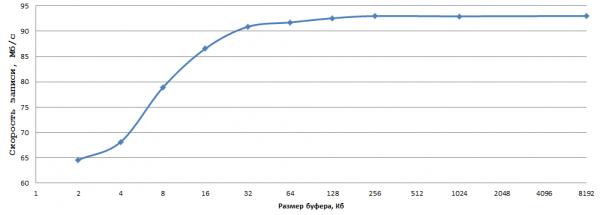
The data was obtained by averaging 5 experiments; I was too lazy to account for inaccuracies. As for me, 93 MB/s when writing 1 byte on a regular HDD is quite a good result, you just need to choose the optimal buffer size (for me, 256 KB is just right) and replace fwrite with _fwrite_nolock/fwrite_unlocked (if thread safety is not needed, of course).
Similarly with fread under such conditions. Since I don't have a 'metal' machine with Linux at hand (single-board computers don't count), I decided to conduct a limited experiment on a virtual machine (Hyper-V, OpenSUSE 15, GCC 8.3.1) — the pattern, in principle, is the same: 'bare' fwrite gives 20 MB/s, fwrite + 256 KB buffer produced 23 MB/s, fwrite_unlocked with the same buffer — 35 MB/s (64-bit binary built with g++ -o2 -s -static-libgcc -static-libstdc++ fwrite_test.cpp -o fwrite_test).
Pasthënie
Qëllimi i këtij artikulli ishte përshkrimi i një metode të thjeshtë dhe efektive në shumë raste (me funksionet _fwrite_nolock/fwrite_unlocked nuk kam pasur ndonjëherë të bëj, nuk janë shumë të njohura – por kot). Nuk pretendoj për novacion të materialit, por shpresoj që artikulli do të jetë i dobishëm për komunitetin.
Burimi: habr.com
