

En grupp forskare från Katolska universitetet i Leuven (Belgien) har identifierat en arkitektonisk sårbarhet (CVE-2023-52424) i Wi-Fi-standarden IEEE 802.11, vilket möjliggör anslutning till ett mindre skyddat trådlöst nätverk istället för det pålitliga nätverket som användaren avsåg att ansluta till. Detta kan leda till avlyssning och manipulation av trafiken. Problemet förekommer i de trådlösa stakarna för alla operativsystem och påverkar autentiseringsmetoderna WPA3, WEP, EAP, AMPE och FILS.
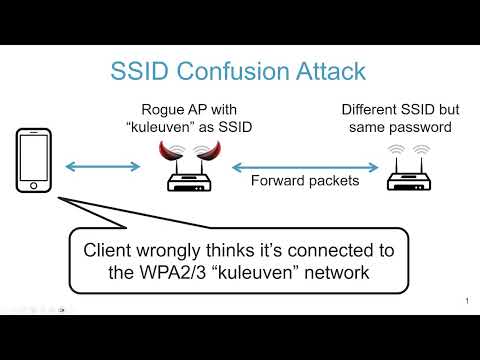
Den föreslagna attacktekniken, som kallas SSID Confusion, möjliggör att kringgå de skyddsåtgärder som finns i protokollet för att förhindra förfalskning av SSID-nätverksidentifierare och hindra skapandet av falska nätverk med samma namn som det nätverk kunden ansluter till. Problemet orsakas av specifikationerna i standarden som anger situationer där SSID kan vara oautentiserad. Särskilt för att signalera sin närvaro skickar åtkomstpunkten beacon-ramar i broadcast-läge, som innefattar information om SSID-nätverket. För att förenkla processen för att hitta nätverket autentiserar inte kunder SSID i dessa ramar, eftersom det antas att en verifiering krävs efter att kunden har beslutat att ansluta till nätverket.
För att lyckas med attacken måste användaren initiera anslutningen till ett visst trådlöst nätverk, och det måste finnas ett annat trådlöst nätverk i närheten med samma anslutningsparametrar som det första nätverket. Detta förekommer till exempel när olika nätverk skapas för bandbredden 2.4GHz och 5GHz, där det ena är dåligt skyddat och sårbart för typiska avlyssningsattacker, såsom KRACK eller Frag. Den problematiska konfigurationen tillämpas också i vissa universitetsnätverk som stöder tjänsten Eduroam. Angriparen måste vara inom signalens räckvidd för att kunna tränga sig mellan användaren och målnätverket (MitM). För att utföra attacken behöver angriparen inte känna till offrets autentiseringsuppgifter.
Attack involves creating an access point by the attacker (WrongAP in the diagram), which provides transmission of requests to a less secure spoofed network (WrongNet) over another channel, which the client should connect to instead of the desired network (TrustedNet). The access point can be created on a regular laptop and is used to conduct a multi-channel MitM attack on the victim (MC MitM). The attack occurs in three stages:
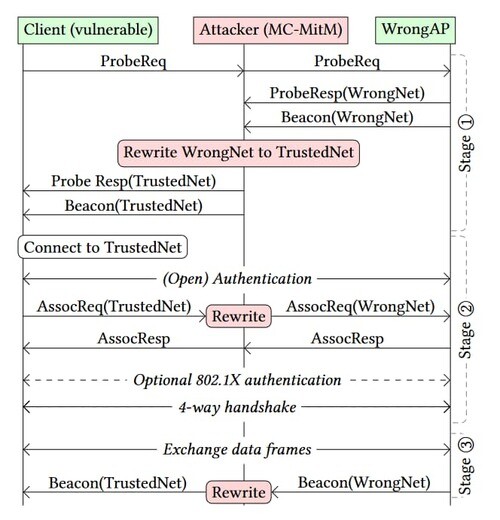
Exploiting vulnerabilities, the attacker can force the client to connect to a less secure network, and the interface will display the SSID of the network to which the user initially intended to connect, not the one to which they are actually connected. Once the user is connected through an unsecured network, the attacker can analyze and intercept unencrypted traffic streams. Meanwhile, using some VPN, such as WARP, hide.me, and Windscribe, the VPN will not be activated when connecting to networks marked in the settings as trusted.
Attack is applicable to wireless authentication protocols using EAP (Extensible Authentication Protocol), SAE (Simultaneous Authentication of Equals), and 802.1X, as well as in the optional operation mode of the WPA3 protocol, where SSID is not used in the formation of the PMK (Pairwise Master Key), which is done to exclude initially known data during the key formation to protect against various crypto attacks. The FILS (Fast Initial Link Setup) protocol is vulnerable when using the PMK created during the connection negotiation based on EAP. Protocols WPA1, WPA2, and FT (Fast BSS Transition) are not affected by this issue as they require a correct SSID during connection negotiation.
To protect against the SSID Confusion attack on the access point side, it is recommended to include in the 802.11 standard the requirement for SSID authentication during connection, which can be implemented by adding the SSID to the key formation function or including the SSID among the additional data verified during connection negotiation. On the client side, protection can be organized by ensuring the protection of beacon frames (to be implemented in WiFi 7). Network creators can prevent the attack by refraining from using common credentials in networks with different SSIDs. Users can protect themselves by using reliable VPNs when connecting through any wireless networks.
Källa: opennet.ru
