

Tim Berners-Lee har meddelat att specifikationen som definierar decentraliserade identifierare för webben (DID, Decentralized Identifier) har fått status som rekommenderad standard. Invändningarna från företagen Google och Mozilla har avvisats.
DID-specifikationen introducerar en ny typ av unika globala identifierare som inte är kopplade till enskilda centraliserade tjänster och organisationer, såsom domänregistratorer och certifikatmyndigheter. En identifierare kan associeras med en valfri resurs och genereras av system som ägaren av resursen litar på. För att autentisera identifieraren används ägandebevisverifiering baserat på kryptografiska mekanismer, såsom digitala signaturer. Specifikationen möjliggör användning av olika metoder för distribuerad hantering och hämtning av information om identifierare, inklusive metoder baserade på blockchain.
Formatet för den nya URI:n bildas som «did:metod:unik_identifierare», där «did» definierar den nya URI-schemat, «metod» anger mekanismen för hantering av identifieraren, och «unik_identifierare» representerar en resursidentifierare specifik för den valda metoden, exempelvis «did:example:123456789abcdefghi». Fältet med metod anger namnet på den använda tjänsten för lagring av verifierbara data, som garanterar identifierarens unikhet, definierar dess format och möjliggör kopplingen av identifieraren till den resurs som den skapats för. URI med identifieraren omvandlas till ett dokument i JSON-format med metadata som beskriver det begärda objektet och inkluderar offentliga nycklar för verifiering av ägaren.
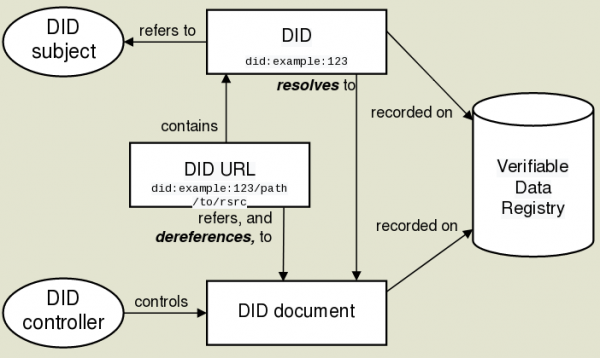
Genomföranden av metoder går utöver DID-standarden, definieras i sina egna specifikationer och stöds i ett separat register. För närvarande har 135 metoder föreslagits baserade på olika blockkedjor, kryptografiska algoritmer, distribuerade teknologier, decentraliserade databaser, P2P-system och identifieringsmekanismer. Det är även tillåtet att skapa DID-infattningar ovanpå centraliserade system, till exempel tillåter metoden web att använda kopplingar till traditionella värdnamn (till exempel «did:web:example.com»).
Google's objections relate to the separation of the specification for the general mechanism of decentralized identifiers from the specifications for the final implementations of methods, making it impossible to analyze the correctness of the main specification without studying the method specifications. Publishing the main specification while the method specifications are not ready complicates the review process, and Google has suggested postponing the standardization of the general DID specification until several best method standardizations are ready, as during the process of method standardization, subtle details may arise that require refinement of the main specification.
Mozilla's objections are based on the specification not adequately promoting portability, putting this issue on the shoulders of the method registry. The registry has already proposed over a hundred methods created without consideration for compatibility and standardization of typical solutions. In its current form, it encourages the creation of a new method for each task instead of attempting to adapt existing methods to one's needs.
The W3C's position is that the standardization of the DID specification, which defines a new extensible class of identifiers and the associated syntax, will serve as an impetus for developing methods and achieving consensus regarding method standardization. There is enough evidence of the applicability of the main specification to address the problems demanded by the community developing decentralized technologies. Proposed method implementations should not be evaluated in analogy with new URL schemes, and the creation of many methods can be seen as aligning the base specification with the needs of developers.
The standardization of certain methods is viewed as a more complex task in terms of achieving consensus among developers than the standardization of the general class of identifiers. Therefore, adopting the general specification before standardizing methods is considered a solution that could potentially inflict less harm on the community implementing decentralized identifiers.
Källa: opennet.ru
